
SILLAG Region 1 Prepares Startups to Compete for DOST-PCIEERD Funding Through Startup Grant Fund Bootcamp
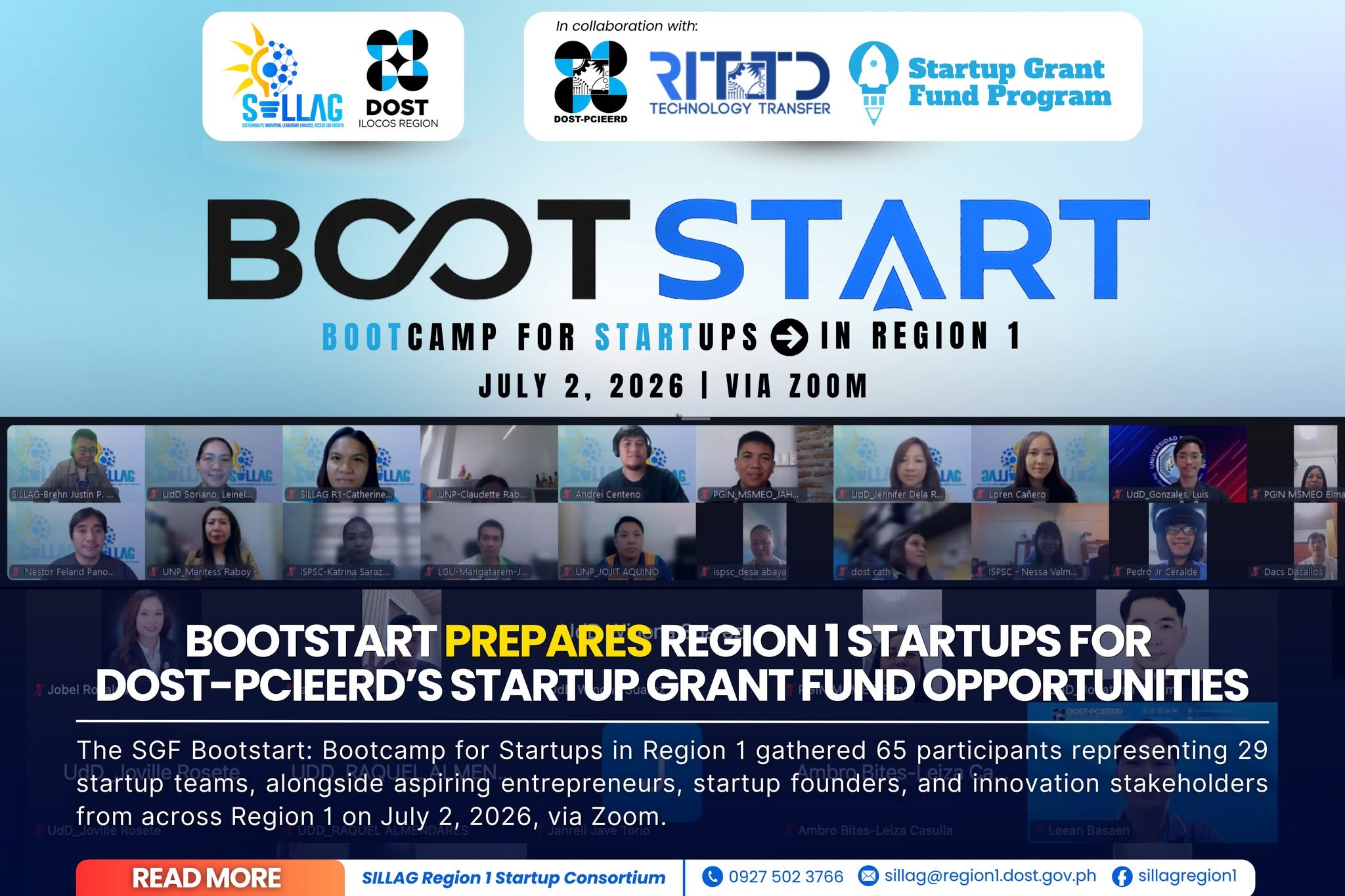
Sixty-five participants representing 29 startup teams joined the SGF Bootstart on July 2, equipping founders with the knowledge to develop stronger R&D proposals and compete for government innovation funding.
 Featured Partner
Inv8 Studio
Innovation Partner for Startups & Growing Businesses
Funding Is Available, but Competitive Startups Need More Than Innovative Ideas
Founders and aspiring entrepreneurs from across Region 1 gathered on July 2, 2026 for the SGF Bootstart: Bootcamp for Startups in Region 1, a capacity-building program designed to help startups prepare for funding opportunities under the Department of Science and Technology - Philippine Council for Industry, Energy and Emerging Technology Research and Development (DOST-PCIEERD) Startup Grant Fund (SGF).
Held virtually via Zoom, the bootcamp brought together 65 participants representing 29 startup teams, along with startup founders, innovators, and ecosystem stakeholders from across the region. The activity was organized by the Sustainability, Innovation, Leadership, Linkages, Access, and Growth (SILLAG) Region 1 Startup Consortium in collaboration with the DOST-PCIEERD Research Information and Technology Transfer Division (RITTD).
Rather than introducing another funding opportunity, the bootcamp focused on helping founders understand what it takes to develop competitive research and development (R&D) proposals, navigate the grant application process, and position their innovations for commercialization.
Strong Proposals Are the Gateway to Government Innovation Funding
While funding programs often receive the most attention, successful applications begin long before submission. One of the biggest challenges faced by early-stage startups is translating innovative ideas into structured proposals that demonstrate technical feasibility, commercial potential, and measurable impact.
The bootcamp addressed this gap through sessions on proposal development, project conceptualization, work planning, budgeting, and the online application process for the Startup Grant Fund.
In his welcome message, Engr. Arnold C. Santos, Project Leader of the SILLAG Region 1 Startup Consortium, emphasized that the activity was more than an orientation on available grants. He described it as an investment in the region’s innovators, designed to equip participants with the knowledge, mentorship, and connections needed to develop solutions aligned with the 2026 Startup Grant Fund priority areas and move promising technologies closer to commercialization.
Building Innovation Capacity Requires More Than Access to Capital
The technical sessions highlighted both the funding opportunity and the broader innovation ecosystem supporting startups in Region 1.
Mr. Brenn Justin P. Guevarra, Project Staff of SILLAG Region 1, introduced participants to the consortium, the Innovative Startup Act, and the objectives of the DOST-PCIEERD Startup Grant Fund Program.
Proposal development sessions led by Mr. Nestor Felad Tanopio, SILLAG Region 1 Management Team Member, and Mr. James Carlo R. Lucas, Project Staff, provided practical guidance on preparing competitive R&D proposals, from defining research objectives and methodology to developing implementation plans and realistic project budgets.
The program concluded with an open forum featuring Mr. Leean Basaen, Technology Transfer Officer and Project Manager, and Ms. Zennia Marie C. Granado, Project Technical Assistant and Technology Transfer Officer from DOST-PCIEERD. The discussion allowed participants to clarify proposal requirements, funding priorities, and the Startup Grant Fund application process directly with program representatives.
Founder Readiness Is Becoming a Competitive Advantage for Regional Ecosystems
As more government agencies invest in startup development, the ability of founders to prepare high-quality proposals is becoming just as important as the availability of funding itself.
Programs like SGF Bootstart strengthen an often overlooked part of the innovation pipeline by helping entrepreneurs develop the capabilities needed to access public R&D investments. Better-prepared founders lead to stronger proposals, more commercially viable technologies, and a higher likelihood that government support translates into businesses capable of creating jobs, attracting investment, and solving real-world problems.
For SILLAG Region 1, the initiative also reinforces the consortium’s role in connecting startups with the knowledge, networks, and government programs that support innovation beyond the ideation stage.
What This Means for Northern Luzon’s Startup Ecosystem
Across Northern Luzon, startup support is gradually shifting from simply promoting funding opportunities to preparing founders to compete for them. This distinction matters. Access to capital has never depended solely on the existence of grants, but on the ability of entrepreneurs to present credible solutions backed by sound research, realistic implementation plans, and clear market opportunities.
Initiatives like SGF Bootstart help strengthen this capability at the regional level. By investing in proposal development and founder readiness, Region 1 is building a stronger pipeline of startups that are better positioned to access national innovation programs and bring homegrown technologies closer to commercialization.
As more regional startup consortia adopt this approach, Northern Luzon moves closer to developing an ecosystem where innovative ideas are not only created, but successfully funded, validated, and brought to market.
Founders interested in future Startup Grant Fund opportunities can begin preparing today by validating customer problems, strengthening their technical documentation, and developing commercialization strategies before funding calls are announced. Early preparation remains one of the strongest predictors of a competitive grant application.
Original Source
Market Context
The Startup Grant Fund (SGF) is one of DOST-PCIEERD’s flagship funding programs supporting technology-driven startups through research and development grants under the Innovative Startup Act (Republic Act No. 11337). Unlike traditional business financing, the program supports startups developing science and technology-based solutions that require further validation before commercialization. As regional startup ecosystems continue to mature, founder readiness programs are becoming increasingly important because successful grant applications require not only innovative technologies, but also well-developed research plans, commercialization pathways, and measurable societal or economic impact.
Are you a founder, innovator, or community builder in Northern Luzon?
We're always looking for compelling stories from the region's ecosystem. Whether you're launching a startup, running a program, or doing something interesting — we'd love to feature you.