
Baguio City releases 2026 Research and Innovation Agenda and invites students and faculty to help build a livable, inclusive, creative city
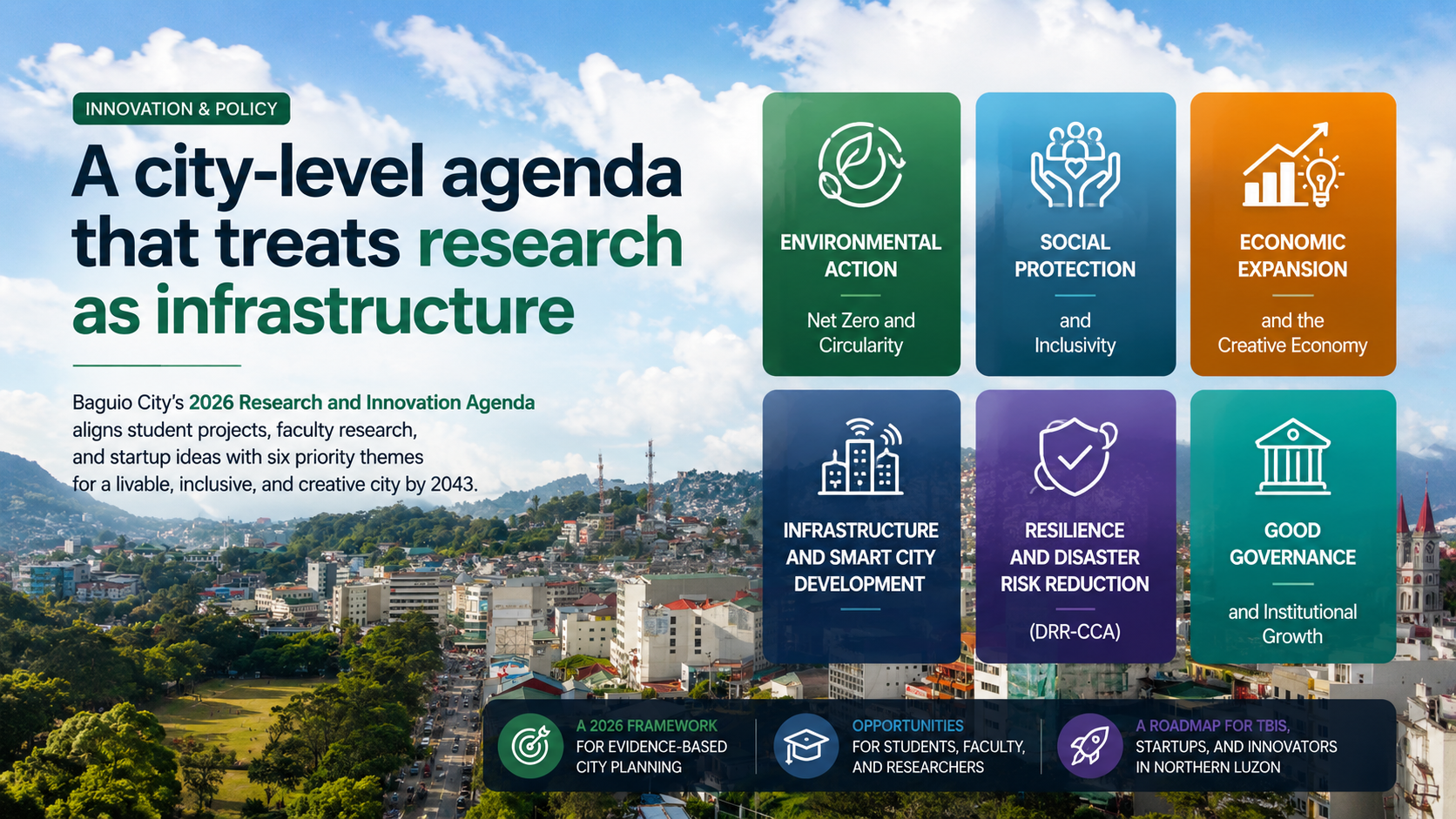
The agenda names priority themes from environmental action to creative economy and smart city development, framing academic and innovation work as a pathway to Baguio’s 2043 vision.
 Featured Partner
Inv8 Studio
Innovation Partner for Startups & Growing Businesses
A city‑level agenda that treats research as infrastructure
Baguio City has released its 2026 Research and Innovation Agenda, a framework that treats student projects, faculty research, and startup ideas as part of the city’s planning toolkit rather than as separate academic exercises. The agenda is tied to the long‑term goal of making Baguio a livable, inclusive, creative city by 2043, and it asks local institutions to see their work as pieces of that timeline, not just degree requirements or one‑off pilots.
Instead of broad calls for “more research,” the agenda spells out specific themes where evidence and innovation are most needed: Environmental Action (net zero and circularity), Social Protection and Inclusivity, Economic Expansion and the Creative Economy, Infrastructure and Smart City Development, Resilience and Disaster Risk Reduction, and Good Governance and Institutional Growth. Each theme is broken down into concrete topics, like optimal land use and urban greening, poverty eradication and universal health care, creative city infrastructure and sustainable tourism, innovation ecosystems, livable neighborhoods, and social vulnerability indices.
View Original Post: https://www.facebook.com/share/p/1DG2t4ztFZ/

What this unlocks for students and faculty right now
For students, the agenda is essentially a ready‑made list of thesis and capstone directions where the city has already signaled demand. A project on barangay livability indices or circular economy models is no longer just “interesting”; it is directly aligned with a documented city priority, which can make it easier to secure data access, interviews, and potential implementation partners. Faculty can also use the agenda to frame research proposals in ways that match local policy needs, increasing the odds that outputs are cited in planning documents or inform future ordinances.
It also changes the typical question from “What topic is easy to finish?” to “What topic will still matter in Baguio ten years from now?” When a student group chooses to work on social vulnerability mapping, disaster risk reduction, or creative city infrastructure, they are plugging into long arcs of city development where each piece of research can serve as a stepping stone for later work by other groups and agencies.
Why innovators and TBIs should care
For TBIs and startup founders, the agenda doubles as a market map. Themes like innovation ecosystems, economic formalization, sustainable tourism, and smart city development point directly to areas where solutions are needed and where the city is willing to engage. A startup working on tourism data, neighborhood safety, waste management, or community health can use the agenda to show that its work is not only commercially relevant but also aligned with Baguio’s strategic direction, which is a language funders and public partners respond to.
The agenda also gives incubators and research offices a common reference when designing calls, hackathons, or grant programs. Instead of running isolated competitions, they can frame challenges around specific agenda items, like net‑zero strategies or creative economy support, and then route promising outputs into city discussions. Over time, this can create a pipeline where campus projects feed into pilot implementations, which in turn inform policy and bigger investments.
What a Northern Luzon reader can do with this
For a student, researcher, or founder reading this from Baguio or elsewhere in Northern Luzon, the practical takeaway is simple: treat the agenda as a partner document whenever you plan your next piece of work. Pick one priority area, identify the subtopics under it, and ask what small but concrete question you can answer that would help the city move one step closer to its 2043 vision.
HEIs and TBIs across the region can also borrow the structure. The act of publishing a research and innovation agenda is replicable in other cities and provinces, and Baguio’s decision to put its themes in public view is a signal that local governments can make their knowledge needs visible, not just their infrastructure projects. That visibility makes it easier for Northern Luzon’s growing network of campuses and innovation hubs to design work that matters beyond their own walls.
Original Source
Market Context
Baguio’s agenda builds on the city’s existing innovation governance work under the Baguio City Research and Innovation Alliance and Incubator Baguio, which already connect academe, government, industry, and civil society in a quadruple‑helix structure. City‑level research agendas are increasingly used in global urban policy as a way to focus limited research capacity on problems where evidence is thin and innovation can change trajectories, particularly in areas like net‑zero planning, social protection, creative economy development, and resilience. For Northern Luzon, a city that combines tourism, higher education, and early‑stage startup activity publishing such an agenda strengthens its position as a regional node where research, startups, and policy can align.
Are you a founder, innovator, or community builder in Northern Luzon?
We're always looking for compelling stories from the region's ecosystem. Whether you're launching a startup, running a program, or doing something interesting — we'd love to feature you.