
Philippine Startups Contribute 3% of GDP and 200,000 Jobs. Investors Are Now Asking a Different Question.
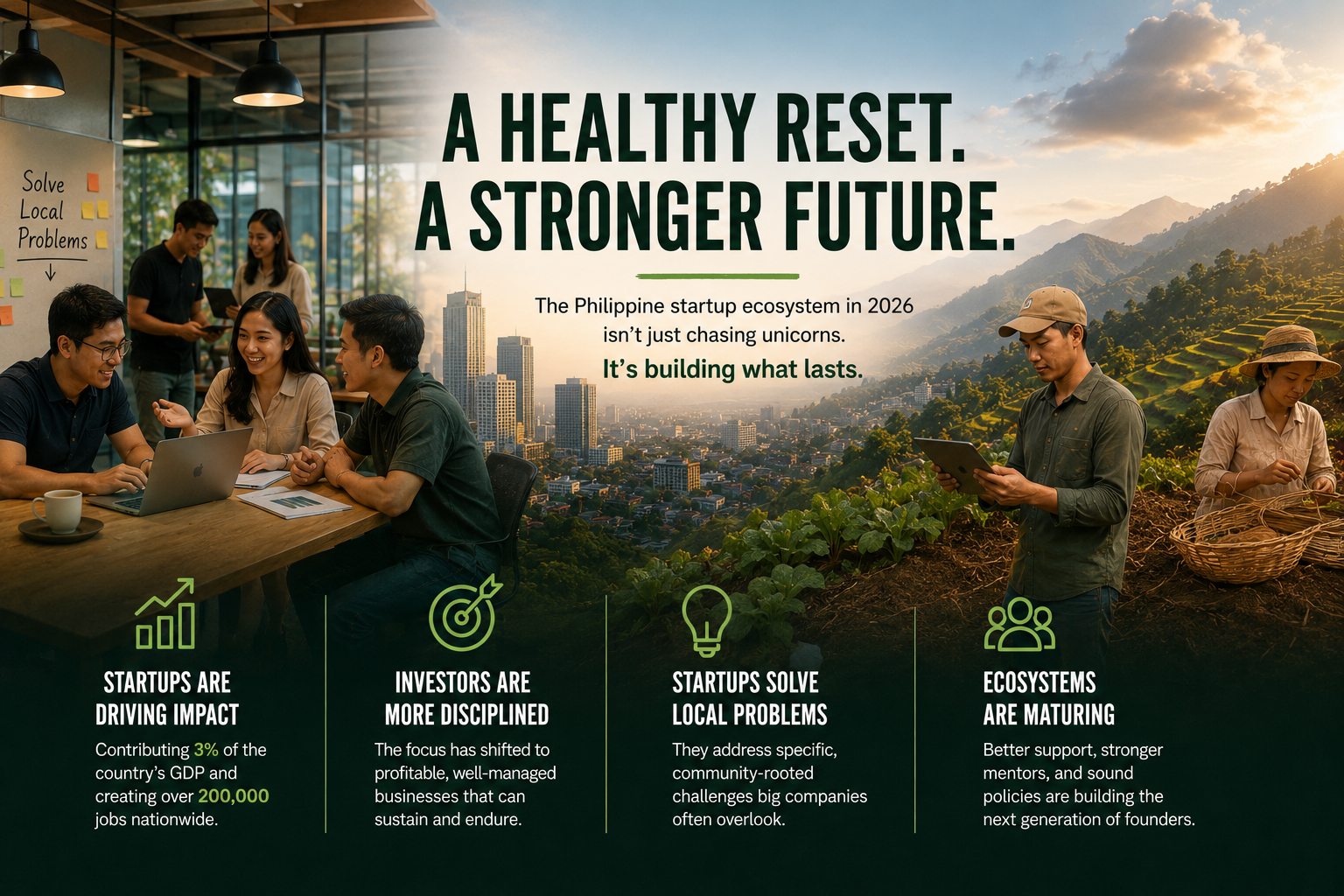
The Philippine startup ecosystem is in what investors are calling a "healthy reset," with capital deployment at a six-year low but discipline at an all-time high. Startups now contribute 3% of nominal GDP and over 200,000 jobs, and the investors backing the next wave are looking for sustainability over speed.
 Featured
Amianan Ventures
The Philippine startup ecosystem built its early momentum on pandemic-era digital adoption, venture enthusiasm, and the aspiration of producing the country's next unicorn. In 2026, the question has changed. It is no longer who can scale the fastest. It is who can last.
"We call it a healthy reset because investors in startups are more disciplined," said Celina Durante, head of communications of Kickstart Ventures, a corporate venture capital firm owned by Globe Telecom. "Investors are looking at startups that are profitable and more disciplined in how they operate their businesses." Capital deployment is at a six-year low. But according to the people closest to the ecosystem, that is precisely the point.
The Numbers Behind the Reset
Despite the investment slowdown, the structural contribution of Philippine startups to the economy is substantial and growing. According to a November 2025 report by venture capital firm Gobi Partners, startups now contribute 3% of the country's nominal GDP and have created over 200,000 jobs nationwide. Those are not startup ecosystem vanity metrics. They are indicators of a sector that has moved from hype-driven novelty to genuine economic infrastructure.
The discipline now being applied by investors reflects that maturation. Minette Navarrete, managing director of Kickstart Ventures, framed the new standard clearly: "Is this business going to persist? Is the demand going to be there? Is the customer base being developed? Is the company managed well? Are they going to be self-sustaining so they can go for a long time?" Those questions were always the right ones. The ecosystem is now being built around answers that hold up.
Why Startups Solve Problems That Big Companies Cannot
One of the clearest articulations of what startups contribute that large corporations do not came from Edgar Paul Apigo, a senior science research specialist and senior technology transfer officer at the DOST.
"They're the ones that really address local problems," Apigo said. "Yung bigger companies kasi they solve general problems." That distinction matters enormously for a country as geographically and economically diverse as the Philippines, and for regions like Northern Luzon where the problems being faced by farmers, fisherfolk, weavers, and small enterprise owners are specific, local, and poorly served by solutions designed for mass markets.
Startups are structurally better positioned to address those problems because they are small enough to be specific, fast enough to iterate, and motivated enough to stay close to the communities they serve. The ecosystem infrastructure being built around them, through DOST programs, incubators, Negosyo Centers, and legislative frameworks like the Philippine Innovation Act and the Innovative Startup Act, exists to remove the barriers that prevent good local solutions from becoming sustainable businesses.
From No Mentors to a Maturing Ecosystem
The founders who built the first wave of Philippine tech startups did it largely without the support infrastructure that today's founders take for granted. Alex and Patrick Gentry, co-founders of Sprout Solutions, a tech company that streamlines human resource processes, recalled the difficulty of finding mentors who had actually built something in the Philippine context.
"It was just hard to get real, local mentors around that have done it and that have built something. We were really trying to find our footing on how to do things," Alex Gentry said. Patrick added that attracting employees was equally difficult in the early days, when candidates would say directly: "I'm not really sure because I don't know if Sprout is a stable company."
Navarrete confirmed that when Kickstart Ventures started in 2012, aside from a few early mobile content players, "there wasn't much of a scene" for startups in the Philippines. The legislative legitimization that came with the Philippine Innovation Act and the Innovative Startup Act in 2019 gave the ecosystem the legal foundation it needed to operate with institutional credibility. Companies like GrowSari, GCash, and Sprout built their niches in the years that followed, creating the reference points that today's founders and mentors can actually learn from.
What the Reset Means for Northern Luzon
For startup ecosystems outside Metro Manila, the healthy reset is not a threat. It is an opportunity. When investors shift their criteria from growth speed to sustainability, from scale to problem-solving quality, from unicorn aspiration to long-term viability, the advantage tilts toward founders who are solving real, visible, community-rooted problems with local resources and local knowledge.
That description fits a significant portion of the startups and early-stage ventures being built across Northern Luzon right now: agri-enterprise founders using design thinking to address post-harvest loss, food processors building from local crops with FDA certification support, digital skills graduates building careers from wherever they are. These are not ventures chasing a global market. They are ventures solving the problems their communities actually have.
The investors now asking "is this business going to persist?" are, whether they realize it or not, increasingly likely to find their most compelling answers outside the startup hubs of BGC and Makati.
Source: The Business Manual | Article by Mikael Borres | Gobi Partners Philippine Startup Ecosystem Report 2025 | April 2026
Are you a founder, innovator, or community builder in Northern Luzon?
We're always looking for compelling stories from the region's ecosystem. Whether you're launching a startup, running a program, or doing something interesting — we'd love to feature you.