
From bark cloth to high‑value nonwovens: how centuries‑old Philippine textiles are powering the next wave of material innovation
DOST–PTRI’s ONWARD nonwoven program is drawing from ancient bark cloth traditions in Cagayan, Cordillera, Palawan, and beyond to turn local fibers into modern solutions for hygiene, agriculture, fashion, construction, transport, and more.
 Featured
Amianan Ventures
Bark cloth: a pre‑weaving textile with deep Philippine roots
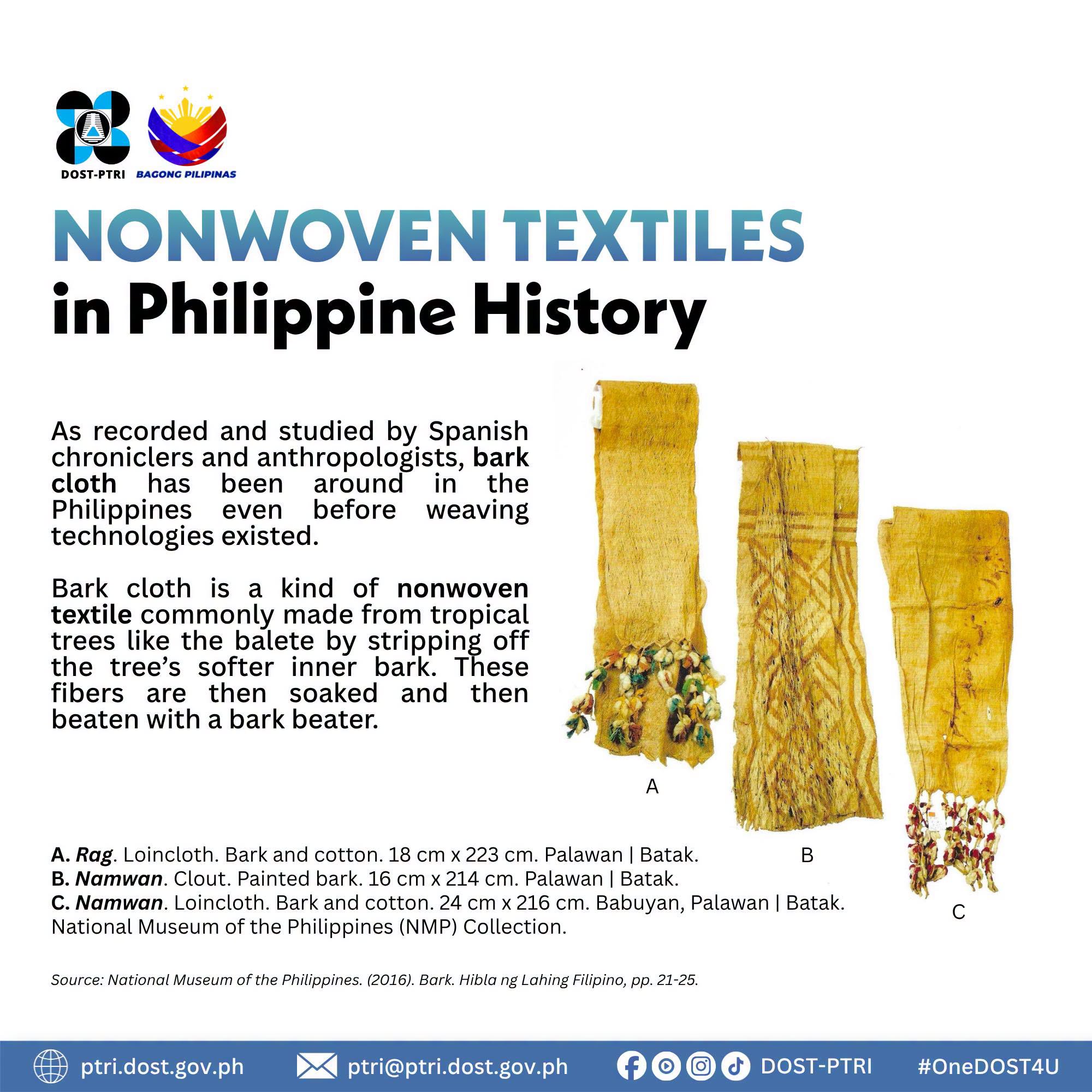
Long before looms arrived in the archipelago, communities in the Philippines were already making textiles by hand from tree bark. Educational materials and museum records note that Spanish chroniclers and later anthropologists documented bark cloth in different parts of the country, showing that it has been in use since before weaving technologies took hold. Bark cloth is a nonwoven textile: makers strip the inner bark of certain tropical trees such as balete, soak the fibers, then beat them until they fuse into a flexible sheet that can be cut, sewn, and worn.
Specimens held by the National Museum of the Philippines include loincloths, garments, and cloth pieces that combine bark with cotton and decorative elements, such as items from Batak communities in Palawan and from other indigenous groups. These pieces prove that bark cloth is not an abstract concept, but a real material that was used on bodies, in homes, and in daily life.

Tools, time depth, and regional spread
Behind every strip of bark cloth is a specialized tool: the bark beater. Educational graphics from DOST–PTRI and cited references show bark beaters made from granite, sandstone, wood, bone, or horn, shaped with ridges to soften and flatten bark fibers. Archaeological work has identified a sandstone bark beater from the foothills of the Sierra Madre in Peñablanca, Cagayan Province, dated to around 935 B.C., suggesting that bark cloth production in northern Luzon is more than two thousand years old.
Collections at the National Museum and other institutions document bark cloth in many forms: skirts, loincloths, belts, waistbands, bags, and upper garments from indigenous peoples in Zambales, Cagayan in Northern Luzon, Camarines and Polillo Island in Quezon Province, as well as pieces from Baler in Aurora and from the Itneg/Tinguian of Abra. This spread shows that bark cloth is not tied to a single community, but part of a wider textile story across Luzon and other regions.

More than clothing: ritual meanings and cultural memory
Bark cloth has also carried ritual and spiritual weight. Ethnographic work on Bontoc society describes a bark cloth called ukop, placed on the mouth of the deceased to keep their “last breath” inside the body before burial. This practice underlines that bark cloth was not only valued for warmth or modesty, but also for its role in ceremonies and beliefs around death and the afterlife. In some communities, the material itself becomes a container of meaning, not just a neutral fabric.
Understanding these cultural roles matters for innovators and designers today. When a material has both practical and ritual uses, any attempt to “modernize” it needs to respect the communities and contexts it comes from, instead of treating it like a generic raw input.
ONWARD: turning heritage into nonwoven innovation
In the present, woven fabrics often dominate conversations about Philippine textiles, but DOST–PTRI has been deliberately putting nonwovens back on the map. The institute’s public materials explain that its ONWARD Philippine Nonwoven Textile Innovations program is aimed at diversifying local textiles through nonwoven technologies that rely heavily on natural fibers.
ONWARD positions these fibers as inputs for high‑value nonwoven products across sectors such as hygiene, agriculture, apparel, fashion, construction, health, transportation, and other industrial uses. The logic is simple but powerful: if bark and other local fibers could be turned into durable, wearable sheets without industrial machinery centuries ago, then today’s nonwoven processes can push those same fibers into filter media, absorbent layers, cushioning, or technical textile components that meet modern performance requirements.

What this opens up for Northern Luzon founders and researchers
For Northern Luzon founders, artists, and researchers, the story of bark cloth and ONWARD offers a concrete bridge between heritage and future materials. The archaeological find in Peñablanca, the documented garments from Cagayan and Abra, and the ritual ukop practice in Bontoc all show that the region has a long relationship with nonwoven bark textiles. DOST–PTRI’s current focus on nonwoven innovation creates room for collaborations where local knowledge about fiber sources, processing techniques, and cultural meaning feeds into new nonwoven products and prototypes.
A founder working in creative tech, fashion, or even agritech can look at bark cloth as proof that nonwoven thinking is not “imported,” but part of local practice. The next step is to ask: which local fibers are abundant, what performance is needed in hygiene, packaging, or construction, and how can ONWARD’s nonwoven R&D help translate those fibers into commercial products that still respect their cultural roots.
Original Source
Market Context
ONWARD Philippine Nonwoven Textile Innovations highlights natural fibers as inputs for nonwoven products aimed at hygiene, agriculture, apparel, fashion, construction, health, transportation, and similar sectors, extending Philippine fibers beyond traditional woven cloth into technical and industrial applications. As global demand for nonwoven materials grows in areas like disposable hygiene items and technical textiles, linking this demand with locally available fibers and documented heritage practices, such as bark cloth production, gives Philippine innovators a distinct narrative and material advantage.
Are you a founder, innovator, or community builder in Northern Luzon?
We're always looking for compelling stories from the region's ecosystem. Whether you're launching a startup, running a program, or doing something interesting — we'd love to feature you.