
IPOPHL Is Looking for AI-Driven Green Technologies That Build Climate-Resilient Filipino Communities. The Submission Deadline Is June 30
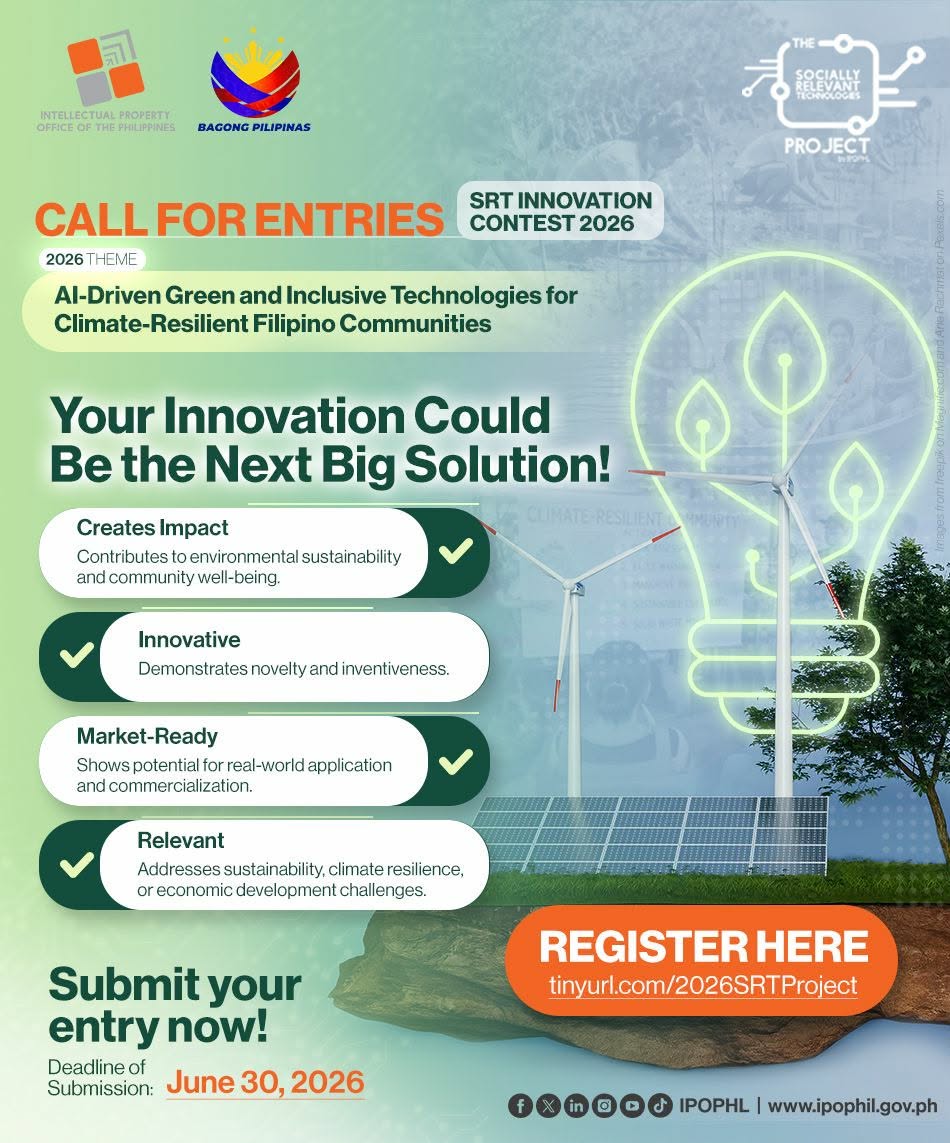
The Intellectual Property Office of the Philippines has opened submissions for the 2026 Socially Relevant Technologies Innovation Contest, themed "AI-Driven Green and Inclusive Technologies for Climate-Resilient Filipino Communities," with entries accepted until June 30, 2026, finals on August 20, and categories covering everything from climate risk prediction to smart agriculture, flood mitigation, and low-carbon mobility.
 Featured
Amianan Ventures
Here is the full article:
Article type label: Opportunity Alert
Title: IPOPHL Is Looking for AI-Driven Green Technologies That Build Climate-Resilient Filipino Communities. The Submission Deadline Is June 30.
Subheadline: The Intellectual Property Office of the Philippines has opened submissions for the 2026 Socially Relevant Technologies Innovation Contest, themed "AI-Driven Green and Inclusive Technologies for Climate-Resilient Filipino Communities," with entries accepted until June 30, 2026, finals on August 20, and categories covering everything from climate risk prediction to smart agriculture, flood mitigation, and low-carbon mobility.
The Intellectual Property Office of the Philippines is running a national innovation competition, and the submission window closes in two weeks. If you are building a technology in Northern Luzon that addresses climate resilience, disaster preparedness, sustainable agriculture, water management, renewable energy, or any of the adjacent problem areas, this is one of the most directly relevant national competitions available to you right now.
The 2026 Socially Relevant Technologies Innovation Contest is open for entry submissions until June 30, 2026. The theme is "AI-Driven Green and Inclusive Technologies for Climate-Resilient Filipino Communities." The final judging and awards ceremony is on August 20, 2026.
What IPOPHL Is Looking For
The contest is explicitly designed for technologies that solve real problems at the intersection of environmental sustainability, climate resilience, and inclusive community development. Entries do not have to be finished commercial products. They need to demonstrate innovation, novelty, and inventiveness, show potential for real-world application and commercialization, and address sustainability, climate resilience, or economic development challenges in ways that are scalable and replicable.
Having filed or granted IP protection, whether patents or utility models, is listed as an added advantage, not a requirement. That is a significant detail for university-based researchers, startup founders, and MSME innovators who have developed functional technologies but have not yet formalized their IP position.
The 2026 contest covers ten technology categories:
AI for Climate Risk Prediction and Disaster Resilience — using artificial intelligence to predict hazards and enable faster, data-driven disaster preparedness and response
Smart and Sustainable Urban Infrastructure — intelligent infrastructure systems that improve urban efficiency, safety, and resilience to climate impacts
Renewable Energy and Energy Efficiency Solutions — clean energy technologies that reduce carbon emissions and expand access to sustainable power
Waste Management and Circular Economy Technologies — systems that minimize waste, promote recycling, and convert materials into valuable resources
Water Resource Management and Flood Mitigation — smart technologies for efficient water use, water quality improvement, and flood risk reduction
Climate-Smart Agriculture (Urban and Peri-Urban) — technologies that enhance agricultural productivity and resilience under changing climate conditions
Inclusive and Assistive Technologies — accessible solutions that empower marginalized groups in climate adaptation
Environmental Monitoring and Decision Support Systems — data and AI tools that monitor environmental conditions and support informed policy and planning
Low-Carbon Mobility and Transport Solutions — sustainable transport systems that reduce emissions and improve mobility
Digital Platforms for Climate Governance — digital tools that strengthen climate planning, community engagement, and evidence-based governance
Why This Is Directly Relevant to Northern Luzon
The ten categories read like a development agenda written specifically for Northern Luzon's most pressing challenges.
The region faces some of the most acute climate exposure in the country. Typhoons enter the Philippine landmass through Northern Luzon with regularity, affecting Ilocos, Cagayan Valley, and the Cordillera every season. Flood risk in low-lying coastal and riverine communities across Pangasinan, La Union, and Cagayan is a persistent planning and infrastructure challenge. The Cordillera's agricultural communities are experiencing changing rainfall patterns that affect the traditional farming calendars that have governed land use in the region for generations. Water resource management in a region where upland watersheds feed the agricultural systems of several downstream provinces is a problem with direct economic and food security consequences.
The university research centers, TBIs, and innovation programs across Northern Luzon, from IFSU to Cagayan State University to Benguet State University to Mariano Marcos State University to Saint Louis University to the University of the Cordilleras, are producing research and prototypes in exactly these domains. The researchers and founders working on these problems have until June 30 to submit.
Beyond universities, the region's startup ecosystem includes founders building in agritech, clean energy, logistics, and digital platforms for rural and agricultural communities. Several of those products and technologies map directly onto the SRT contest categories. The EV charging infrastructure being built from Baguio addresses low-carbon mobility. The agricultural processing innovations coming out of Ifugao and the Cordillera address climate-smart agriculture. The water management challenges of Cagayan Valley's flood-prone municipalities are exactly the kind of problem the water resource management category was designed for.
The Contest Timeline
Submissions are open now and close on June 30, 2026. The evaluation process runs through July, with five finalists announced on August 10. The Final Judging and Awards Ceremony is on August 20, 2026.
That timeline gives innovators across Northern Luzon approximately two weeks to prepare and submit an entry. For technologies that already exist in working or prototype form, the submission process is the work of documenting what has already been built, not of building something new for the competition.
What Winning Means Beyond the Award
The SRT Innovation Contest is organized by IPOPHL, the national agency responsible for intellectual property administration and advocacy in the Philippines. Recognition from IPOPHL carries institutional weight that goes beyond a trophy. It signals to investors, government procurement offices, development agencies, and international partners that the technology has been evaluated against a national standard and found to be among the country's most promising innovations in its category.
For a founder in Baguio or a researcher in Tuguegarao whose technology has been validated by local users but not yet recognized at the national level, an SRT contest finalist or winner designation is the kind of credentialing that opens doors that would otherwise require years of relationship-building to access.
IPOPHL's broader mission, leveraging patent information to drive Filipino innovation and promote economic growth, means that the contest is also a gateway into the agency's wider ecosystem of IP support, commercialization pathways, and technology transfer resources.
How to Submit
Entry submissions are open through June 30, 2026. Register and submit at: tinyurl.com/2026SRTProject
Original Source
Market Context
The Philippines consistently ranks among the world's most climate-vulnerable countries, positioned 3rd in the Global Climate Risk Index in recent years, with Northern Luzon bearing disproportionate exposure to typhoons, flooding, and agricultural disruption. IPOPHL's Socially Relevant Technologies program is one of the national government's primary mechanisms for identifying and accelerating the commercialization of locally developed technologies with social impact potential. The 2026 contest's focus on AI-driven green technologies reflects both the national government's digital transformation agenda and the growing recognition that climate adaptation in the Philippines requires technological solutions developed by Filipino innovators who understand local conditions, not imported solutions designed for different geographies. For Northern Luzon's research universities and startup ecosystem, national innovation competitions like the SRT contest represent one of the most accessible pathways to the institutional recognition, IP support, and commercialization resources that regional innovators need to bring locally developed technologies to national and international scale.
Are you a founder, innovator, or community builder in Northern Luzon?
We're always looking for compelling stories from the region's ecosystem. Whether you're launching a startup, running a program, or doing something interesting — we'd love to feature you.