
DOST Has a Technology That Turns Agricultural Waste Into Charcoal. Enterprises in Northern Luzon Can Adopt It Now.
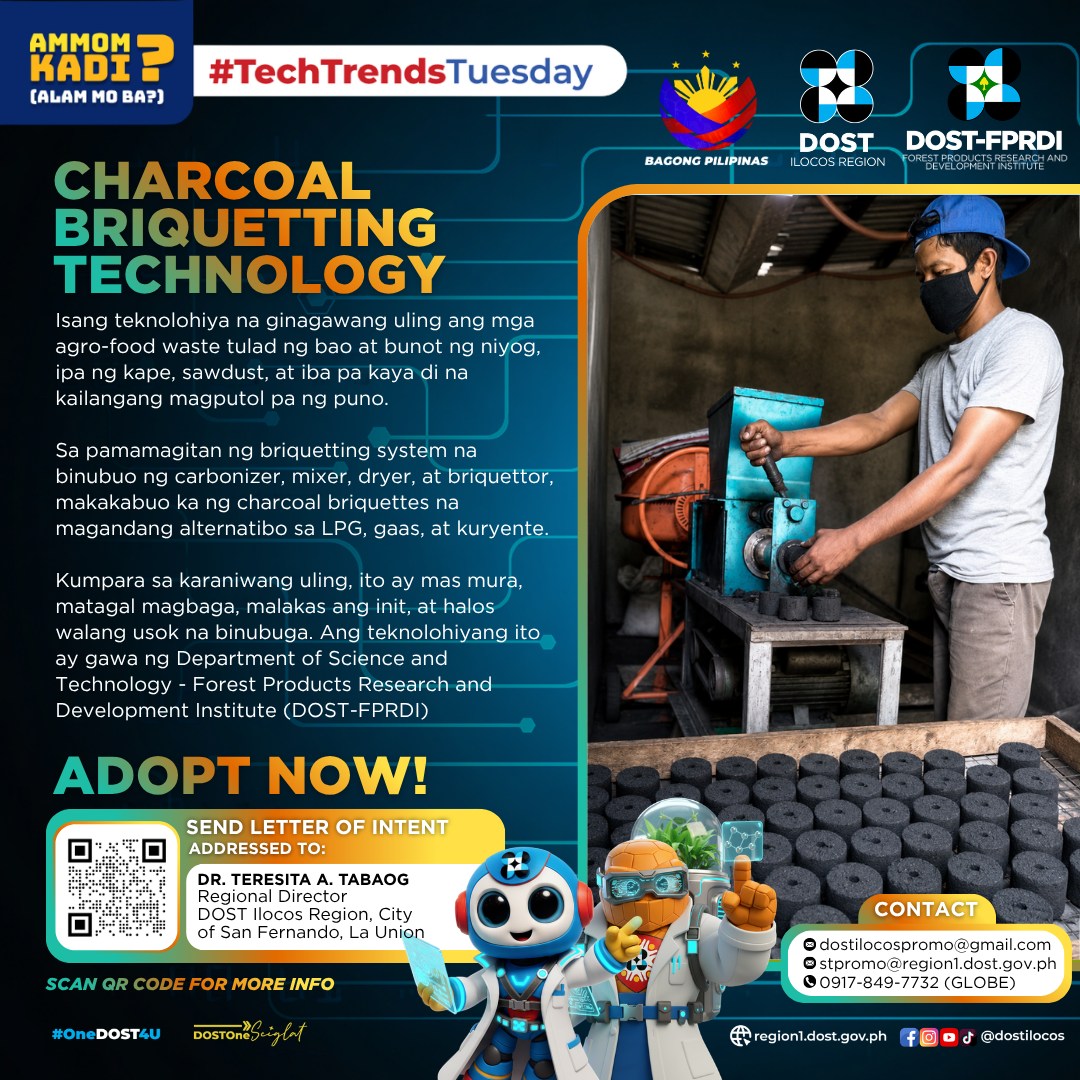
The DOST Forest Products Research and Development Institute has developed a Charcoal Briquetting Technology that converts agro-forest waste including coconut shells, coffee husks, and sawdust into high-quality charcoal briquettes, a nearly smokeless, longer-burning, and carbon-neutral alternative to LPG, gas, and conventional charcoal. DOST Ilocos Region is actively inviting enterprises to adopt the technology.
 Featured
Amianan Ventures
Every year, farms and food processing operations across Northern Luzon generate enormous volumes of agricultural waste: coconut shells, coconut husks, coffee husks, sawdust, rice husks, and other organic byproducts that are typically discarded, burned openly, or left to decompose. The DOST Forest Products Research and Development Institute has developed a technology that turns all of that waste into something useful, affordable, and commercially viable.
The Charcoal Briquetting Technology converts agro-forest waste into charcoal briquettes through a four-step system: a carbonizer, a mixer, a dryer, and a briquettor. The output is a compressed charcoal product that performs significantly better than conventional charcoal and positions itself as a direct, affordable alternative to LPG, gas, and electricity for cooking and other household and commercial energy uses.
DOST Ilocos Region, through its Science and Technology Promotions unit, is now actively inviting enterprises and entrepreneurs across the region to adopt the technology by submitting a Letter of Intent.
Why Briquettes Outperform Conventional Charcoal
The performance gap between charcoal briquettes and ordinary charcoal is substantial across every metric that matters to a household or commercial user:
Nearly smokeless — significantly less smoke produced during burning, reducing indoor air pollution and improving the cooking experience
Consistent, even heat — uniform burn temperature gives more predictable and controllable cooking results
Longer burning time — burns significantly longer than conventional charcoal, reducing the frequency of replenishment and lowering overall fuel cost
Structurally durable — does not crumble easily, reducing waste and handling loss
More affordable per use — the longer burn time and higher heat output translate to lower cost per cooking session compared to equivalent conventional charcoal
For households managing tightening energy budgets as LPG prices continue to fluctuate, charcoal briquettes made from locally available agricultural waste represent a practical, accessible, and cost-effective alternative that does not require any change in cooking equipment or method.
The Environmental Case
Beyond the household economics, charcoal briquettes made through the DOST-FPRDI technology carry a meaningful environmental advantage. The technology is classified as carbon-neutral: the carbon dioxide released during burning is equivalent to the carbon the source plants absorbed during their lifetime. No new carbon is introduced into the atmosphere from outside the existing natural cycle.
Equally important is what the technology prevents. Agricultural waste that would otherwise be burned openly in fields or processing facilities releases uncontrolled emissions. Converting that same waste into briquettes channels those materials into a controlled, efficient combustion process that produces a useful energy product while reducing open burning in agricultural communities.
For a region like Northern Luzon, where coconut farming, coffee production, and rice cultivation generate large volumes of precisely the waste inputs the technology uses, the supply chain for raw materials is already in place. The technology does not require enterprises to source new inputs. It turns what they are already discarding into a product they can sell.
What the Technology System Looks Like
The Charcoal Briquetting Technology operates as an integrated four-machine system:
Carbonizer — converts raw agricultural waste into carbonized material through controlled heating
Mixer — blends the carbonized material with a binding agent to create a workable mixture
Dryer — reduces moisture content to ensure structural integrity and efficient burning
Briquettor — compresses the mixture into uniform briquette shapes ready for packaging and sale
The system is designed to be adopted at a micro to small enterprise scale, making it accessible to community cooperatives, agricultural associations, social enterprises, and individual entrepreneurs who want to build a livelihood around waste-to-energy conversion.
How to Adopt the Technology
DOST Ilocos Region is accepting Letters of Intent from interested enterprises and entrepreneurs. Letters should be addressed to:
Dr. Teresita A. Tabaog
Regional Director, DOST Ilocos Region
City of San Fernando, La Union
For inquiries before submitting a Letter of Intent, the DOST Ilocos Region Science and Technology Promotions team can be reached at:
0917-849-7732 (Globe)
DOST Ilocos Region official Facebook page: @dostilocos
The technology is available for adoption now. For Northern Luzon enterprises sitting on agricultural waste they currently have no use for, this is a direct pathway to turning that waste into a product, a livelihood, and a contribution to the region's energy resilience.
Source: DOST Ilocos Region | DOST-FPRDI | Charcoal Briquetting Technology | May 2026
Are you a founder, innovator, or community builder in Northern Luzon?
We're always looking for compelling stories from the region's ecosystem. Whether you're launching a startup, running a program, or doing something interesting — we'd love to feature you.