
The Philippines Does Not Have Enough Scientists, Engineers, and Researchers. DOST Says That Is One of the Most Urgent Problems the Country Faces.
DOST Western Visayas Regional Director Rowen Gelonga has sounded the alarm on the country's shortage of science and technology professionals, warning that the Philippines cannot sustain economic growth, global competitiveness, or innovation-led development without producing significantly more scientists, engineers, and researchers. The warning applies as directly to Northern Luzon as it does to any other region in the country.
 Featured Partner
Inv8 Studio
Innovation Partner for Startups & Growing Businesses
The Philippines has an innovation gap. Not a funding gap. Not a programme gap. A people gap. The country does not have enough scientists, engineers, and researchers to meet the demands of a modernizing economy, an increasingly complex technological landscape, and the mounting challenges of climate change, food security, healthcare, and digital transformation.
DOST Western Visayas Regional Director Rowen Gelonga said it plainly: "We need to create more science and technology personnel to support socio-economic development." His regional office currently supports nearly 2,000 scholars in Western Visayas enrolled in science and technology-related courses. He said that number is still insufficient. Given that Western Visayas is one of the country's more urbanized and institutionally developed regions, the shortfall in a region like the Cordillera or Cagayan Valley is likely more acute.
The Scale of the Shortage
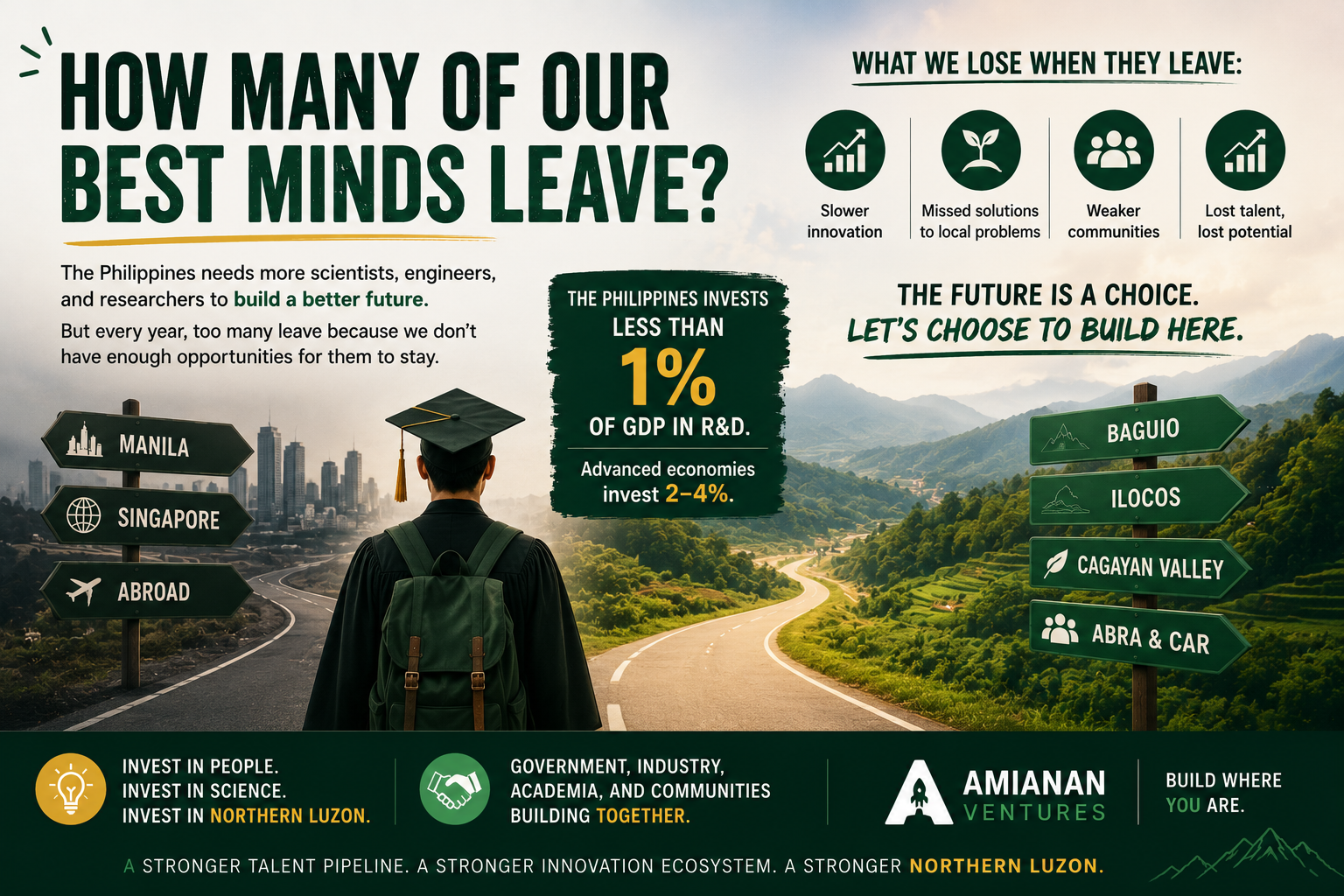
The warning from DOST is not new, but the urgency behind it is growing. The Philippines currently allocates a fraction of one percent of its GDP to research and development, well below the one percent minimum that Gelonga identified as a competitive threshold, and far below the two to four percent that advanced economies typically invest. That investment gap translates directly into a talent gap: without sustained public and private funding for R&D, there are fewer research positions, fewer career pathways, and fewer reasons for talented young Filipinos to choose science and technology as a life's work rather than a stepping stone to emigration.
Gelonga noted that advanced economies heavily invest in R&D with substantial support from private industries, a model the Philippines has not yet replicated. The country still largely depends on government funding for science and technology initiatives, creating a structural vulnerability where programme continuity and talent pipeline development are subject to budget cycles rather than long-term institutional commitment.
For Northern Luzon specifically, the talent pipeline question is particularly consequential. The region's universities, from the University of the Philippines Baguio and Saint Louis University in Baguio to MMSU in Ilocos Norte, ISU in Isabela, and Apayao State College, are producing graduates in science and technology disciplines. What the region often loses is the retention of those graduates after they qualify. The most capable science and technology graduates from Northern Luzon frequently end up in Metro Manila research institutions, overseas universities, or international employment markets. The region trains talent it cannot fully keep.
Why This Is an Ecosystem Problem, Not Just an Education Problem
Gelonga was careful to frame the shortage not just as a numbers problem but as a culture and values problem. "Science and technology should not merely be viewed as pathways to financial stability but as disciplines capable of transforming communities and uplifting society through innovation and problem-solving," he said.
That framing matters for how communities, parents, school administrators, and local government officials think about science careers. If the dominant cultural narrative around science and engineering is that they are routes to a stable salary, the country will produce competent professionals who leave for wherever that salary is highest. If the narrative shifts to science and engineering as routes to community transformation, the calculus changes for the students who have a reason to stay and build where they came from.
The examples emerging from Northern Luzon's own ecosystem reinforce that alternative narrative. MMSU student researchers building AI joint detection systems and studying Inabel's generational survival. UP Diliman engineers developing CHaRM fast-charging technology that is now deployed in Apayao. DOST-funded food science specialists training Sugpon farmers to produce ube products that can reach global markets. These are scientists and engineers doing exactly what Gelonga described: transforming communities and uplifting society through innovation and problem-solving. They are the reference points that Northern Luzon's next generation of science students needs to see.
What Gelonga Is Calling For
The DOST official's call extends beyond students and parents. He explicitly addressed policymakers, legislators, local government officials, and the private sector, calling on all of them to work together in building a stronger culture of scientific inquiry and innovation.
"Our collaborative efforts are vital in paving the way for a brighter, more sustainable future," he said. For Northern Luzon, that means local government units investing in science and technology programmes beyond what DOST's budget can fund alone. It means private sector enterprises partnering with universities on research that addresses real industry problems. It means school administrators treating science and technology tracks not as secondary options but as primary pathways worth investing in.
The target Gelonga set is specific: at least one percent of GDP allocated to scientific and technological advancement. The Philippines is not close to that figure today. But the conversation about why it matters, and what the country loses by staying below it, is one that every region, every city, and every community with a stake in its own development needs to be part of.
What Northern Luzon Can Do With This Signal
The shortage DOST is describing is a warning, but it is also an opportunity framing. Regions that build strong local science and technology talent pipelines, retain their graduates through meaningful career pathways, and create the research and enterprise infrastructure that gives scientists and engineers a reason to stay, will have a structural advantage in the innovation economy that is coming.
Northern Luzon has the universities. It has the DOST and DICT programmes. It has the emerging ecosystem of agri-enterprise, digital skills, and clean technology initiatives that create real career pathways for science and technology graduates who want to build in the region they come from. The missing piece is the coordinated, sustained investment in making those pathways visible, credible, and economically competitive enough to retain the talent the region is already producing.
Gelonga's warning from Western Visayas applies here with equal force. The country needs more scientists. Northern Luzon needs to keep the ones it trains.
Source: Panay News | Article by Neljoy N. Galigao | DOST Western Visayas | Rowen Gelonga
Are you a founder, innovator, or community builder in Northern Luzon?
We're always looking for compelling stories from the region's ecosystem. Whether you're launching a startup, running a program, or doing something interesting — we'd love to feature you.