
A Province Rooted in Ancient Tradition Is Building One of the Cordillera's Most Forward-Looking Innovation Ecosystems.
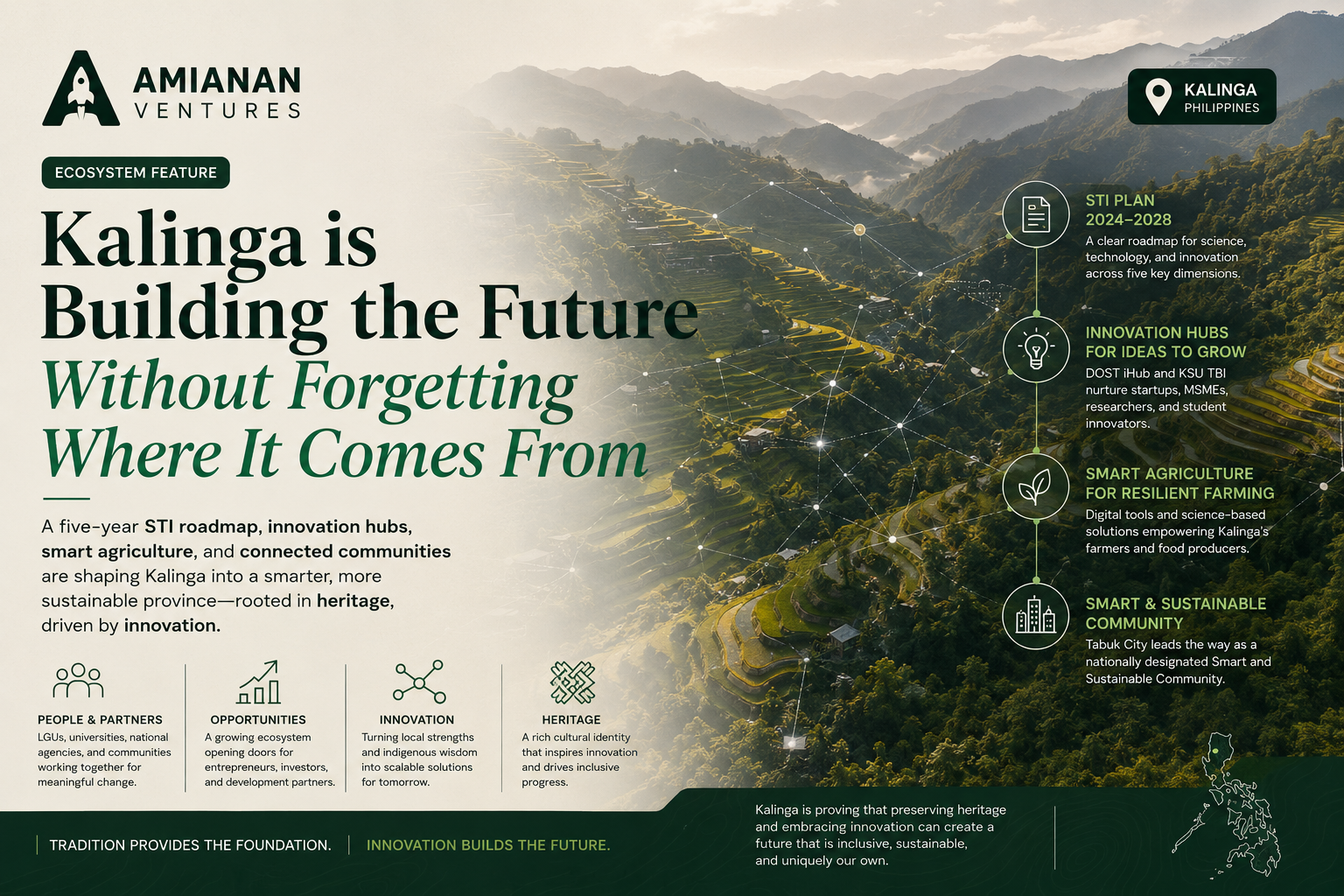
Kalinga province — home to one of the world's most recognized indigenous cultures — is now also home to a DOST Innovation Hub, a university TBI, a Smart and Sustainable Community capital city, and a five-year science and technology roadmap. Tradition and innovation are not opposites here. They are building partners.
 Featured Partner
Inv8 Studio
Innovation Partner for Startups & Growing Businesses
Kalinga has always been a province that commands attention. Its rice terraces cascade down mountain slopes that have been farmed for generations. Its weaving traditions carry patterns that encode the identity of specific communities. Its tattooing culture, practiced by the legendary mambabatok, has earned international recognition as one of the world's most remarkable living heritage practices.
But something else is being built in Kalinga right now, quietly, systematically, and with a level of institutional commitment that deserves a much wider audience.
Over the past two years, the province has been assembling the components of a genuinely smart province: a formal science and technology roadmap with a five-year implementation horizon, a government-backed innovation hub for startups and researchers, a university technology business incubator, satellite internet connectivity reaching its most geographically isolated villages, smart agriculture programs covering the Cordillera's largest rice-producing province, and a nationally designated Smart and Sustainable Community capital city.
The same province that has preserved centuries-old traditions is now building the infrastructure for the next century of innovation. In Kalinga, those two things are not in tension. They are reinforcing each other.
The Blueprint: Kalinga STI Plan 2024–2028
Every credible smart province development story begins with a plan. Kalinga's is formal, multi-sectoral, and already in implementation.
In February 2025, DOST officially launched the Kalinga Science, Technology, and Innovation Plan for the 2024 to 2028 period, formulated through the agency's iSTART program, which stands for Innovation, Science, and Technology for Accelerating Regional Transformation. Kalinga is one of only two pilot provinces in the Cordillera Administrative Region selected for iSTART, giving it a level of DOST technical assistance and institutional support that most other provinces in the region have not yet accessed.
The plan outlines strategies across five development dimensions: social, economic, environmental, institutional, and infrastructure. To implement it, the province established the Provincial Science, Technology and Innovation Committee, chaired by Governor James Edduba and co-chaired by DOST-Kalinga head Dexy Catacutan. The committee is specifically tasked with crafting policies and programs to promote science, technology, and innovation across sectors, developing technology-based development plans for agri-based, manufacturing, and services enterprises, and attracting new technology-based investments into the province.
The STI plan is not a vision document filed in a cabinet. It is a governance commitment backed by a committee, a timeline, and a budget.
Tabuk City: A Nationally Designated Smart and Sustainable Community
Alongside the provincial STI plan, Tabuk City, the capital of Kalinga, received a formal designation as one of 80 partner cities nationwide committed to becoming a Smart and Sustainable Community under the DOST SSC program.
That designation gives Tabuk City access to DOST's technical support, data systems, and smart community implementation framework while positioning it as a model for the Cordillera in integrating innovative technologies, data-driven solutions, and sustainable practices into local governance.
The commitment is not ceremonial. In July 2023, the Tabuk City local government entered into a memorandum of agreement with multiple government agencies and state universities for the adoption of DOST-vetted technologies and the development of Smart and Sustainable Cities and Communities projects. Under that agreement, the city committed to establishing linkages in public and private sectors involved in the promotion of science, technology, and innovation, and to providing co-funding for DOST technology projects implemented within the city.
In April 2025, the Provincial Science and Technology Office of Kalinga, together with the Tabuk City government and Kalinga State University, held preparatory meetings to explore entering the DOST Search for Philippine Smart and Sustainable Communities Award for LGUs, a national recognition program for local governments that have made measurable progress toward smart community development. That Kalinga is now preparing to compete for national recognition is itself a signal of how far the province has come.
Two Innovation Hubs: Where Ideas Become Ventures
A smart province needs places where ideas become ventures. Kalinga now has two, one government-backed and one university-based, both operational.
In February 2025, DOST-Kalinga officially launched an Innovation Hub at its provincial office. The iHub functions as a co-working space for meetings, trainings, business matching, pitching, and other startup and MSME activities. Its target community includes students, researchers, startups, MSMEs, and local government units. The explicit goals are to increase the number of startups in the region and to increase the number of publicly funded research outputs that are transferred and commercialized.
In September 2025, Kalinga State University launched the 'kalinga' Technology Business Incubator Hub at the KSU Technology and Innovation Building in Bulanao, a facility that was inaugurated in January of the same year. The TBI is designed to serve as a cradle for ideas, nurturing MSMEs and student innovators through incubation, mentorship, and connections to partner agencies.
The KSU Technology and Innovation Center houses an innovatorium, five laboratories, an instruments room, an exhibit hall, a social hub area, a conference room, and a lounge. DOST-Kalinga describes it as a one-stop shop for SMEs, researchers, students, and faculty with ideas. On the same day the KSU TBI launched, DOST also signed an MOA with KSU to establish a dedicated Capacitating Knowledge, Technology, and Innovation Hub specifically for local food enterprises, creating a third node of innovation support within the same ecosystem.
Governor Edduba, at the TBI launch, reaffirmed his personal commitment to the initiative and acknowledged what is increasingly clear from the outside: Kalinga State University is becoming one of the most active innovation anchors in the Cordillera.
Connecting Every Corner: Starlink in the Most Remote Villages
Innovation infrastructure means nothing if the communities it is meant to serve cannot connect to it. Kalinga has been solving this problem with deliberate urgency.
In February 2025, DICT-Cordillera awarded 27 Starlink internet units to LGUs across Kalinga province, covering public sites including evacuation centers, health units, PNP stations, public markets, and elementary schools in municipalities including Tanudan, Balbalan, Rizal, Lubuagan, Pinukpuk, and Tinglayan. Several of these are among the most geographically isolated communities in the entire Cordillera.
In April 2025, three additional Starlink units were turned over to the provincial capitol, each providing a 200-meter radius of free internet connectivity. Governor Edduba has requested a total of 60 Starlink units to provide stable connectivity across all Kalinga PLGU offices and geographically isolated and disadvantaged areas, with installations planned for the Kalinga Provincial Hospital and district hospitals as well.
This connectivity deployment is part of the Governor's LUMIN-AWA Eight-Point Agenda for ICT development, an agenda that has already earned formal recognition from DICT for the province's ICT improvement initiatives. The vision is a province where no barangay, no health unit, no school, and no farming community is left offline.
Smart Agriculture for the Cordillera's Rice Granary
Kalinga is the rice granary of the Cordillera. Its 130,783 hectares of declared agricultural land represent roughly 40 percent of the province's total land area. It is also the main supplier of coffee in the region. Applying smart technology to that agricultural base is not a secondary priority. It is the core of the province's economic future.
In December 2025, DOST-CAR signed a Memorandum of Agreement with the Kalinga PLGU, Rizal LGU, Tabuk City LGU, and Kalinga State University for the implementation of Project SARAI, which stands for Smart Approaches to Reinvigorate Agriculture as an Industry in the Philippines. The project deploys science-based crop technologies and digital tools to farming communities in direct response to climate change impacts.
The tools available to Kalinga farmers through SARAI include SPIDTECH for pest identification, the SARAI Knowledge Portal, WAISS for water advisory, BANATECH, and Bantay SARAI, digital services providing identification, analysis, forecasts, crop estimates, and decision support to help farmers make better-informed choices about crops, inputs, and risk management. The Department of Agriculture has simultaneously been piloting digital aid distribution programs in Kalinga using Intervention Monitoring Cards, allowing farmers to receive government assistance digitally.
For a province where agriculture is the economic foundation of most households, making farming smarter is the highest-leverage application of technology available.
What Opportunity Looks Like in Kalinga Right Now
The infrastructure being built in Kalinga is not waiting for founders, researchers, and investors to arrive before it becomes useful. It is already operational. But the ecosystem is still early enough that those who engage now will shape what it becomes rather than joining something that is already fully formed.
For student innovators and researchers at Kalinga State University, the TBI and the DOST iHub are open and looking for ideas worth incubating. The food enterprise hub recently signed into existence is specifically seeking local food producers with products worth developing.
For agritech founders and researchers across the Cordillera, Kalinga's 130,000-plus hectares of agricultural land, its position as the region's primary rice and coffee producer, and the SARAI digital agriculture infrastructure now in place create a testing ground for agricultural technology that is unmatched in the region for scale and institutional readiness.
For investors and development partners watching the Cordillera ecosystem develop, Kalinga offers something rare: a provincial government with a clear and committed ICT and innovation agenda, a state university actively building startup infrastructure, national agencies already deployed and co-investing, and a community whose indigenous heritage creates authentic place-based product and tourism opportunities that no other province in the Philippines can replicate.
For founders building in food, agriculture, tourism, environmental technology, or community development, the combination of Kalinga's cultural identity, natural resources, and emerging digital infrastructure creates a product development environment with a built-in authenticity advantage.
Tradition and Innovation as Building Partners
What makes Kalinga's story different from a standard government digitalization narrative is the cultural dimension that runs through everything being built here.
The province's indigenous heritage, its rice terraces, its weaving traditions, its tattooing culture, is not a historical artifact that innovation is being built around or despite. It is an active asset that gives every innovation emerging from Kalinga a provenance and an identity that cannot be manufactured elsewhere. A food product developed through the KSU TBI using traditional Kalinga agricultural ingredients carries the full weight of that heritage into every market it enters. A tourism technology built for Kalinga's community-based heritage sites is solving a problem that exists precisely because the culture is extraordinary enough to draw visitors from around the world.
The founders and researchers who build in Kalinga are not just building for a provincial market. They are building with one of the most compelling cultural narratives in the Philippines behind them.
That is not a small advantage. That is the kind of differentiation that takes decades to build, and Kalinga already has it.
Original Source
This is an original feature article by Amianan Ventures, researched and written from verified sources including the Philippine Information Agency, Guru Press Cordillera, the Baguio Herald Express, Kalinga State University, and DOST-CAR. All sources are cited inline.
Are you a founder, innovator, or community builder in Northern Luzon?
We're always looking for compelling stories from the region's ecosystem. Whether you're launching a startup, running a program, or doing something interesting — we'd love to feature you.