
MMSU's Bannuar TBI Is Building the Ilocos Region's Technology Startup Pipeline. From a P12.7 Million Launch to Its First Graduates, Here Is What It Has Built So Far.
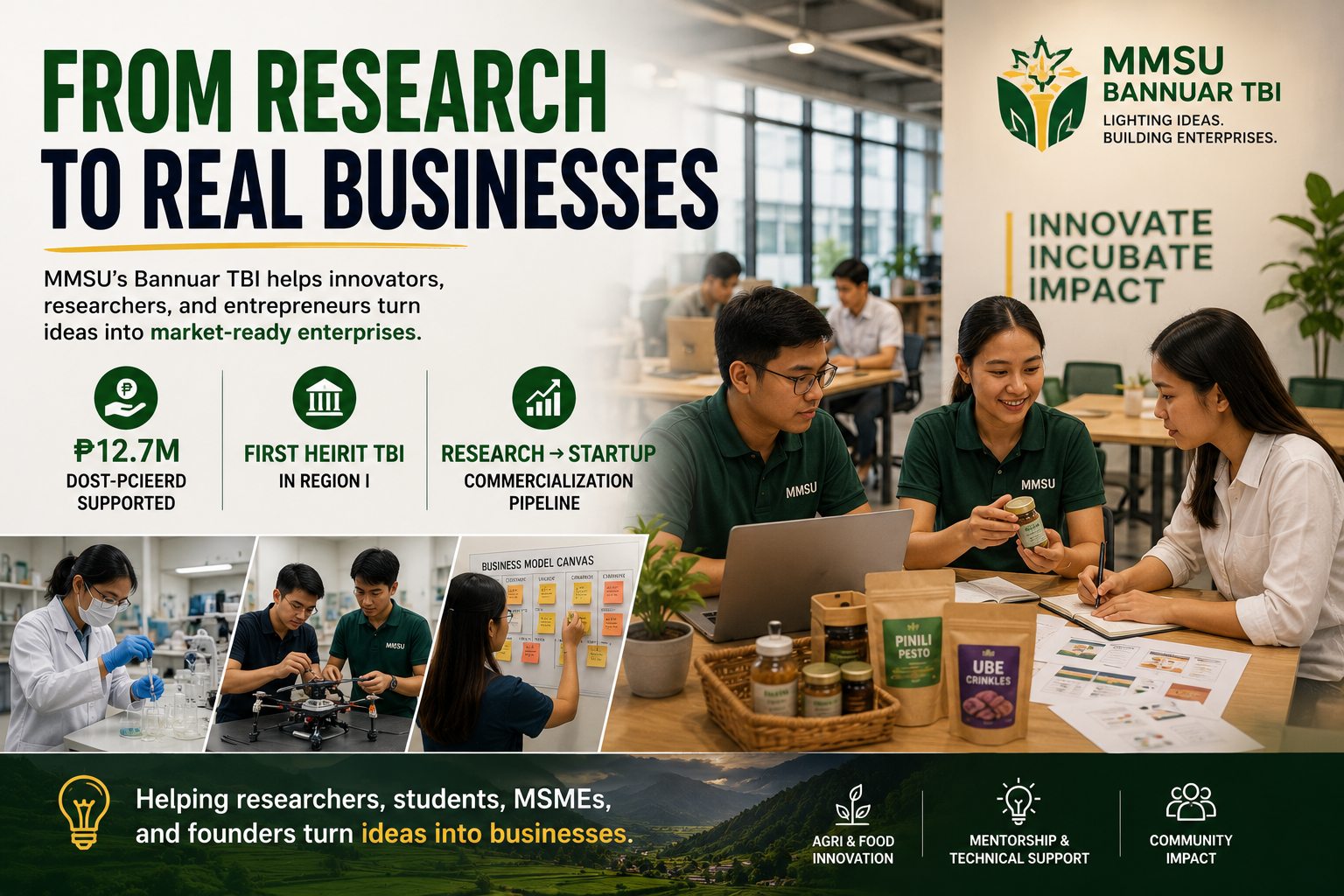
The MMSU Bannuar Technology Business Incubator, the first HEIRIT-TBI in Region I funded by DOST-PCIEERD at P12.7 million, has moved from its 2023 launch to its first batch of graduates, its first MOA with food startup incubatees, a second TBI in the pipeline for agri-fishery enterprises, and a vision to become the center for research-based technology commercialization in Northern Luzon.
 Featured
Amianan Ventures
When Mariano Marcos State University kicked off its Bannuar Technology Business Incubator project on April 19, 2023, it became the first state university in Region I to establish a HEIRIT TBI, a distinction that placed it among only a handful of higher education institutions in the entire country receiving direct incubation programme support from DOST-PCIEERD. Two years later, Bannuar TBI has its first graduates, its first signed incubatee agreements with Ilocos Norte food startups, a growing caravan presence in communities across the province, and a second incubator in development for the agri-fishery sector.
The name Bannuar means "light" in Ilocano. The programme it represents is one of the most structurally significant pieces of startup ecosystem infrastructure in Northern Luzon.
What Bannuar TBI Is and What It Does
Bannuar TBI is a collaborative project of MMSU and DOST-PCIEERD, funded at P12.7 million, designed to promote the use of technology in enterprise management and startup development in the Ilocos region. Its vision is direct: to become the center for research-based technology promotion and commercialization in Northern Luzon toward sustainable community development.
The incubation programme covers the full startup development journey from idea to market-ready business. Incubatees receive support across:
Market validation — testing whether a product or service has real demand before committing to full production or scaling
Product development and prototype testing — translating an idea into a testable, refinable product
Business model and business plan preparation — building the commercial logic and financial projection framework that investors and buyers require
Intellectual property counseling and application — protecting innovations before commercializing them
Co-working space access — physical infrastructure for incubatees who need a professional working environment
Fund sourcing assistance — connecting enterprises to financing options they may not know exist
Business registration support — navigating the regulatory requirements for formal enterprise establishment
Networking and linkaging — building the relationships with government agencies, private industries, and financial institutions that accelerate growth
Prof. Armie Sabugo, Bannuar TBI project leader, designed the programme to make use of MMSU's existing infrastructure, facilities, and research capabilities as the foundation for incubatee support, rather than building from scratch. That integration between the university's research output and the TBI's commercialization pipeline is what makes the HEIRIT model structurally distinct from standalone incubators: the technologies being commercialized come from MMSU's own researchers, faculty, and students.
From Launch to First Graduates
The Bannuar TBI's grand launching was held on August 14, 2023, at the MMSU Teatro Ilocandia, attended by MMSU President Dr. Shirley C. Agrupis, DOST-PCIEERD Executive Director Dr. Enrico Paringit, and DOST Undersecretary for R&D Dr. Leah Buendia, with a recorded keynote from DOST Secretary Renato U. Solidum Jr.
"We are confident that the DOST-MMSU Bannuar TBI will be able to connect students, faculty, researchers, entrepreneurs, business owners, non-government organizations, and financial institutions, and eventually translate these collaborations into jobs and opportunities for technopreneurship," Secretary Solidum said in his message.
Less than two years after that launch, the programme achieved its first major graduation milestone. Three business incubatees officially completed the MMSU Bannuar TBI program during a graduation ceremony in 2025, marking the first cohort to move from admission through the full incubation cycle to programme completion. That first graduation is not just a ceremonial milestone. It is proof that the programme's structure works end-to-end: that an incubatee who enters with a business idea can exit with a market-ready enterprise.
The Food Startup Agreements
In September 2024, MMSU TBI signed a memorandum of agreement with two food manufacturers, Tasty Treats and Snack Stop, formalizing their entry into the incubation programme. The agreement covered the full range of Bannuar TBI's incubation services: market validation, prototype development, IP protection, pilot testing, business model development, business plan preparation, pitching and registration, and training and coaching sessions.
TBI Chief Prof. Sabugo framed the partnerships explicitly around bridging the gap between academic research and local industry. "Through this partnership, we aim to equip our young incubatees with the necessary tools, knowledge, and technical expertise to thrive in the competitive food industry," she said. For Ilocos Norte food enterprises, MMSU TBI's assistance in product development, packaging, and marketability addresses the specific bottlenecks that keep local food products from scaling beyond informal or local market sales.
Taking the Programme to Communities
Beyond its campus-based incubation services, Bannuar TBI has run the RIMAT Caravan, which stands for Revitalizing Homegrown Industries through Mentorship, Adoption and Technopreneurship, across Ilocos Norte towns to identify potential incubatees and introduce MMSU technologies ready for commercialization to local communities.
One caravan session in San Nicolas drew over 200 participants, including farmer association representatives, pottery owners, bamboo processors, out-of-school youth, Sangguniang Kabataan members, and high school students. The multi-sector participant profile reflects the TBI's intentional design: Bannuar is not exclusively for university students or tech founders. It is built to serve the agricultural enterprises, artisan producers, and community-based businesses of Ilocos Norte that have commercially viable ideas and need structured support to develop them.
The Agri-Fishery TBI: The Next Layer
In 2024, MMSU secured an additional P7.18 million from the Department of Agriculture to establish an Agri-Fishery Technology Business Incubator, a companion programme to Bannuar TBI specifically focused on agri-fishery technologies. The AFTBI will offer office space, access to a food product processing facility, business management coaching, bootcamp training for business plan development, technical support, IP advice, financing assistance, and food safety compliance support under the Philippine Food Safety Act.
Target incubatees for the AFTBI include agriculture, food technology, fisheries, and entrepreneurship graduates, as well as members of farmers and fishers cooperatives, women groups, rural improvement clubs, and MSMEs across the Ilocos Norte agricultural and aquatic sector. Together, Bannuar TBI and the forthcoming AFTBI give MMSU two parallel incubation tracks addressing the technology startup ecosystem and the agri-enterprise ecosystem simultaneously, a combination that positions the university as the most comprehensively equipped innovation institution in Region I.
Why This Matters for Northern Luzon
MMSU's vision for Bannuar TBI as "the center for research-based technology promotion and commercialization in North Luzon" is an ambitious but structurally grounded claim. The university has the research base, the DOST partnership, the physical infrastructure, and now a two-year track record of active incubation, community engagement, and programme graduates to back it up.
For the Northern Luzon startup ecosystem, a functioning university-based TBI in Batac, Ilocos Norte changes the geography of who can access structured startup support. Founders and enterprise owners in Ilocos Norte no longer need to travel to Baguio or Manila to access incubation services, IP counseling, product development support, and financing guidance. The infrastructure is now local.
Source: MMSU Strategic Communications | DOST-PCIEERD | MMSU Bannuar TBI | MMSU News | 2023–2025
Are you a founder, innovator, or community builder in Northern Luzon?
We're always looking for compelling stories from the region's ecosystem. Whether you're launching a startup, running a program, or doing something interesting — we'd love to feature you.