
DTI Ilocos Region Is Telling MSMEs to Adapt or Fall Behind. It Is Also Handing Them the Tools to Do It.
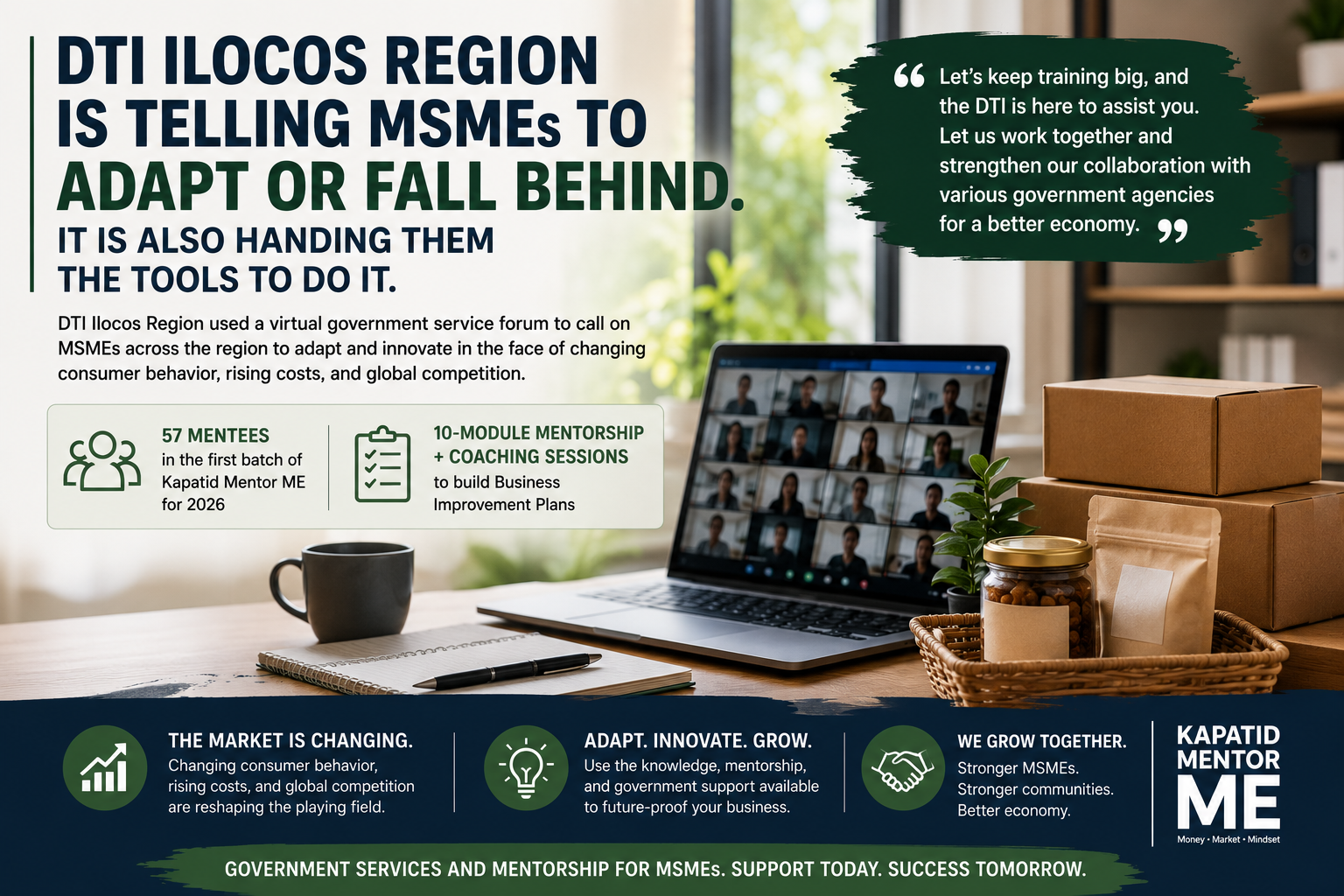
DTI Ilocos Region Director Merlie Membrere used a virtual government service forum to call on MSMEs across the region to adapt and innovate in the face of changing consumer behavior, rising costs, and global competition, while announcing the first batch of 57 mentees under this year's Kapatid Mentor ME program, supported by DOST, DOLE, BIR, and the Intellectual Property Office.
 Featured Partner
Inv8 Studio
Innovation Partner for Startups & Growing Businesses
The message from DTI Ilocos Region to the small businesses of Northern Luzon is direct and unambiguous: the market is changing, the competition is intensifying, and doing things the way they have always been done is no longer a viable strategy. DTI-1 Director Merlie Membrere made that case during a virtual government service forum this week, but she did not deliver it as a warning without a response. She delivered it alongside a programme lineup that gives MSMEs in the Ilocos Region a concrete set of tools for doing what they are being asked to do.
"Let's keep training big, and the DTI is here to assist you. Let us work together and strengthen our collaboration with various government agencies for a better economy," Membrere said. That framing captures the approach: not a lecture on competitiveness, but an operational commitment to providing the support that makes competitiveness achievable for enterprises that do not have the internal resources to build it alone.
What the Forum Delivered
The virtual forum was organized in collaboration with the Philippine Center for Entrepreneurship and Go Negosyo as part of the Kapatid Mentor ME program, which has been running since 2016 and has established itself as one of the most substantive MSME development programmes the government offers. This year's first batch includes 57 mentees who participated in the forum to access the full range of government services relevant to their business development.
The programme is built around a 10-module mentorship structure paired with coaching sessions designed to help mentees develop their Business Improvement Plans and strengthen their presentation and materials. The distinction between mentorship modules and coaching sessions matters: the modules build knowledge, but the coaching sessions translate that knowledge into a specific, actionable plan for each business. A Business Improvement Plan that a mentor helped develop is not a classroom exercise. It is a roadmap that a business owner can implement and measure.
Government agencies represented at the forum included the DOST, the Intellectual Property Office of the Philippines, the Department of Labor and Employment, Small Business Corporation, and the Bureau of Internal Revenue, covering the full institutional landscape that MSMEs need to navigate from technology adoption and IP protection to labor compliance, financing, and tax obligations.
What DOST Is Offering
DOST's presence at the forum was represented by senior science specialist Katrina Ronquillo, who used the session to remind MSME owners that the agency's role extends well beyond creating new technologies for research institutions. "We offer various programs and services for MSMEs. We not only create technologies to make life better, but also innovate to benefit more MSMEs," she said, urging business owners to contact the nearest DOST office to explore available opportunities.
For MSMEs in the Ilocos Region, that invitation covers a range of support mechanisms: the SETUP technology upgrading programme, food safety and quality testing through DOST-accredited laboratories, packaging and product development assistance, and funding support for enterprises ready to invest in technology improvements. These are not theoretical offerings. They are programmes that enterprises in Ilocos Sur, Ilocos Norte, La Union, and Pangasinan can access by walking into their provincial DOST office and asking.
The challenge, as with most government MSME programmes, is that the enterprises most in need of these services are often the least likely to seek them out. The forum format addresses that challenge directly by bringing the information to the MSMEs rather than waiting for the MSMEs to find the agencies.
The Competitive Pressure Behind the Urgency
Membrere's call for adaptation is not rhetorical. The pressures she identified, changing consumer behavior, rising costs, and global competition, are shaping the operating environment for every MSME in Northern Luzon regardless of sector or location.
Consumer behavior has shifted in ways that reward businesses with digital presence, online ordering capabilities, and consistent quality documentation. Rising input costs, from energy to raw materials to logistics, are compressing margins for enterprises that have not yet found ways to improve efficiency or move into higher-margin product categories. And global competition, once an abstraction for small local businesses, is now a daily reality for any MSME that sells in markets where imported alternatives are available at competitive prices.
The Kapatid Mentor ME programme's combination of mentorship, business planning, and government service access is designed to address all three of those pressures. Digitalization support helps with consumer behavior shifts. Technology upgrading through DOST addresses cost efficiency. IP protection through the Intellectual Property Office and product standards support build the quality credentials that allow MSMEs to compete on merit rather than just price.
What MSMEs in Northern Luzon Should Do With This
For MSME owners across the Ilocos Region and Northern Luzon, the Kapatid Mentor ME programme is worth pursuing actively. The 10-module mentorship plus Business Improvement Plan coaching is one of the most structured and substantive MSME development offerings available at no cost through the government. The network of agencies present at the forum covers every major support need a growing enterprise is likely to encounter.
The first batch of 57 mentees for 2026 is already enrolled. The DTI's consistent message to MSMEs in the region is that the support infrastructure is in place and that the limiting factor is whether business owners choose to engage with it.
Membrere was clear about where that responsibility sits. "Let us work together and strengthen our collaboration with various government agencies for a better economy." The collaboration she is describing is between government and enterprise, each doing the part that the other cannot do for them.
Source: Philippine News Agency | Article by Leilanie Adriano | DTI Ilocos Region | DOST Ilocos Region | Kapatid Mentor ME | Philippine Center for Entrepreneurship
Are you a founder, innovator, or community builder in Northern Luzon?
We're always looking for compelling stories from the region's ecosystem. Whether you're launching a startup, running a program, or doing something interesting — we'd love to feature you.