
A Rice Mill in Solsona, Ilocos Norte Cut Its Electricity Bill in Half Using Solar Power. DOST Helped Make It Happen. Now the Owner Is Expanding.
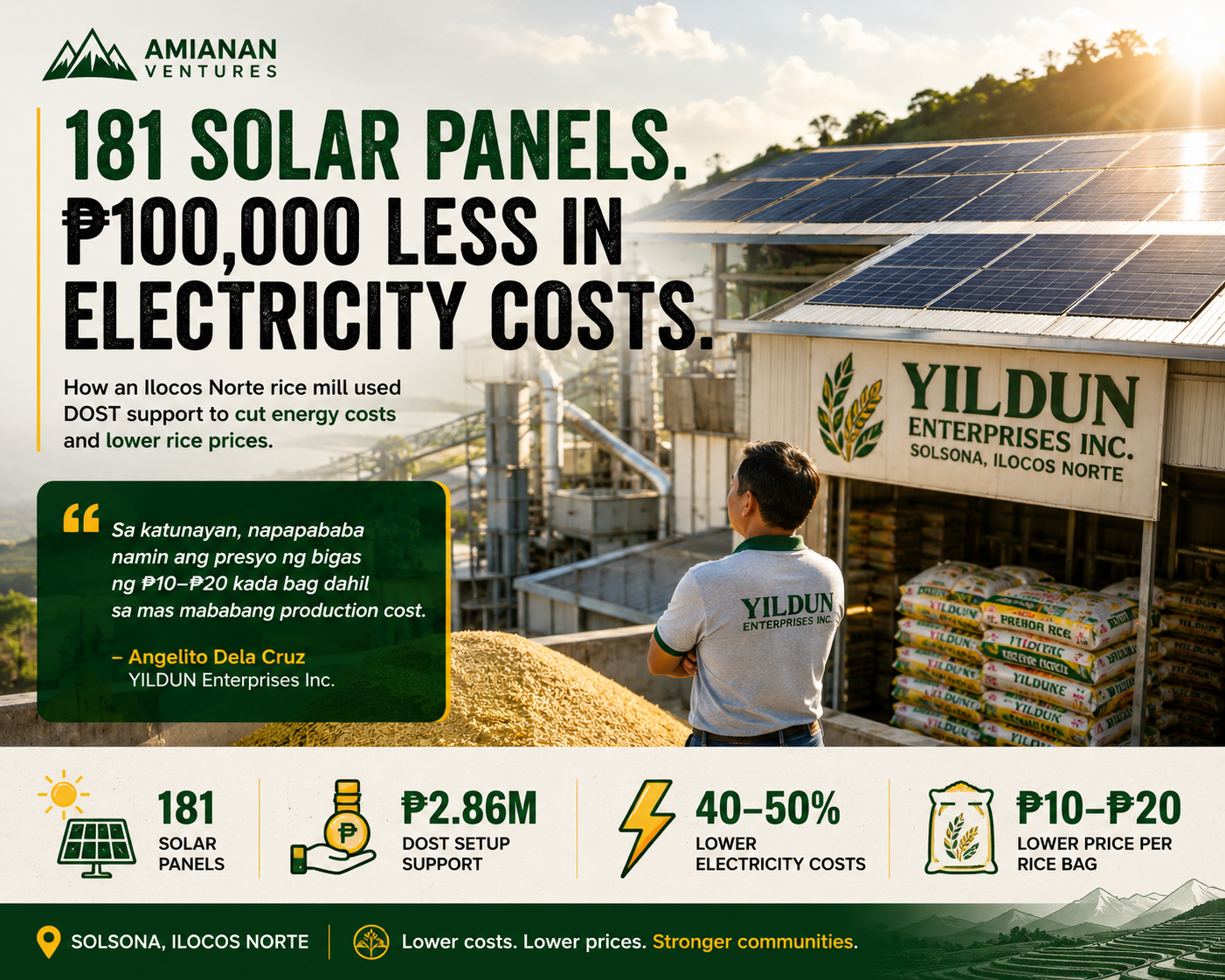
YILDUN Enterprises Inc. in Barangay Juan, Solsona, Ilocos Norte received ₱2.86 million in DOST SETUP assistance in 2024 to install 181 solar panels, dropping its monthly electricity bill from ₱200,000–₱250,000 to ₱100,000–₱150,000, enabling owner Angelito Dela Cruz to lower rice prices by ₱10–₱20 per bag and plan a second solar-powered rice mill facility.
 Featured
Amianan Ventures
Rice milling is one of the most energy-intensive operations in Philippine agriculture. Machinery runs for extended hours processing one of the country's most essential food commodities, and every hour of operation is metered at whatever the current electricity rate happens to be. When electricity prices climb, the cost of milling rice climbs with them, and the margin between a commercially viable operation and one that is slowly being squeezed out tightens in direct proportion.
Angelito Dela Cruz of YILDUN Enterprises Inc. in Barangay Juan, Solsona, Ilocos Norte was facing exactly that equation. Monthly electricity bills running between ₱200,000 and ₱250,000 were a structural burden on a business whose competitiveness depends on keeping production costs low enough to offer rice at prices that work for buyers. In 2024, DOST gave him the tools to change that math permanently.
What DOST SETUP Provided
Under DOST's Small Enterprise Technology Upgrading Program, YILDUN Enterprises Inc. received ₱2,861,141.34 in assistance in 2024 for a project titled "Technology Upgrading for Ricemill Using Renewable Energy." The centrepiece of the upgrade was the installation of 181 solar panels, allowing the facility to partially shift its daily milling operations from grid electricity to solar-generated power.
SETUP is designed precisely for this kind of intervention: identifying enterprises in energy-intensive sectors where a targeted technology investment can produce significant, measurable improvements in operational efficiency and cost structure, and providing the financial assistance that makes that investment viable for a small or medium enterprise that cannot absorb it alone. For a rice mill in a provincial municipality operating on thin margins, ₱2.86 million in technology assistance is not incremental support. It is transformative.
The Numbers That Tell the Story
The impact of the solar installation is immediate and quantifiable. Before the upgrade, YILDUN Enterprises Inc. was paying ₱200,000 to ₱250,000 per month in electricity costs. After the 181-panel solar system came online, that figure dropped to approximately ₱100,000 to ₱150,000 per month, a reduction of nearly half on one of the business's largest recurring expenses.
For an enterprise operating in a commodity sector where price competition is constant and margins are thin, cutting electricity costs by that magnitude changes the fundamental economics of the operation. It creates financial breathing room that did not exist before. It reduces the business's exposure to future electricity price increases. And it translates directly into commercial benefits for customers.
"Sa katunayan, napapababa namin ang presyo ng bigas ng ₱10–₱20 kada bag dahil sa mas mababang production cost," Dela Cruz said. The lower production cost from solar is being passed on directly to rice buyers at ₱10 to ₱20 less per bag, a meaningful price reduction in a staple commodity market where every peso difference affects household food budgets.
"Thank you, DOST," Dela Cruz added, acknowledging the support that made the transition possible.
Why This Model Matters Beyond Solsona
The YILDUN story is not just a single enterprise success. It is a demonstration of what becomes possible when government technology assistance is matched to the specific operational reality of a provincial agricultural enterprise.
Rice milling is not the only power-intensive agricultural processing operation in Northern Luzon. Corn mills, coffee processors, cold storage facilities, and agro-processing operations across Ilocos Norte, Ilocos Sur, La Union, Pangasinan, and the Cordillera provinces face the same energy cost pressure that was squeezing YILDUN before 2024. For any of those enterprises, the YILDUN model, a DOST SETUP application for a renewable energy technology upgrade with a directly measurable payback in lower electricity bills and lower product prices, is a replicable template.
The combination of 181 solar panels, a ₱2.86 million DOST grant, and a clear before-and-after cost comparison gives other enterprise owners in similar sectors a concrete business case to bring to their own DOST provincial office when they explore SETUP eligibility.
What Comes Next for YILDUN
Dela Cruz is not treating the solar installation as the endpoint of his enterprise's technology journey. Motivated by the measurable gains from the 181-panel system, he is already planning an expansion: an additional 99-kilowatt solar power system to support a new rice mill facility he intends to build.
That planned expansion reflects a shift in how the enterprise owner understands the relationship between energy costs and business growth. The first solar investment proved that renewable energy is not just an environmental choice but a competitive business decision. The second investment, now planned rather than hypothetical, reflects confidence that the model works and that scaling it further will compound the benefits already realized.
For DOST's SETUP program, the YILDUN expansion plan is the kind of outcome the programme is designed to produce: not just a one-time technology upgrade, but an enterprise owner who has experienced what technology-driven efficiency gains feel like and is now self-motivated to invest further in the direction SETUP started.
The Broader Signal for Northern Luzon's Agricultural Sector
Energy affordability is one of the most persistent structural challenges facing Philippine agriculture and agro-processing. Enterprises in food processing, milling, and agricultural logistics are disproportionately exposed to electricity price volatility because their machinery-dependent operations cannot reduce consumption the way office-based businesses can.
Solar adoption by agricultural enterprises is the most direct available response to that structural exposure, and DOST's SETUP program is the most accessible pathway for small and medium enterprises to make that transition without carrying the full capital cost alone. The YILDUN case proves the model works at the scale of a provincial rice mill. The lower electricity bill is real, the lower rice prices are real, and the expansion plan is already underway.
For enterprise owners across Ilocos Norte and Northern Luzon navigating the same energy cost pressures that YILDUN was facing before 2024, the message from Solsona is direct: the support is available, the technology works, and the economics are compelling enough that the owner is already building his second facility around the same model.
Source: DOST Ilocos Region | DOST SETUP Program | YILDUN Enterprises Inc. | Article by Kent J. Ramil | Solsona, Ilocos Norte | 2024–2026
Are you a founder, innovator, or community builder in Northern Luzon?
We're always looking for compelling stories from the region's ecosystem. Whether you're launching a startup, running a program, or doing something interesting — we'd love to feature you.