News
DTI La Union Brought AI Training to Six Municipalities at Once — Teaching MSMEs to Use Artificial Intelligence for Marketing, Operations, and Growth
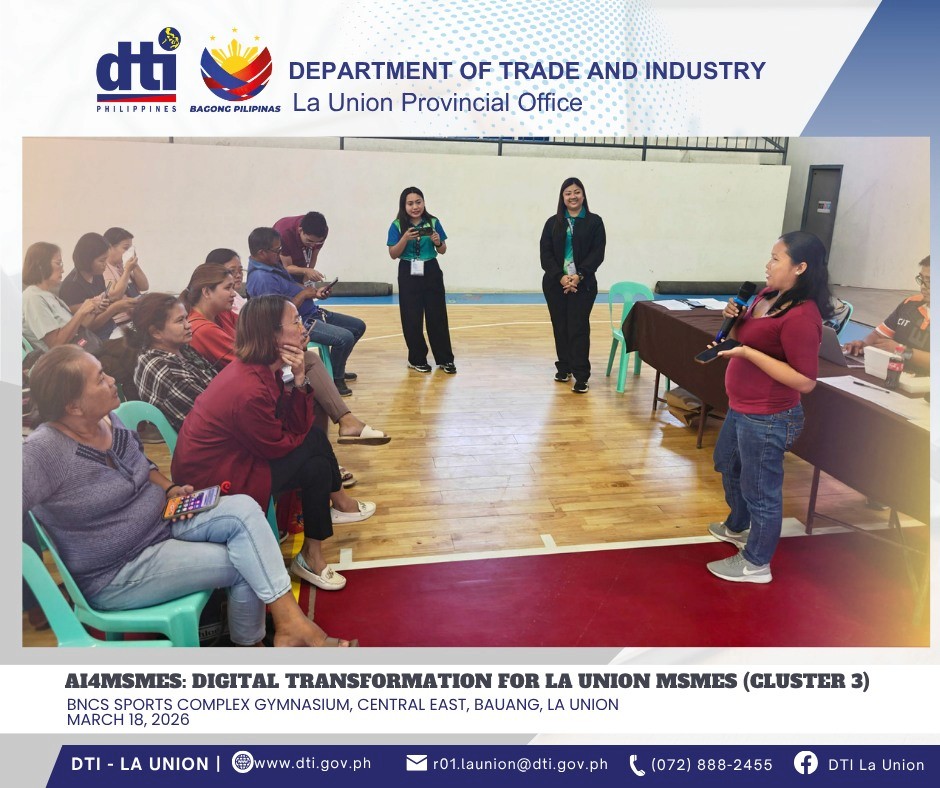
The AI4MSMEs Cluster 3 session in Bauang on March 27 gathered small business owners from Aringay, Bagulin, Bauang, Burgos, Caba, and Naguilian for a practical, beginner-friendly introduction to AI tools — part of a coordinated push to build digital capability across La Union's MSME base.

Amianan Desk
Amianan Innovation Ventures
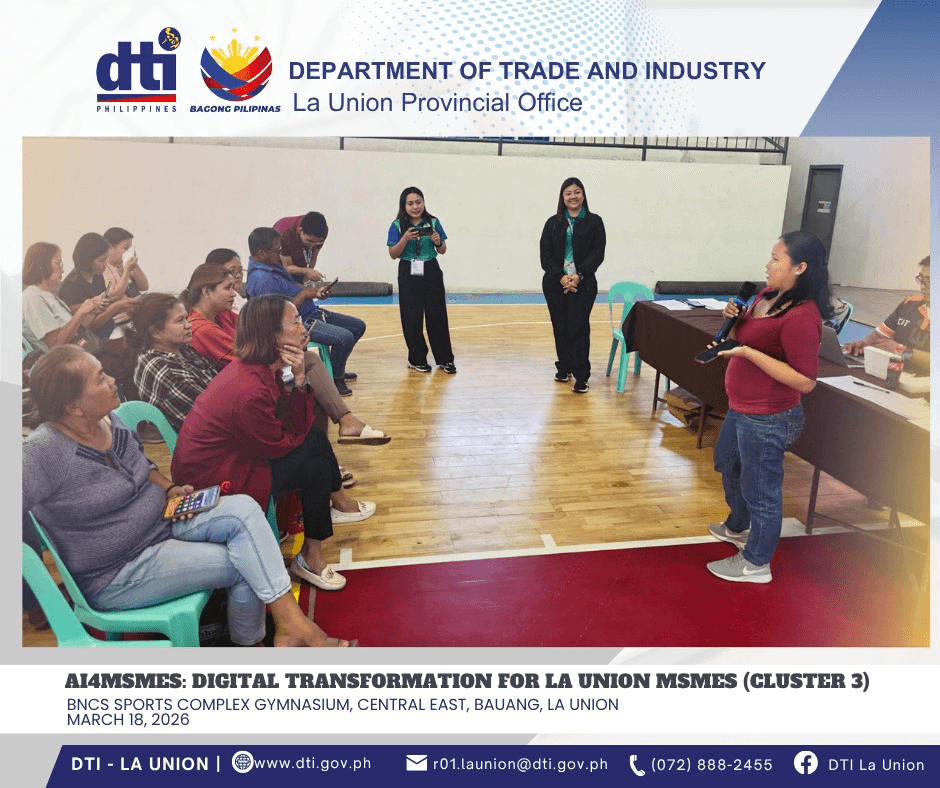
The DTI La Union Provincial Office, in partnership with the Negosyo Centers of Aringay, Bagulin, Bauang, Burgos, Caba, and Naguilian, conducted the AI4MSMEs: Digital Transformation for La Union MSMEs Cluster 3 session in Bauang, La Union. The training brought together small business owners from six municipalities for a structured introduction to artificial intelligence tools designed specifically for the practical needs of micro, small, and medium enterprises.
The cluster format is the right approach for a province like La Union, where MSMEs are distributed across municipalities that rarely share a single training venue. Consolidating six Negosyo Center catchment areas into one session creates a critical mass of participants, reduces per-municipality logistics costs, and builds the kind of cross-municipal peer network that individual town-level trainings cannot produce.
What the Training Covered
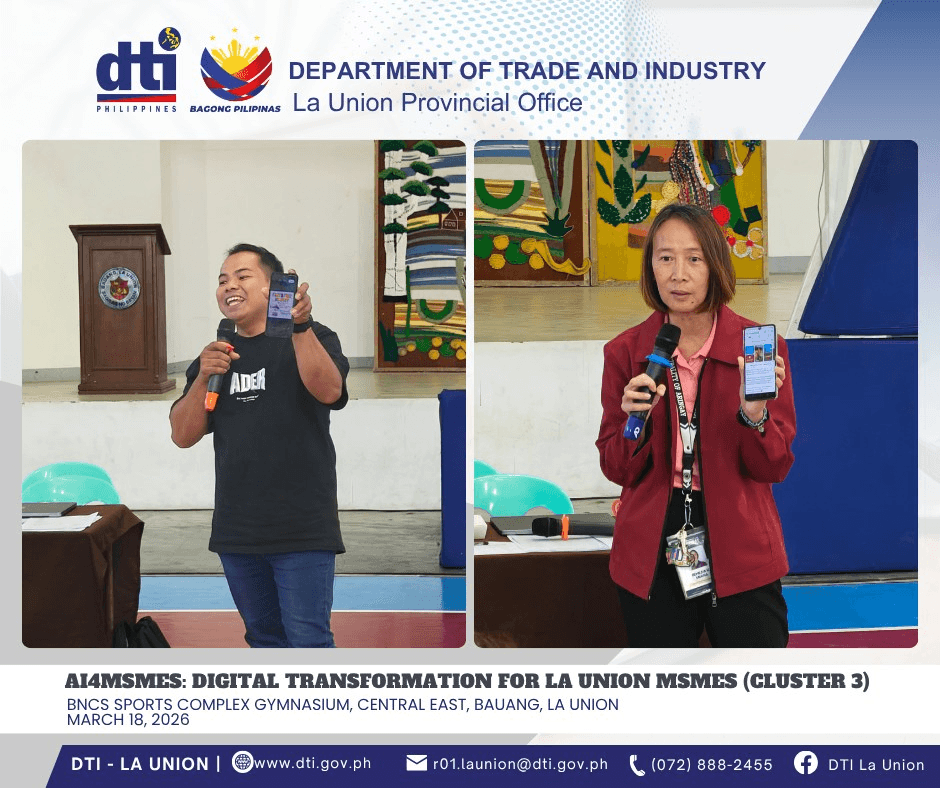
Facilitators Mr. Denver Novencido and Mr. Edelvar Malamion guided participants through four areas that reflect how AI is actually useful to a small business owner today — not in theory, but in practice.
AI fundamentals gave participants a working understanding of what artificial intelligence is and is not, removing the mystique that often makes the topic feel inaccessible to non-technical users. Practical applications in marketing, customer service, and operations showed participants specific tools and workflows they could apply immediately to the businesses they are already running. Beginner-friendly AI tools focused on productivity gains and manual workload reduction — the most immediate and tangible benefit for an MSME owner who is simultaneously the owner, manager, marketer, and delivery person of their enterprise. Responsible and ethical AI adoption rounded out the curriculum, ensuring participants understand not just how to use these tools but how to use them in ways that build rather than undermine trust with their customers.
That last component is more important than it might appear. AI tools used irresponsibly — generating misleading product claims, automating deceptive customer interactions, or producing content that misrepresents a business — can damage an MSME's reputation faster than the efficiency gains are worth. Teaching ethical adoption alongside practical application is the mark of a training program that takes its participants' long-term success seriously.
Why This Matters Now
The timing of DTI La Union's AI4MSMEs program reflects a genuine shift in what small business owners in the Philippines need to compete. AI tools for content creation, customer response automation, inventory management, and data analysis are no longer expensive enterprise software. Many are free or low-cost, accessible on a smartphone, and require no technical background to use. The barrier is not cost or access — it is awareness and confidence.
A bakery owner in Bauang who learns to use an AI writing tool to create social media captions in half the time, or a sari-sari store operator in Naguilian who uses an AI-powered inventory tool to reduce spoilage, has a measurable productivity advantage over a competitor who is still doing everything manually. Multiplied across six municipalities and the full MSME population of La Union, that kind of capability upgrade compounds into a regional economic advantage.
According to a 2024 report by the Asian Development Bank, MSMEs that adopt digital tools — including AI-assisted applications — report productivity gains of 15 to 25% on average, with the most significant gains in marketing efficiency and customer communication. For La Union's MSME base, which spans food processing, tourism services, retail, and agriculture-linked enterprises, those gains are directly relevant.
What This Means for Northern Luzon
La Union's cluster-based approach to AI training for MSMEs is a model worth replicating across Northern Luzon. The province has demonstrated that a single well-organized session can serve multiple municipalities simultaneously, reducing the institutional effort required to reach a dispersed MSME population. For provinces like Ilocos Sur, Ilocos Norte, Pangasinan, and the Cordillera — all of which have significant MSME populations spread across geographically varied territories — the cluster format addresses one of the most persistent barriers to rural skills development: the difficulty of reaching enough participants in one place to make a training session logistically viable.
For MSMEs in La Union who attended the Cluster 3 session, the immediate next step is to apply at least one of the AI tools introduced in the training to a specific task in their business within the next two weeks. The confidence to do that — built during the session — deteriorates quickly without practice. For those who missed this cluster, DTI La Union's Negosyo Centers are the right point of contact for upcoming sessions in the AI4MSMEs series.
Source: DTI La Union Provincial Office