
UC Make-a-Thon 2026 Turns Student Ideas Into Potential Solutions and Future Ventures
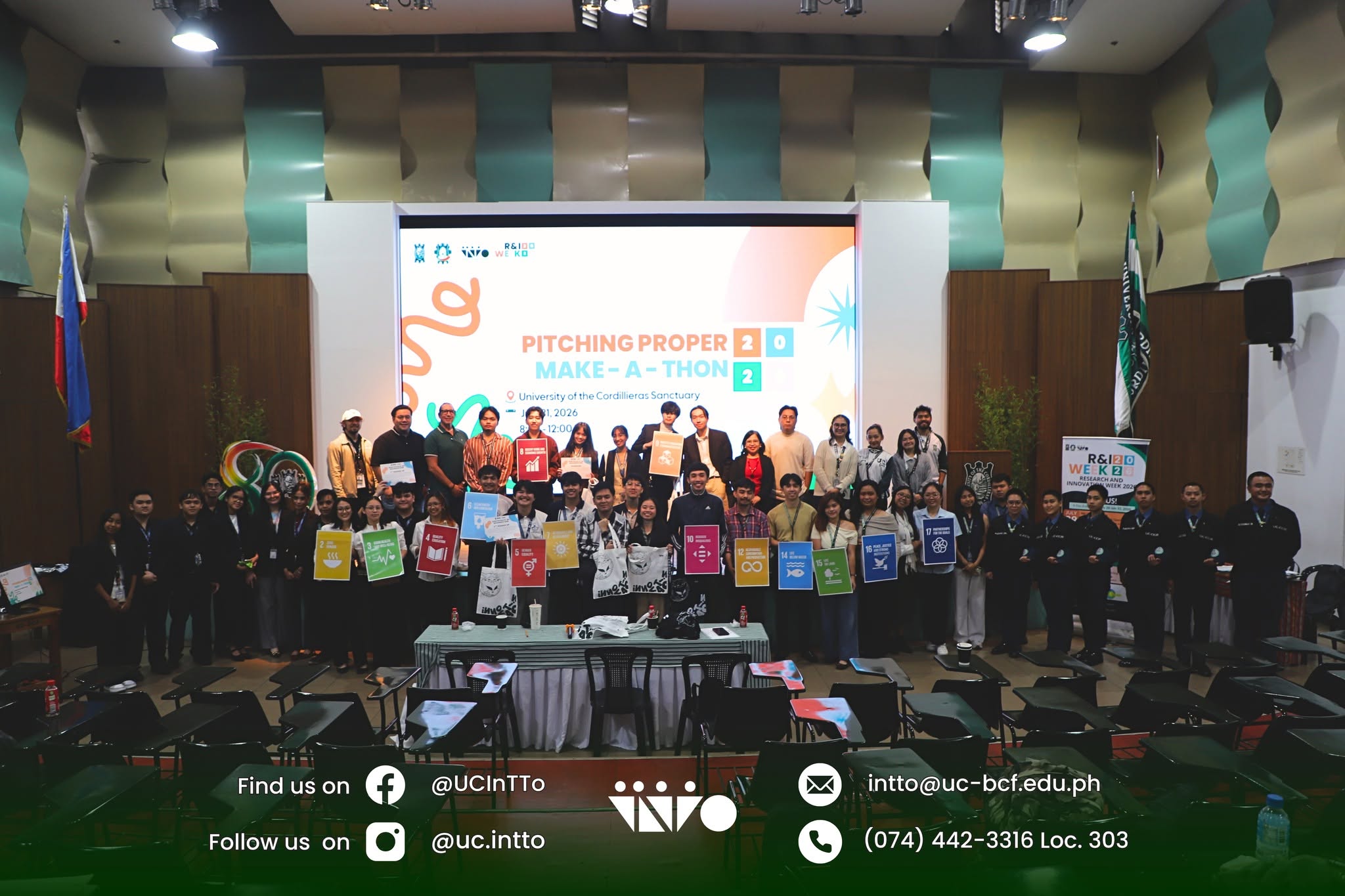
The University of the Cordilleras’ Make-a-Thon 2026 brought together 11 teams during Research and Innovation Week, giving students a platform to develop ideas, practice entrepreneurial thinking, and explore how concepts can move closer to real-world application.
 Featured
Amianan Ventures
A University Challenge Designed to Move Ideas Forward
The University of the Cordilleras (UC) concluded Make-a-Thon 2026 as part of its weeklong Research and Innovation Week, held from July 28 to 31, 2026.
Organized by the UC Innovation and Technology Transfer Office (InTTO), the event brought together 11 teams for an innovation challenge focused on creativity, collaboration, and entrepreneurial thinking.
At its core, the Make-a-Thon provided students with an environment to take ideas beyond the classroom and explore how they could become practical solutions.
This distinction matters.
Coming up with an idea is only the beginning of innovation. The harder work is understanding the problem, developing a solution, working with others, communicating its value, and determining whether the concept has potential for real-world application.
From Ideas to Solutions
The participating teams were challenged to develop and present their ideas through the competition.
For students, this creates an opportunity to practice skills that are difficult to develop through lectures alone.
They have to think creatively, collaborate under time constraints, make decisions with incomplete information, and explain why their proposed solution matters.
These are also skills that become increasingly important when students eventually enter research, industry, or entrepreneurship.
The Make-a-Thon therefore functions not only as a competition but also as a practical learning environment where students can experience some of the early stages of innovation and venture development.
Recognizing the Teams That Stood Out
Following the showcase and pitching activities, UC recognized the following winners:
🏆 Champion: RATELA
🥈 1st Runner-Up: PROWESS
🥉 2nd Runner-Up: SUNGUARD
🎤 Best in Pitch: Nathaniel Fagkangan of PROWESS
While the awards recognize the strongest entries, the participation of all 11 teams is significant.
Every team had to take an idea and put it forward for evaluation, creating an opportunity to receive feedback and learn how to communicate an innovation more effectively.

Why Innovation Challenges Matter for Students
Innovation challenges can serve as an important bridge between education and entrepreneurship.
A student may have a technical idea, research project, or solution to a community problem, but moving from an idea to something people can actually use requires a different set of capabilities.
Students need to understand users.
They need to test whether the problem is important.
They need to think about feasibility.
They need to communicate their value proposition.
And eventually, they need to consider whether there is a sustainable way to deliver the solution.
These experiences help students develop an entrepreneurial mindset even if they do not immediately create a startup.
For universities, this creates another pathway for research and student ideas to move toward innovation, technology transfer, and potential commercialization.
The Pitch Is More Than a Presentation
One particularly valuable element of innovation competitions is the opportunity to pitch.
A pitch forces innovators to answer a simple but difficult question:
Why should anyone care about this idea?
Students can build technically impressive solutions, but if they cannot clearly explain the problem, the user, and the value they create, the innovation becomes difficult to adopt.
Learning to communicate an idea is therefore part of learning to innovate.
The recognition of Best in Pitch at Make-a-Thon 2026 also highlights this dimension of innovation. Technical capability and communication capability increasingly need to work together, particularly when innovators eventually engage with users, partners, investors, or industry.
What This Means for Northern Luzon’s Innovation Ecosystem
The Cordillera has a growing network of universities, technology transfer offices, incubators, research institutions, and innovation programs.
Activities like Make-a-Thon contribute to this ecosystem by giving students a place to experiment with ideas before they enter more advanced stages of research commercialization or venture development.
This creates a potential pipeline:
Student idea → Prototype → Validation → Venture or technology transfer → Market
Not every idea will become a startup, and that should not be the expectation.
Some may become research projects.
Others may become technologies adopted by organizations or communities.
Some may evolve into businesses.
Others may simply give students the experience and confidence to pursue innovation later in their careers.
The important part is having pathways that allow promising ideas to continue developing after the competition ends.
Universities Can Become More Than Places of Learning
The growing role of university innovation offices is changing how higher education institutions contribute to regional development.
Universities are not only producing graduates. They are also generating research, technologies, ideas, and talent that can contribute to local economies.
Innovation programs can help connect these assets with industry, government, communities, and entrepreneurs.
For the Cordillera, this is particularly important because many of the region’s potential innovators are already inside its universities.
The opportunity is to create stronger bridges between what students and researchers develop and the problems that communities and industries actually need solved.
The Bigger Opportunity Is What Happens After the Competition
Winning a competition is valuable, but it should not be the end of the innovation journey.
The more important question is what happens next.
Can the teams continue developing their prototypes?
Can they validate their ideas with users?
Can they access mentors?
Can they connect with technology transfer offices or incubators?
Can promising solutions receive support for commercialization?
This is where innovation ecosystems become important.
A competition can create momentum. An ecosystem needs to provide the next steps.
For universities like UC, programs such as Make-a-Thon can become entry points into a broader pipeline of innovation support, helping promising student ideas move from competition to experimentation, validation, and potentially venture creation.
Building the Next Generation of Technopreneurs
Make-a-Thon 2026 demonstrates the value of giving students opportunities to build, test, collaborate, and pitch.
The next generation of innovators will need more than technical knowledge. They will need the ability to identify meaningful problems, work across disciplines, understand users, communicate ideas, and turn knowledge into solutions.
That is the kind of capability that innovation challenges can help develop.
For the Cordillera, every student who gets the opportunity to experience this process represents another potential researcher, founder, engineer, designer, or innovation leader who could contribute to the region’s future.
The strongest innovation ecosystems do not wait for entrepreneurs to appear. They create environments where people can learn how to become one.
Make-a-Thon 2026 is one example of how universities can create that environment by giving students the space to turn ideas into action.
Original Source
Market Context
University-based innovation programs are increasingly important in developing regional innovation ecosystems because they connect education, research, entrepreneurship, and technology transfer. Innovation challenges can help students develop practical skills in problem-solving, pitching, collaboration, and early-stage venture development. However, competitions create the most value when they connect participants to continued mentorship, prototyping, validation, incubation, and commercialization support. For Northern Luzon, strengthening these pathways across universities can help ensure that promising student ideas do not end with a competition but have opportunities to develop into technologies, research outputs, social innovations, or sustainable ventures.
Are you a founder, innovator, or community builder in Northern Luzon?
We're always looking for compelling stories from the region's ecosystem. Whether you're launching a startup, running a program, or doing something interesting — we'd love to feature you.