
From Research to Market: Agri-Aqua Innovations Take Center Stage at Regional Technology Pitch Day
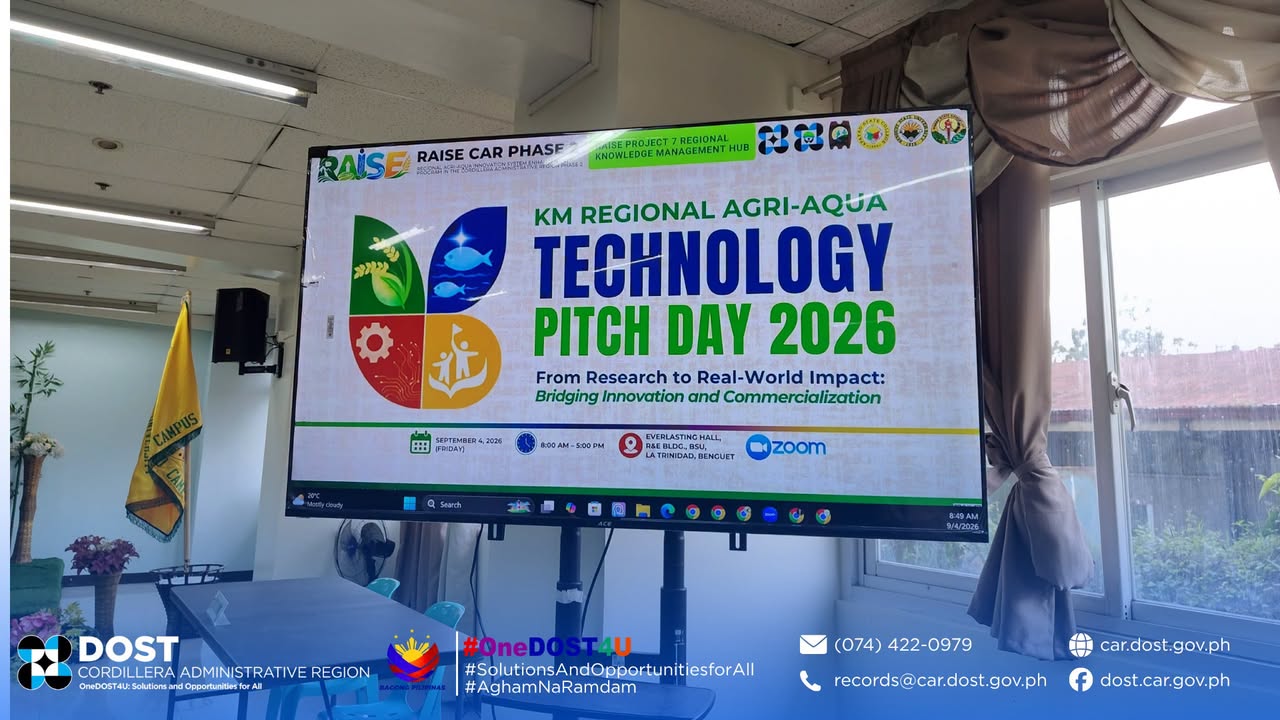
Five agriculture, aquatic, and natural resources technologies were presented during the Regional Agri-Aqua Technology Pitch Day 2026 at Benguet State University, where researchers received expert feedback on how to move their innovations closer to actual users and commercial markets. DOST-CAR Regional Director Dr. Nancy A. Bantog emphasized that successful commercialization begins with understanding demand—not simply developing a technology and looking for someone to use it.
 Featured
Amianan Ventures
Moving Beyond Technology for Technology’s Sake
A promising research output does not automatically become a successful product.
For technologies developed in agriculture and food processing, the path from laboratory or research facility to the market often depends on a much simpler question: Does someone actually need it, and does it solve a problem they are willing to pay to address?
That question was at the center of the Regional Agri-Aqua Technology Pitch Day 2026, held September 4 at the BSU Everlasting Hall of the Research and Extension Building of Benguet State University in La Trinidad, Benguet.
With the theme “From Research to Real-World Impact: Bridging Innovation and Commercialization,” the event brought together researchers and stakeholders around five agriculture, aquatic, and natural resources (AANR) technologies developed by Benguet State University (BSU), Apayao State College (ASC), and Ifugao State University (IFSU).
The technologies featured food processing innovations that turn surplus vegetables and underutilized crops into value-added products.
The Market Should Be Part of the Research Conversation
As one of the pitch evaluators, DOST-CAR Regional Director Dr. Nancy A. Bantog urged researchers to rethink the traditional technology development process.
Rather than relying primarily on a technology-push approach, she highlighted the importance of a demand-pull approach—developing and refining technologies with the needs of potential adopters in mind.
For researchers, this means engaging the people who may eventually use the technology, particularly micro, small, and medium enterprises (MSMEs).
Their feedback can reveal practical considerations that may not emerge during research and development: What does the market actually want? What production problems need to be addressed? What specifications are required? Can an MSME afford to adopt the technology?
These questions can influence how a technology is refined before it reaches the market.
Commercialization Does Not End With a Working Product
Another point raised during the event was the importance of regulatory compliance.
For food-related technologies, commercialization involves more than proving that a product can be produced.
Researchers and potential technology adopters also have to consider food safety, packaging and labeling, nutritional information, and other applicable standards.
This is an important part of the journey because a technology may work technically but still face barriers before it can be sold commercially.
For researchers hoping to see their work become an actual product or business, understanding these requirements early can save time and help shape development decisions.
Five Technologies, One Bigger Question
The five technologies presented by BSU, ASC, and IFSU demonstrate how research can respond to a familiar agricultural challenge: what to do with surplus or underutilized crops.
Turning these materials into value-added products can potentially create additional economic value while opening possibilities for processing enterprises.
But the pitch day was not simply about presenting finished innovations.
The expert evaluation and feedback gave researchers an opportunity to examine their technologies from the perspective of potential users, markets, and commercialization.
That exchange is important because researchers often know their technology better than anyone else—but potential adopters understand their own operational and market realities better.
Bringing those perspectives together can strengthen the technology.
Where Startups and MSMEs Can Enter the Picture
This demand-driven approach also creates an interesting space for entrepreneurs.
Researchers may develop the underlying technology, but commercialization can require another set of capabilities: product development, branding, manufacturing, distribution, sales, and customer engagement.
This is where startups and MSMEs can potentially become partners in the technology transfer process.
Instead of treating research commercialization as a straight line from university to company, it can be viewed as a collaborative process where researchers, entrepreneurs, enterprises, and end users continuously refine the solution.
For Northern Luzon, that connection could be particularly valuable in agriculture, where many innovations need to be adapted to the realities of local producers and processors.
Making Research More Responsive
The event was organized under the Regional Agri-Aqua Innovation System Enhancement (RAISE) Program, funded by the DOST–Philippine Council for Agriculture, Aquatic and Natural Resources Research and Development (DOST-PCAARRD).
Its emphasis on moving innovations toward technology transfer and commercialization reflects a broader challenge for research institutions: producing knowledge is only one part of creating impact.
The next steps—validation, technology transfer, adoption, and commercialization—are where research begins to interact directly with the economy.
DOST’s Project TECHGROW, which Dr. Bantog also cited, supports this broader process by facilitating the issuance of Fairness Opinion Reports (FOR) for government-funded technologies intended for commercialization.
These mechanisms help address some of the practical requirements involved when publicly funded technologies move toward potential commercial use.
What This Means for Northern Luzon
The pitch day offers a useful model for strengthening the region’s innovation pipeline.
Northern Luzon has universities and research institutions working on agriculture, food, natural resources, and other technologies closely connected to local industries. The challenge is ensuring that promising research does not remain within institutional boundaries.
A stronger pathway could look like:
Research → Market Need → Technology Validation → Technology Transfer → Adoption → Commercialization
Each stage requires different actors.
Researchers develop and improve the technology.
MSMEs and potential adopters provide market and operational feedback.
Government and technology transfer offices help navigate support and commercialization processes.
Entrepreneurs can help build businesses around validated technologies.
When these pieces work together, research has a clearer route toward becoming something people can actually use.
The Real Test Comes After the Pitch
A technology pitch can demonstrate what an innovation is capable of. But the more important test begins afterward.
Can an enterprise adopt it?
Can it meet regulatory requirements?
Can it compete in the market?
Can it solve a real problem better than existing alternatives?
Those questions will ultimately determine whether a research output becomes a commercial product or remains a promising prototype.
The Regional Agri-Aqua Technology Pitch Day puts researchers one step closer to answering them. More importantly, it reinforces a shift in thinking: commercialization should not begin after the technology is finished. The market should have a voice in shaping the technology from the start.
Original Source
Market Context
Research commercialization is increasingly being viewed as a process that requires close interaction between researchers, businesses, potential adopters, and markets. For agriculture and food processing, this is particularly important because technologies must address practical production needs while meeting market and regulatory requirements.
For Northern Luzon, a demand-driven approach can help strengthen the connection between the region’s research institutions and its MSMEs and agribusinesses. The opportunity lies in creating stronger pathways where local problems inform research, research produces applicable technologies, and validated technologies find entrepreneurs and enterprises capable of bringing them to market.
Are you a founder, innovator, or community builder in Northern Luzon?
We're always looking for compelling stories from the region's ecosystem. Whether you're launching a startup, running a program, or doing something interesting — we'd love to feature you.