
Nueva Vizcaya Strengthens Coffee Industry Through New Provincial Development Ordinance
Nueva Vizcaya has established a new policy framework for developing its coffee industry, covering production, processing, market development, research, innovation, and enterprise support. The ordinance also creates a multi-sectoral council tasked with coordinating efforts to strengthen the province’s coffee value chain.
 Featured Partner
Inv8 Studio
Innovation Partner for Startups & Growing Businesses
A New Policy Framework for Nueva Vizcaya Coffee
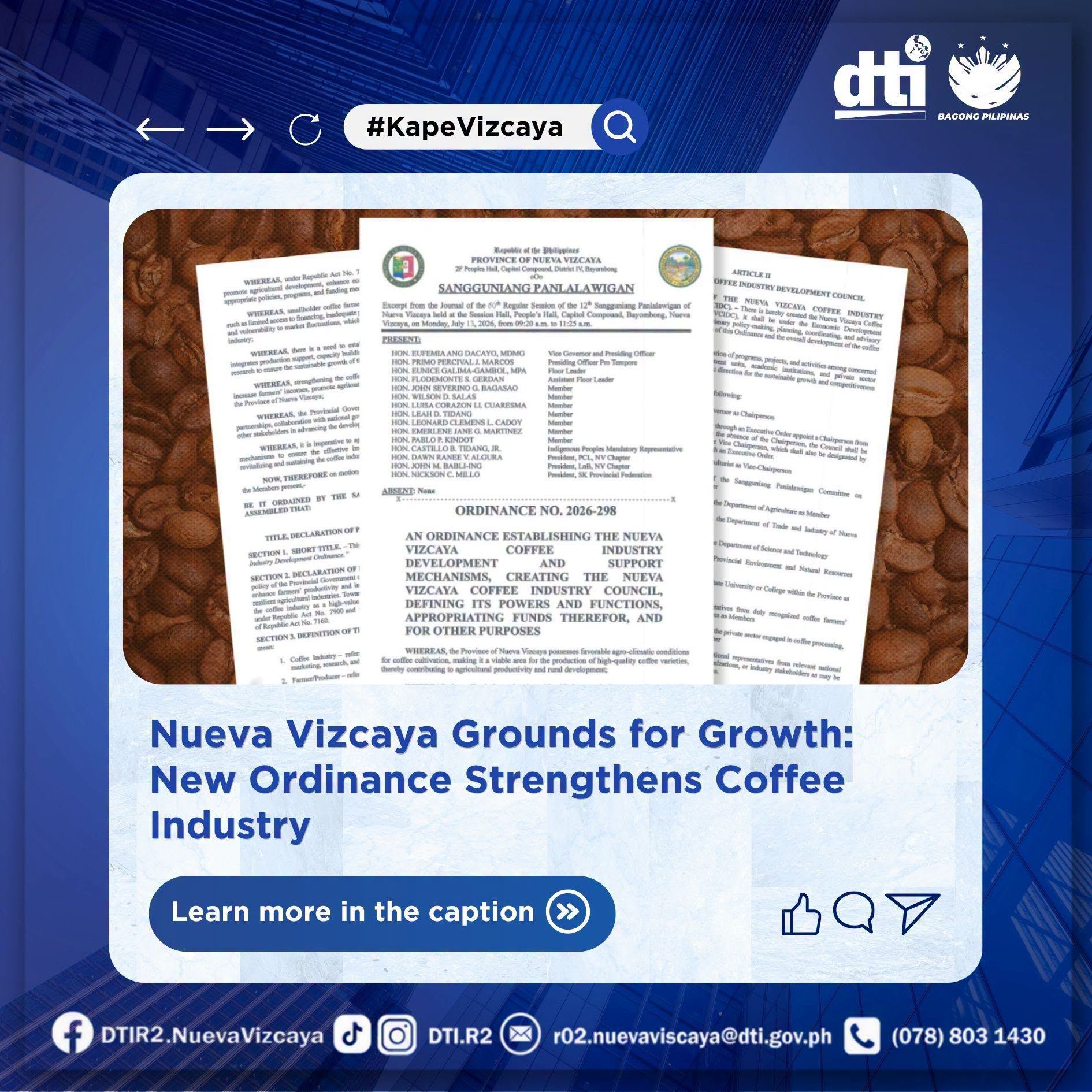
Nueva Vizcaya is strengthening its efforts to develop its coffee industry following the approval of Provincial Ordinance No. 2026-298, or the “Nueva Vizcaya Coffee Industry Development Ordinance.”
The ordinance was passed by the Sangguniang Panlalawigan of Nueva Vizcaya during its 50th Regular Session on July 13, 2026, and was approved by Provincial Governor Atty. Jose V. Gambito on July 21, 2026.
The measure was authored by Hon. Eunice Galima-Gambol, MPA, and sponsored by Hon. Wilson D. Salas.
The new ordinance establishes a more coordinated framework for developing the province’s coffee industry across its value chain.
Developing the Coffee Value Chain
The ordinance covers several areas of coffee industry development, including:
Production
Capacity building
Post-harvest processing
Market development
Research
Innovation
Enterprise development
This approach recognizes that building a competitive coffee industry requires more than increasing production.
Farmers and producers also need access to appropriate processing capabilities, quality improvement, market opportunities, business knowledge, and technologies that can help strengthen the overall value chain.
The ordinance also recognizes coffee’s potential to contribute to employment, increase farmers’ incomes, promote agritourism, and support inclusive economic growth in Nueva Vizcaya.
DTI Takes a Role in Enterprise and Market Development
The Department of Trade and Industry (DTI) Nueva Vizcaya has been designated as a member of the newly created Nueva Vizcaya Coffee Industry Development Council (NVCIDC).
Under the ordinance, DTI, together with the Provincial Cooperative and Enterprise Development Office (PROCEDO), will support efforts to promote Nueva Vizcaya coffee in domestic and international markets.
These efforts include:
Product branding
Packaging innovation
Quality and certification compliance
Trade fairs and exhibitions
Market linkage activities
DTI will also be a partner in capacity-building activities covering coffee production, processing, quality control, and business management.
For local farmers, cooperatives, processors, and other industry players, these interventions can help strengthen not only production capabilities but also the business side of the coffee industry.
A Multi-Sectoral Council for the Industry
At the center of the new framework is the Nueva Vizcaya Coffee Industry Development Council.
The council will serve as the province’s primary policy-making, planning, coordinating, and advisory body for coffee industry development.
It will bring together the Provincial Government, national government agencies, academic institutions, coffee farmer organizations, and private sector stakeholders.
The council is also tasked with facilitating investments and market linkages, strengthening the coffee value chain, and promoting research, development, innovation, and technology transfer.
This creates a more structured mechanism for different stakeholders to coordinate their efforts rather than addressing coffee industry development through isolated activities.
Innovation as Part of Coffee Industry Development
One notable aspect of the ordinance is its inclusion of research, development, innovation, and technology transfer.
This recognizes that improving a local industry is not only about providing traditional agricultural support.
Innovation can contribute to different parts of the coffee value chain, including production, processing, quality control, product development, packaging, and market access.
Technology can also help address challenges related to productivity and climate resilience.
For universities and researchers, this creates potential opportunities to work more closely with farmers, cooperatives, processors, government, and businesses on problems directly connected to the local coffee industry.
Building a Stronger Local Market
The ordinance also seeks to strengthen demand for locally produced coffee within Nueva Vizcaya.
Hotels, resorts, and hospitality establishments are encouraged to prioritize locally sourced coffee.
Meanwhile, OTOP hubs, pasalubong centers, trade fair venues, and government-supported retail outlets are tasked with prominently displaying and promoting locally produced coffee and coffee-based products.
Strengthening the local market can provide producers and processors with additional channels to introduce their products while building greater visibility for Nueva Vizcaya coffee.
It also creates a connection between the coffee industry and tourism, particularly through hospitality and local product promotion.
What This Means for Northern Luzon
Nueva Vizcaya’s move is relevant to the broader Northern Luzon agricultural and innovation ecosystem.
The region has strong agricultural production across multiple provinces, but the challenge for many commodities is moving from production toward higher-value and more competitive industries.
Coffee provides a clear example.
A stronger coffee ecosystem requires connections between farmers, processors, researchers, entrepreneurs, government, retailers, hospitality establishments, and consumers.
The new ordinance provides Nueva Vizcaya with a formal framework for building those connections around coffee.
For Northern Luzon, this also demonstrates the potential of provincial policy to support industry development by bringing together enterprise development, technology, research, market access, and local economic development.
From Commodity to Industry
The bigger opportunity for Nueva Vizcaya is to move coffee from being viewed primarily as an agricultural commodity toward becoming a more integrated local industry.
That transition requires several pieces to work together:
Production → Processing → Quality → Branding → Market Access → Enterprise Growth
Each stage creates opportunities for innovation and entrepreneurship.
Farmers can improve production.
Processors can develop higher-value products.
Entrepreneurs can create new coffee brands and experiences.
Researchers can develop technologies and improve processes.
Hospitality businesses can promote local coffee.
Government and industry organizations can help connect these different players.
The ordinance provides a policy foundation for these activities to become more coordinated.
The Importance of Implementation
A strong policy framework is an important starting point, but its long-term impact will depend on implementation.
The newly established council will have an important role in translating the ordinance into coordinated programs, investments, partnerships, and measurable outcomes.
The effectiveness of the framework will ultimately be reflected in whether it helps improve productivity, quality, farmer incomes, market access, enterprise growth, and the resilience of the local coffee industry.
For innovation ecosystems, this is an important distinction.
Policy creates the direction. Collaboration creates the system. Implementation creates the impact.
A Potential Model for Local Industry Development
Nueva Vizcaya’s coffee ordinance illustrates how local government can create a more structured approach to developing a specific industry.
Rather than focusing on a single intervention, the ordinance brings together production, enterprise development, research, innovation, technology transfer, market access, and stakeholder coordination.
For other provinces across Northern Luzon, the approach offers a useful point of reference: local industries can potentially become stronger when development efforts are organized around the entire value chain rather than individual activities.
Nueva Vizcaya now has a formal policy framework for pursuing that approach in coffee.
The next chapter will be about how the province, industry stakeholders, farmers, researchers, entrepreneurs, and institutions turn that framework into sustained economic opportunities.
Source
Market Context
For Northern Luzon, the development of local agricultural value chains is increasingly connected to enterprise development, innovation, market access, and technology transfer.
Nueva Vizcaya’s coffee ordinance is notable because it approaches industry development across the value chain, bringing together government, academia, farmer organizations, private sector stakeholders, research, innovation, and market development.
The ordinance itself establishes the framework. Its long-term impact will depend on how effectively stakeholders translate that framework into programs, investments, partnerships, and opportunities for coffee producers and enterprises.
The broader opportunity is clear: local resources can create greater economic value when communities have the capabilities and systems to process, brand, commercialize, and bring them to market.
Are you a founder, innovator, or community builder in Northern Luzon?
We're always looking for compelling stories from the region's ecosystem. Whether you're launching a startup, running a program, or doing something interesting — we'd love to feature you.