
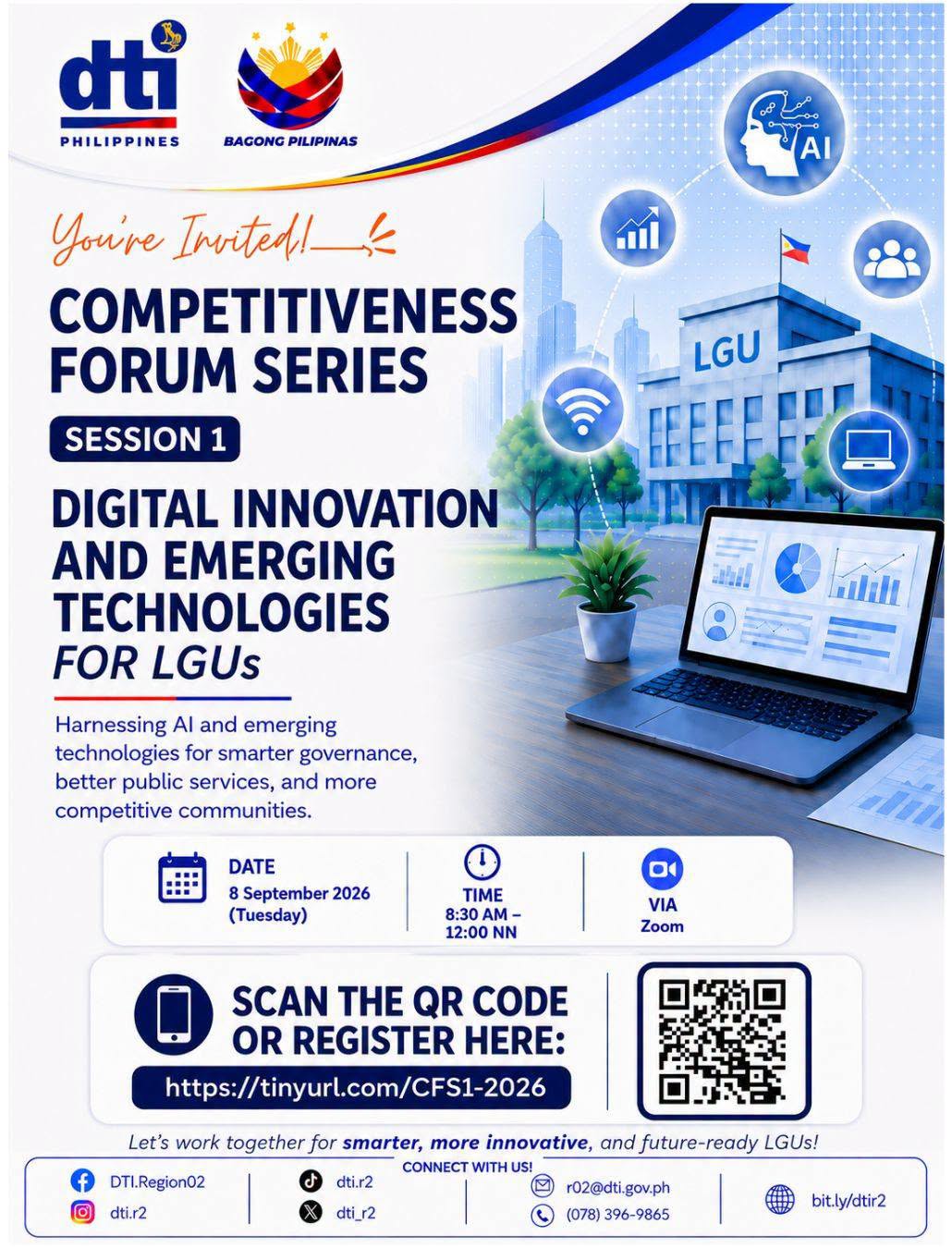
The Department of Trade and Industry Region 2 is set to hold the first session of its Competitiveness Forum Series on September 8, 2026, bringing together Local Government Units in Cagayan Valley to explore how artificial intelligence, digital tools, and emerging technologies can improve public services, government operations, and local competitiveness.
The Department of Trade and Industry Region 2 is set to hold the first session of its Competitiveness Forum Series on September 8, 2026, bringing together Local Government Units in Cagayan Valley to explore how artificial intelligence, digital tools, and emerging technologies can improve public services, government operations, and local competitiveness.
 Featured Partner
Inv8 Studio
Innovation Partner for Startups & Growing Businesses
Moving Local Governance Toward a Digital Future
Local governments are increasingly expected to respond faster, deliver better services, and adapt to changing community needs.
Technology can play an important role in that transition.
Recognizing this opportunity, the Department of Trade and Industry Region 2 (DTI Region 2) is inviting Local Government Units across Cagayan Valley to the Competitiveness Forum Series – Session 1: Digital Innovation and Emerging Technologies for LGUs on September 8, 2026, via Zoom.
The session carries a practical focus: exploring how digital innovation and emerging technologies can contribute to smarter, more responsive, and future-ready local governments.
Understanding the Role of Digital Innovation in Government
Digital transformation is not simply about putting existing government processes online.
The bigger opportunity is to rethink how services are delivered, how information is managed, how decisions are supported, and how government interacts with citizens and businesses.
The forum will explore DICT’s role in digital governance, particularly in enabling competitive, responsive, and future-ready LGUs.
It will also feature discussions on practical AI tools and digital technologies that LGUs can potentially use to make their operations more efficient.
For local governments, this creates an important shift in perspective.
Technology should not be adopted simply because it is new. It should be connected to a real problem and evaluated based on whether it can create better outcomes for citizens, businesses, and government workers.
AI as a Tool for Better Public Services
Artificial intelligence is increasingly becoming accessible to organizations of different sizes, including government institutions.
For LGUs, its potential applications can extend across everyday operations, from helping process information and generate documents to supporting communication, analysis, and other administrative functions.
The forum will introduce practical AI and digital tools for smarter and more efficient LGU operations.
The emphasis on practical applications is important.
For many local governments, the challenge is not knowing that AI exists. The challenge is understanding where it can actually create value, how it can be introduced responsibly, and which problems are worth solving first.
A useful approach is to begin with the problem rather than the technology:
What is taking too much time? What process creates unnecessary friction? Where are citizens experiencing delays? What information could help government workers make better decisions?
These questions can help LGUs identify where digital innovation can have meaningful impact.
From Digital Government to Local Competitiveness
Digital transformation also has implications beyond government efficiency.
The quality of local government services can influence how easily businesses operate, how quickly entrepreneurs access information, and how attractive a locality becomes for investment and innovation.
For MSMEs and startups, government processes can sometimes become part of the overall cost of doing business.
Improving digital services can therefore contribute to a more supportive business environment.
This makes digital governance relevant to the broader competitiveness agenda.
A more responsive LGU can potentially make it easier for businesses to access services, comply with requirements, find information, and interact with government.
Why This Matters for the Startup Ecosystem
There is also a deeper connection between digital government and startup ecosystems.
Government institutions are not only service providers. They can also become users, partners, and potential customers for technology companies developing solutions to public-sector challenges.
When LGUs clearly identify operational and community problems, those challenges can create opportunities for innovators to develop solutions.
This can create a pathway such as:
Government problem → Innovation challenge → Prototype → Pilot → Adoption
For startups, this provides an opportunity to build solutions around real-world needs.
For LGUs, working with innovators can provide access to new approaches and technologies without requiring government to develop every solution internally.
The relationship can become mutually beneficial when innovation is grounded in actual problems and tested in real environments.
Creating More Innovation-Ready Communities
A digitally capable LGU can contribute to a broader innovation environment.
When local governments improve digital infrastructure, processes, and capabilities, they can create conditions that allow businesses, entrepreneurs, researchers, and communities to participate more effectively in the digital economy.
This is particularly relevant for regions outside major urban centers.
For Cagayan Valley, digital transformation can help reduce some of the geographic barriers that traditionally affect access to services, markets, information, and opportunities.
The goal is not simply to make government more technologically advanced.
It is to make communities more capable of responding to change.
The Importance of Starting Practical
Not every LGU needs to immediately implement complex artificial intelligence systems.
In many cases, meaningful digital transformation can begin with smaller improvements.
A government office can identify a repetitive process.
A service can be redesigned around the citizen.
Information can be made easier to access.
Data can be organized more effectively.
A simple digital tool can reduce administrative work.
These improvements can create the foundation for more advanced transformation later.
The most effective technology strategies often begin with clear problems, measurable outcomes, and gradual implementation.
Building Future-Ready LGUs
The Competitiveness Forum Series positions digital innovation as part of the broader conversation on competitiveness.
For LGUs, becoming future-ready means developing the capacity to understand emerging technologies, identify relevant applications, and make informed decisions about their use.
It also means ensuring that technology remains connected to people.
A smarter government is not necessarily one that uses the most technology.
It is one that uses technology where it can make services more accessible, operations more efficient, and communities better equipped for the future.
A Shared Opportunity for Cagayan Valley
The upcoming forum provides an opportunity for LGUs across the region to explore these possibilities together.
By bringing digital innovation, AI, and emerging technologies into the local governance conversation, DTI Region 2 is creating space for government leaders and practitioners to consider how technology can contribute to stronger communities and a more competitive regional economy.
The opportunity extends beyond government offices.
As LGUs become more digitally capable, they can also become better partners for startups, technology providers, universities, and other innovation ecosystem stakeholders.
This can help create a stronger connection between public-sector challenges and innovation solutions.
The Next Step Is Application
Technology discussions become valuable when they eventually lead to action.
The important question after learning about AI and emerging technologies is not simply, “What technology can we use?”
It is:
“What problem are we trying to solve, and can technology help us solve it better?”
That mindset can help LGUs move from technology adoption for its own sake toward purposeful digital transformation.
For Cagayan Valley, building smarter and more innovative local governments can become part of a larger effort to create communities where citizens receive better services, businesses can operate more efficiently, and innovators have more opportunities to contribute.
The future of digital governance will not be defined only by the technologies LGUs adopt.
It will be defined by how effectively those technologies are used to solve real problems.
Event Details
Competitiveness Forum Series – Session 1
Digital Innovation and Emerging Technologies for LGUs
📅 September 8, 2026
🕣 8:30 AM–12:00 NN
💻 Via Zoom
The session will cover digital governance and practical AI and digital tools for LGU operations.
Registration:
Register for the Competitiveness Forum Series
Original Source
The event information, date, format, session topics, and registration details are based on the provided DTI Region 2 materials.
The discussion on startups, innovation ecosystems, government challenges, and potential technology adoption pathways is editorial analysis based on the stated focus of the forum and is not presented as a specific commitment by DTI Region 2 or participating LGUs.
Market Context
Digital transformation is becoming increasingly relevant to local economic competitiveness. For LGUs, digital tools and AI can potentially improve internal operations and public service delivery while creating stronger conditions for businesses and innovators.
For startup ecosystems, digitally capable governments can also become important partners because public-sector challenges can provide opportunities for technology development, pilot projects, and eventual adoption.
For Cagayan Valley, the larger opportunity is to connect digital governance with regional innovation: helping LGUs identify meaningful problems while creating clearer opportunities for startups, technology providers, universities, and other stakeholders to contribute solutions.
Are you a founder, innovator, or community builder in Northern Luzon?
We're always looking for compelling stories from the region's ecosystem. Whether you're launching a startup, running a program, or doing something interesting — we'd love to feature you.