
Ilocos Sur Awards ₱500,000 to Five Research Projects Through Siglat Development Grant
The Provincial Government of Ilocos Sur has awarded ₱100,000 each to five research projects under the Siglat Saliksik Spring Development Grant 2026, providing a total of ₱500,000 in funding for research and innovation initiatives addressing agriculture, disaster resilience, farm technology, cosmetics, and community infrastructure.
 Featured
Amianan Ventures
Ilocos Sur Strengthens Support for Homegrown Research and Innovation
Research becomes more valuable when promising ideas receive the resources needed to move from concept to development.
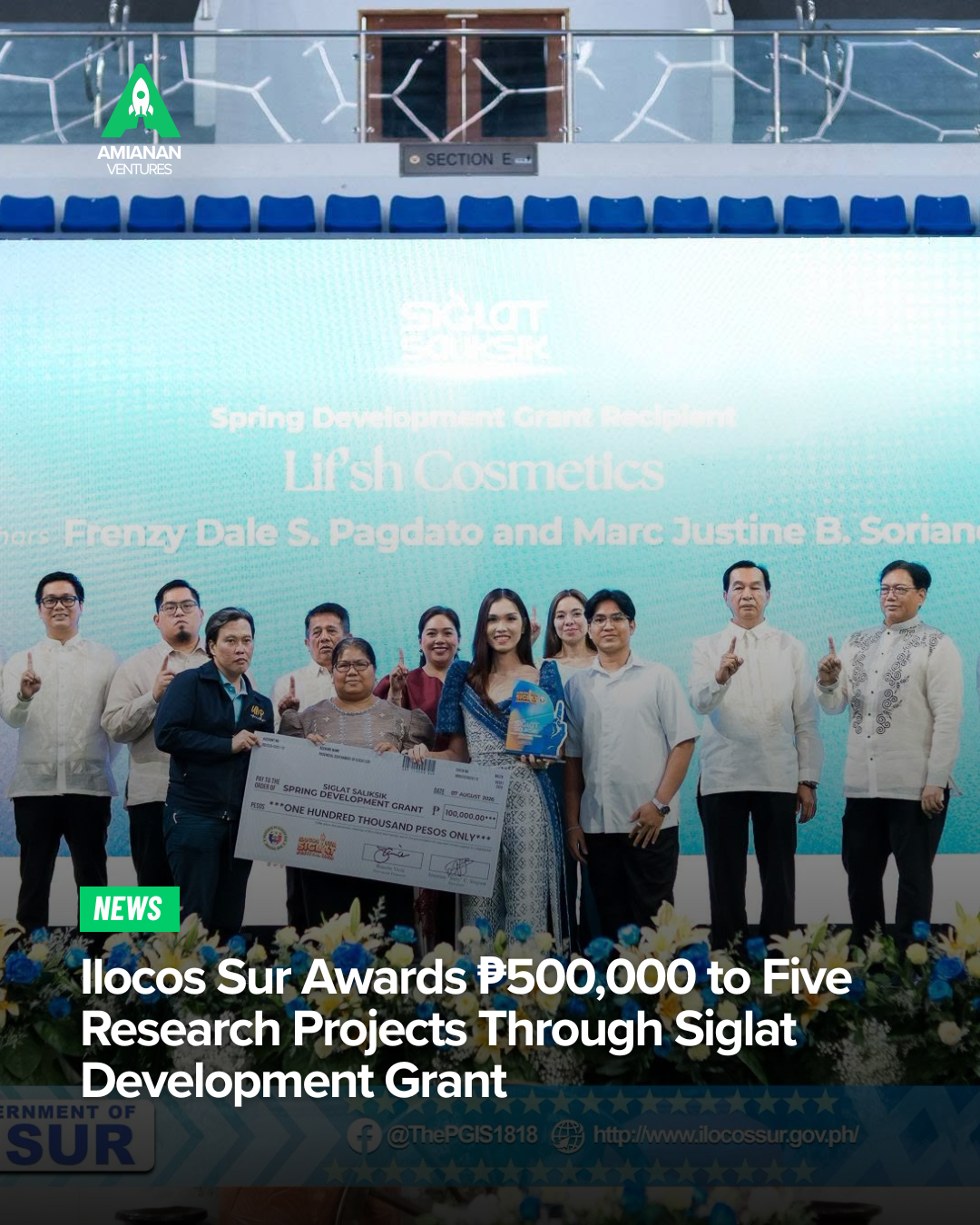
The Provincial Government of Ilocos Sur is strengthening its support for local researchers through the Siglat Saliksik Spring Development Grant (SDG) 2026, awarding funding to five research projects during the Siglat Festival 2026 on August 7, 2026, at the CHAVIT Coliseum in Vigan City.
Each selected project received a ₱100,000 grant, bringing the total funding awarded this year to ₱500,000.
Now on its third year, the Spring Development Grant highlights the creative and innovative potential of Ilocano researchers while providing financial support for projects that can contribute to local development.
Five Research Projects Receive Development Support
The 2026 grant recipients represent a diverse range of research and innovation areas.
Improving Access to Evacuation Centers
Accessibility and Multi-hazard Assessment of Evacuation Centers in Ilocos Sur
Author: Mark Joseph William D. Ducusin
The research focuses on assessing evacuation centers in the province through the lens of accessibility and multi-hazard considerations, an area directly relevant to disaster preparedness and community resilience.
Advancing Coffee Post-Harvest Processing
Development and Evaluation of a Prototype Hydronic Rotary Drum Drying System for Improved Post-harvest Processing of Robusta Coffee Beans in Sigay, Ilocos Sur
Authors: Chineth Angel M. Atiwa, Dhoel Jarren D. Casesola, Ruby Jane C. Collado, and Annaly M. Quines
This project explores the development of a specialized drying system intended to improve the post-harvest processing of Robusta coffee beans in Sigay.
The project demonstrates how engineering and research can be applied to address specific agricultural challenges at the local level.
Using Data to Understand Flood Risks
Flood Susceptibility Index Mapping in Ilocos Sur, Philippines, Using a GIS-Based Multi-Criteria Decision Analysis (MCDA) Approach
Authors: Camille Rafal, Alex Garibay Jr., and Rochelle Paa
The project applies geographic information system (GIS)-based analysis to develop a flood susceptibility index for Ilocos Sur.
Research of this type can contribute to better understanding of areas exposed to flooding and support evidence-based approaches to disaster risk management and planning.
Developing a Local Cosmetics Venture
Lif’sh Cosmetics
Authors: Frenzy Dale S. Pagdato and Marc Justine B. Soriano
Unlike the other research projects, Lif’sh Cosmetics represents a more direct pathway toward entrepreneurship and product development.
The project demonstrates how research and innovation programs can also support ideas with potential to become commercial products and enterprises.
Developing Technology for Small Farms
ONICUT – Portable Onion Leaf-Cutting Unit for Small Farms: Design, Fabrication, and Performance Evaluation
Authors: Myke Lorenz B. Brillantes, Nicole Esmeralda, Ivy Pearl V. Otong, Veejay L. Tacuycuy, and Reynon B. Tomen
ONICUT focuses on developing a portable onion leaf-cutting unit designed specifically for small farms.
The project highlights the potential of locally developed agricultural technologies to improve farm operations while responding to the needs of smaller producers.
From Research Funding to Local Innovation
The five projects demonstrate how local research can address challenges across multiple sectors, from agriculture and disaster resilience to product development and farm mechanization.
This diversity is important for a developing innovation ecosystem. Not every innovation needs to become a startup, but promising research should have pathways toward implementation, adoption, commercialization, or public-sector application.
Small grants can play an important role at this early stage by giving researchers the resources to develop prototypes, test concepts, collect data, and demonstrate whether an idea can work in real-world conditions.
What This Means for Northern Luzon’s Innovation Ecosystem
The Siglat Saliksik Spring Development Grant reflects a broader shift in Northern Luzon toward strengthening locally driven research and innovation.
For provinces like Ilocos Sur, supporting researchers can help ensure that local challenges become opportunities for developing solutions grounded in the realities of communities, farms, businesses, and public institutions.
The inclusion of projects ranging from agricultural machinery and coffee processing to flood mapping and commercial cosmetics also shows the breadth of opportunities available within a regional innovation ecosystem.
The next challenge is ensuring that promising research does not stop after the grant period.
Projects with strong potential can eventually benefit from technology business incubation, intellectual property support, industry partnerships, additional research funding, market validation, and startup development. Creating these pathways can help transform research investments into technologies, enterprises, and solutions that generate measurable economic and social value.
For Northern Luzon, strengthening this research-to-innovation pipeline is essential to building an ecosystem where local researchers are not only producing knowledge but also creating technologies, businesses, and solutions that respond to regional needs.
The ₱500,000 awarded through Siglat Saliksik is therefore more than research funding. It is an investment in the people developing solutions for Ilocos Sur and in the province’s capacity to turn local knowledge into practical innovation.
Original Source
Market Context
Research grants are an important component of regional innovation ecosystems because early-stage researchers often face a funding gap between developing an idea and demonstrating its practical potential. Small development grants can help researchers build prototypes, conduct validation, and generate evidence needed to attract larger funding or industry partnerships. For agriculture-dependent regions such as Northern Luzon, locally developed technologies can also address highly specific challenges that may not receive attention from larger commercial markets. Connecting these research projects to incubators, investors, industry partners, and government adopters can further strengthen the pathway from research to commercialization and community impact.
Are you a founder, innovator, or community builder in Northern Luzon?
We're always looking for compelling stories from the region's ecosystem. Whether you're launching a startup, running a program, or doing something interesting — we'd love to feature you.