
High School Students From Alaminos City Built a Low-Cost Alzheimer's Detection Method. The World Noticed First. Then the Nation Did.
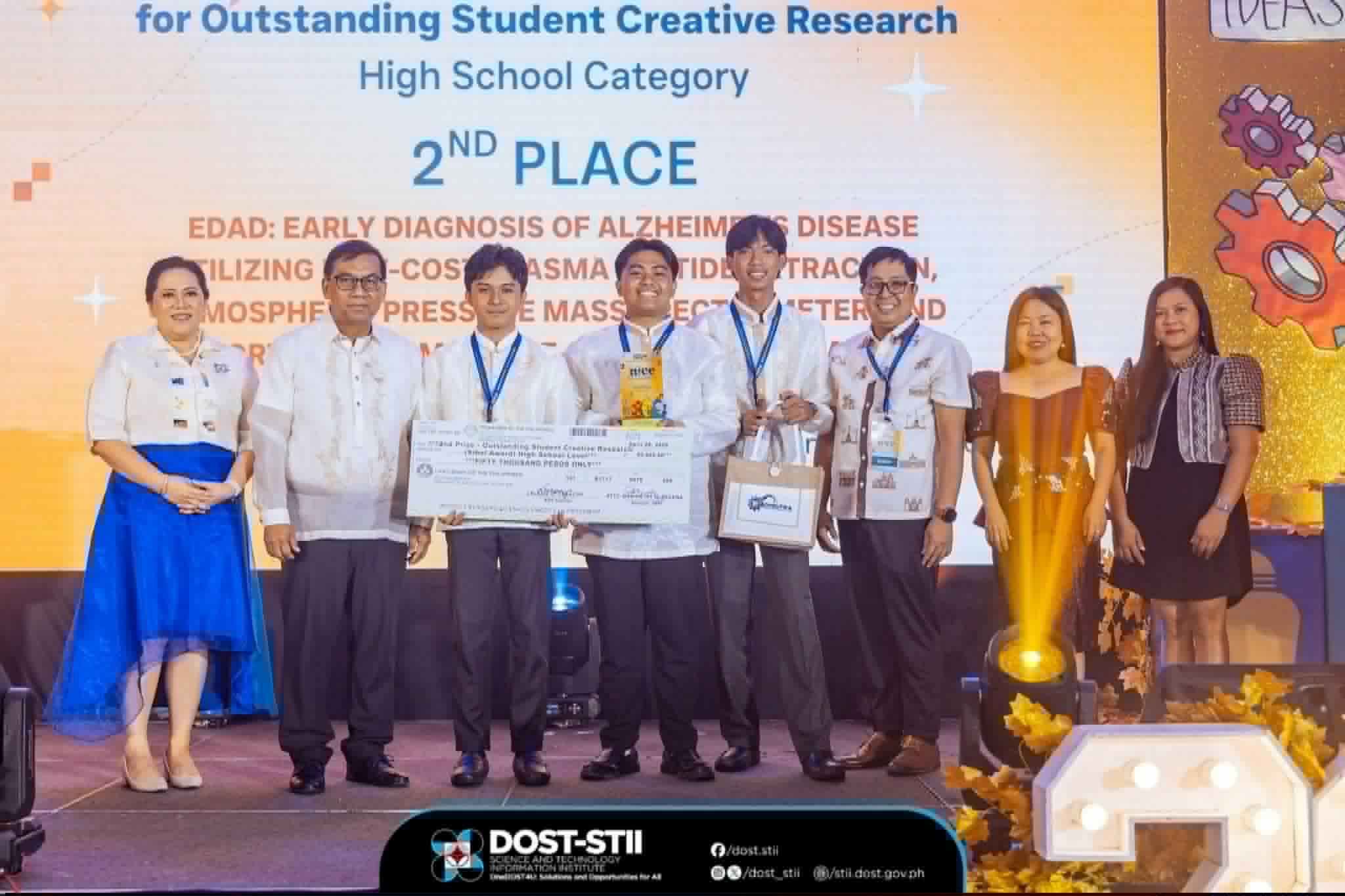
Team EDAD of Alaminos City National High School brought home 2nd Place and the Sibol Award at NICE 2026 — capping a research journey that had already represented the Philippines at Regeneron ISEF 2025 in Ohio, USA.
 Featured
Amianan Ventures
Before they stood on a national competition stage in Muntinlupa, these three high school researchers had already stood on one of the biggest stages in global student science.
In 2025, Charly David T. Manuel, Rey Alfred S. Quiam, and Klien Gunneris R. Bubos of Alaminos City National High School represented the Philippines at the Regeneron International Science and Engineering Fair (ISEF) in Ohio, USA — the world's premier pre-college science competition. They came home with two distinctions: the Qatar Research Development and Innovation Council Special Award and the Best of ISEF Philippines 2025 – H&P Medical Research Award.
A year later, on April 27–28, 2026, at Acacia Hotel in Alabang, Metro Manila, they competed again — this time on the national stage at the National Invention Contest and Exhibits (NICE) 2026, organized by DOST-TAPI. They walked away with 2nd Place and the Sibol Award for Outstanding Student Creative Research (High School Level), along with a cash prize of ₱50,000.00, representing the North Luzon Cluster.
What They Built
The research is titled in full: "EDAD: Early Diagnosis of Alzheimer's Disease Utilizing Low-Cost Plasma Peptide Extraction, Atmospheric Pressure Mass Spectrometer, and Support Vector Machine-Based Classification of Amyloid-beta Species."
Stripped to its core, EDAD is a cost-effective, accessible method for the early detection of Alzheimer's disease. It works by extracting peptides from plasma, analyzing amyloid-beta species using an atmospheric pressure mass spectrometer, and classifying results through a machine learning model — a Support Vector Machine. The clinical and social implications are significant. Alzheimer's disease is most treatable in its earliest stages, and current diagnostic pathways remain expensive and inaccessible for most Filipino families. A low-cost plasma-based detection method, if validated at scale, changes that equation.
This is not a science fair project built for a ribbon. It is a research intervention designed to solve an urgent problem — and the recognition it has received, from Ohio to Alabang, reflects that.
The People Behind the Work
Their coach and project adviser, Mr. Kris Cristhopher C. Dela Cruz, guided the team from conceptualization through every stage of development and competition — sharing technical expertise and giving consistent direction to work that required both scientific precision and competitive preparation.
Dr. Cynthia B. Tablang, Education Program Supervisor in Science for the Alaminos City Schools Division, provided sustained technical assistance and mentoring across the full arc of the project — from early development to the final NICE presentation. Her work reflects what education supervisors can do when they treat research mentorship as a core part of their role, not an add-on.
The institutional foundation was provided by Dr. Ely S. Ubaldo, CESO V, Schools Division Superintendent of Alaminos City, supported by Dr. Wilfredo E. Sindayen, CESO VI, Assistant Schools Division Superintendent, and Dr. Orlando I. Guerrero, Chief of the Curriculum Implementation Division. School Principal Mr. Rey B. Pascua of Alaminos City National High School provided direct institutional backing through the research journey.
Local government support came from City Mayor Arth Bryan Celeste and Vice Mayor Jose Antonio Miguel Perez of Alaminos City, whose administration has consistently backed science education and youth development programmes.
What It Means for Northern Luzon
Alaminos City is in Pangasinan — part of the Ilocos Region and Northern Luzon's broader research and academic geography. Team EDAD's double recognition — first global, then national — is a clear data point for any conversation about where innovation capacity in the Philippines actually lives.
It lives in a high school in Alaminos City. It lives in a student who decided that Alzheimer's detection was too important a problem to leave unsolved. It lives in a teacher who made time, and an education supervisor who showed up every step of the way.
The infrastructure of recognition — ISEF, NICE, the Sibol Award — exists to surface exactly this kind of work. Team EDAD used it fully.
Are you a founder, innovator, or community builder in Northern Luzon?
We're always looking for compelling stories from the region's ecosystem. Whether you're launching a startup, running a program, or doing something interesting — we'd love to feature you.