
He Got Frustrated With Every Running App He Tried. So He Built a Better One. Alone. From Baguio.
Thor Remiendo of Runn is a software engineer and beginner runner who shipped a full-featured AI-powered running app to the iOS App Store in May 2026 — solo, from Baguio City, with everything from design to backend infrastructure done by one person.

Thor Remiendo was not trying to build a startup. He was trying to find a running app that actually helped him get better.
He tried the popular ones. They tracked his runs. They gave him a map, a pace, a distance. They stored the data neatly and displayed it clearly. And then they did nothing with it. "They feel like glorified spreadsheets," he says. No feedback on whether he was improving. No guidance on what to work on next. No reason to open the app except to log another entry into a database that never talked back.
Thor is a software engineer. When he could not find what he was looking for, he did what software engineers do: he opened a blank screen and started building it himself.
The Problem With Running Apps
The gap Thor identified is not a niche frustration. It is the central limitation of how most fitness tracking apps are built: they are designed to capture data, not to do anything useful with it.
Runners want to know if they are improving. They want to understand what their numbers actually mean. They want to feel part of something on the days when motivation is low and the route feels long. Most apps stop at the export button.
"Runners want to know if they're improving, what to work on, and they want to feel part of something," Thor says. "Runn closes that gap with AI that reads your data and gives you personalized feedback, plus social and gamification features that make you want to open the app even on rest days."
That framing, utility plus community plus motivation, is the architecture of Runn. Not just a better tracker. A running companion that earns its place on your phone on the days you are not running, not just the days you are.
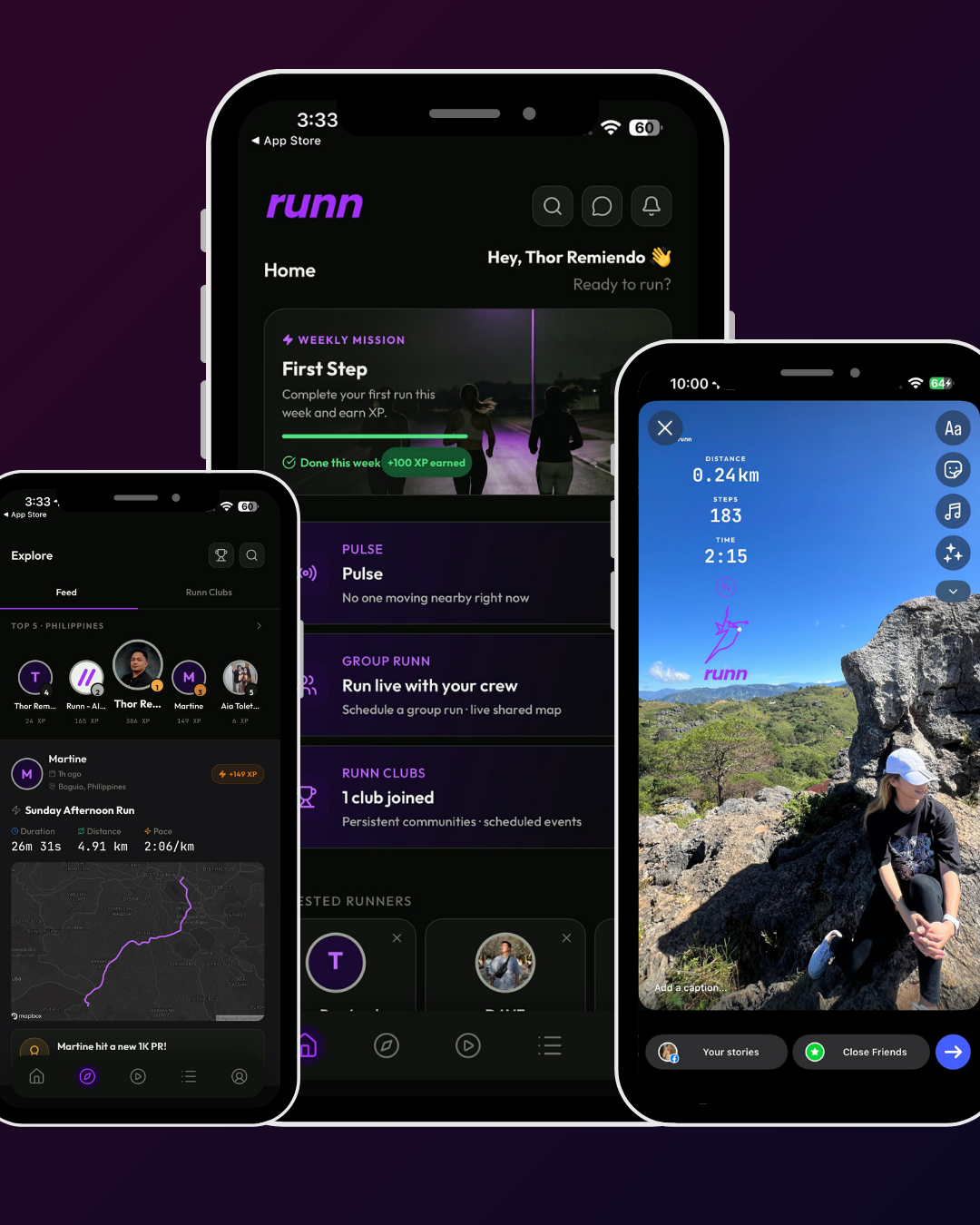
What He Shipped
Runn is live on the iOS App Store as of May 2026. The feature set is complete and in production:
GPS tracking with AI-powered run debriefs after every session
Race time predictions based on actual training data
AI chat coach that answers natural language questions about performance
Weekly missions and seasonal XP with tier rankings and streaks
Run clubs and group runs with live location sharing
Community feed and share cards for social engagement
Android is in closed testing. Everything from design, code, backend infrastructure, to App Store submission was built and shipped by one person.
That last sentence is the one worth sitting with. A full-featured, AI-powered, social running app with a live backend, GPS integration, gamification systems, and community features, built solo, from Baguio City, by a founder who was also the designer, marketer, community manager, and support team.
The Hardest Part of Building Alone
"Scope discipline," Thor says without hesitation.
When you are a solo builder, every yes is a no somewhere else. Every feature added is another feature delayed. Thor had to learn to cut ruthlessly, to ship the smallest version that worked, put it in front of real people, and only build more when the data or the feedback told him to. That discipline, resisting the pull toward completeness in favor of the discipline of shipping, is what got Runn from idea to App Store.
The other challenge is the one every solo founder knows but rarely names cleanly: wearing every hat at once. Developer, designer, marketer, community manager, support. Each role demands full attention. None of them can wait. And all of them land on one person's calendar every single day.
Why He Keeps Building
"I just love building things. Going from a blank screen to a product real people download and use, that never gets old."
There is a second reason, quieter but just as present. Thor wants to show that you do not need to be in a tech hub, or have a big team, or relocate to Manila to ship something legitimate. Runn is his proof of that. A real product, on a real app store, built by one person in Baguio City, because the internet does not care what city you are in.
What Is Next
The next 6 to 12 months are focused on the Android launch, growing the user base, and deepening the AI coaching layer. A conversational AI coach is in development, one that lets runners ask natural language questions about their training data and get meaningful, contextual answers. Long term, Thor wants Runn to be the app people switch to when they finally realize their current app is not actually helping them get better.
He is also looking to partner with local event organizers and run clubs in Baguio and across Northern Luzon to grow the community and shape what gets built next. If you organize run events or manage a run club, Runn wants to hear from you.
His advice to every founder in the region is the same discipline he applied to his own product:
"Stop planning and start building. The gap between 'I have an idea' and 'it's live on the App Store' is smaller than you think if you're willing to ship ugly first versions. Use AI tools, use cloud services, use whatever gets you to a working product faster. And don't wait to move to Manila or anywhere else. Build from where you are. The internet doesn't care what city you're in."
Find Runn:
Available on the iOS App Store now. Android coming soon. For run club and event organizer partnerships, contact Thor directly at thorremiendo@gmail.com. Website: https://join-runn.app/
What Builders Can Learn From Thor Remiendo
Lesson 1 — The best products are built by their own frustrated users.
The most reliable product validation is personal. Thor did not conduct user interviews or run surveys to confirm the problem existed. He was the user. He felt the gap repeatedly, specifically, and in real time. That lived frustration is more valuable than any market research because it is already validated before a single line of code is written. You know the problem is real because you are the person who has it. The remaining question is not whether the problem exists. It is whether enough other people share it. For a product built around running, a sport with hundreds of millions of active participants worldwide, the answer was obvious.
The lesson: If you are your own target user and existing solutions genuinely fail you, that frustration is your product brief. Build the thing you actually needed. Then find the others who needed it too.
Lesson 2 — Shipping ugly beats planning perfect.
The most repeated instruction in serious startup culture is to launch earlier than feels comfortable. Thor internalized this completely. Getting Runn to the App Store required cutting scope ruthlessly at every stage: shipping the smallest version that worked, putting it in front of real users, and only building more when the data or feedback justified it. The alternative — building in private until everything feels polished — is how solo founders spend 18 months on a product nobody downloads. Thor chose the harder psychological path: shipping before it felt ready, then iterating based on what real users actually did with it.
The lesson: Your first version is not your final version. It is your first experiment. The goal is not to be impressive on launch day. The goal is to be in the market, learning, while everyone else is still in a planning document.
Lesson 3 — Geography is not your constraint. Scope is.
Software has made location largely irrelevant for product builders. What limits solo founders is not their city. It is their willingness to say no to features, resist the pull of complexity, and stay focused on the one thing that makes the product worth downloading. Thor built a full-stack, AI-powered, social running app with live GPS, gamification systems, and a community feed — alone, from Baguio City — using cloud infrastructure and AI development tools that made a team of one viable in a way that was not possible a decade ago. The constraint was never the location. It was always the scope, and he managed it better than most funded teams do.
The lesson: Stop waiting for a better city, a co-founder, or a bigger budget. Use the tools available now, ship from where you are, and let the product speak for itself. The App Store does not ask for your address.
Are you a founder, innovator, or community builder in Northern Luzon?
We're always looking for compelling stories from the region's ecosystem. Whether you're launching a startup, running a program, or doing something interesting — we'd love to feature you.