
For 20 Years, Fe Valdez Resold Other People's Salt. Today, She Leads the Association That Makes It.
The story of how DTI and BFAR turned the salt-making community of Barangay Calongbuyan, Candon City, Ilocos Sur from informal resellers into a compliant, market-linked production enterprise, and what it means for the Philippine salt industry's national revival.
 Featured
Amianan Ventures
Fe Valdez, 55, of Barangay Calongbuyan in Candon City, Ilocos Sur, spent two decades buying salt and fermented fish sauce from local producers and reselling them to earn a living. She had no production equipment, no formal compliance credentials, and no direct market access. She was a link in a chain that someone else controlled.
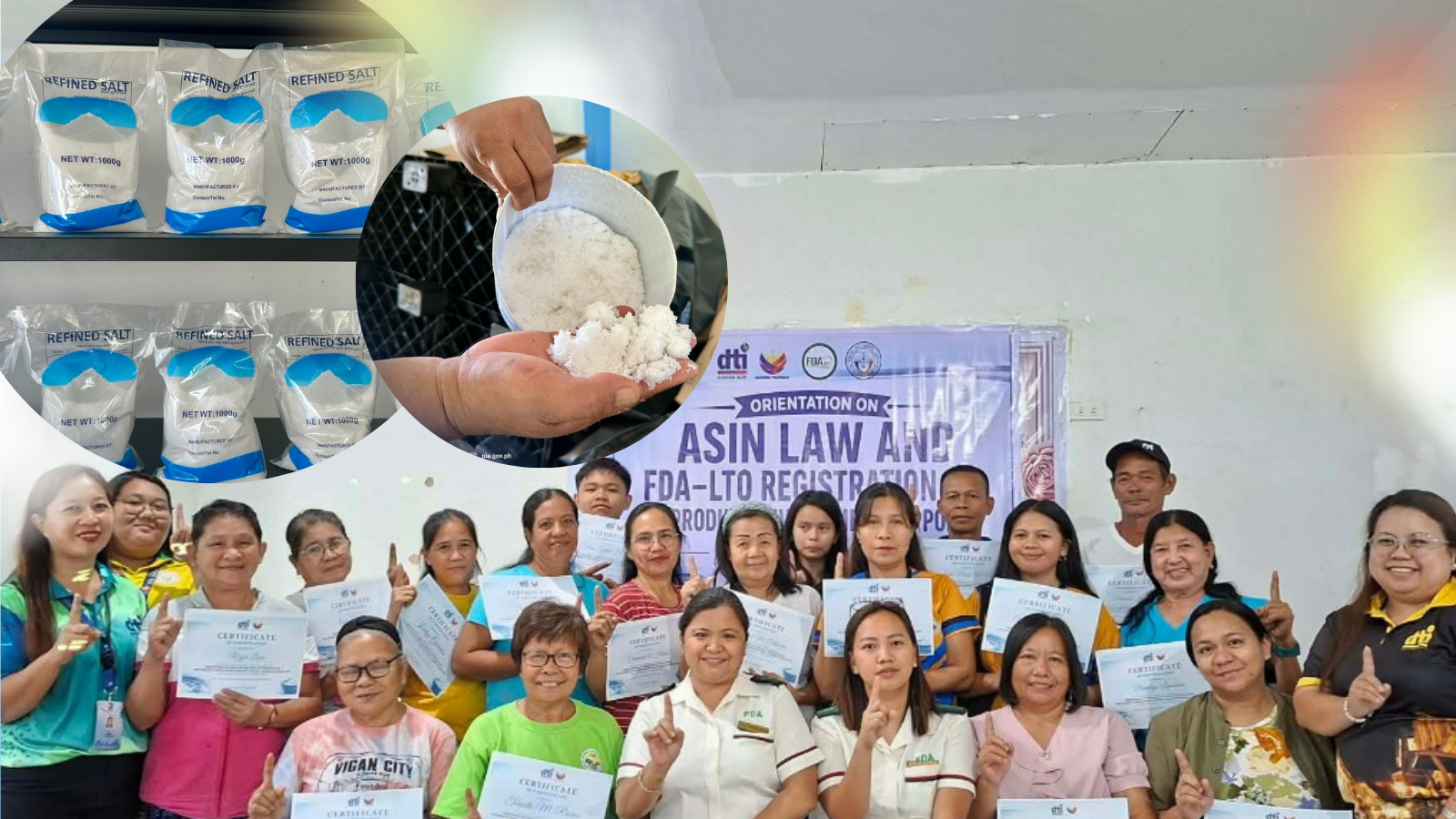
Today, she is president of the Barangay Calongbuyan Salt Makers Association, and the association she leads makes its own salt, labels its own products, and sells directly into formal markets. Three of her children completed college on income from that business. A grandchild is in Grade 9.
That arc, from informal reseller to production enterprise president, did not happen by accident. It happened because the government showed up with equipment, training, regulatory guidance, and market connections, and stayed long enough for it to matter.
What Candon City's Salt-Making History Actually Looks Like
Barangay Calongbuyan sits in Candon City, known nationally as the Tobacco Capital of the Philippines. What most people outside Ilocos Sur do not know is that Calongbuyan has a multi-generational salt-making history that nearly disappeared. The laborious traditional methods used by local producers, combined with the absence of modern equipment and market support, pushed the industry toward collapse. Salt makers were on the verge of abandoning a livelihood their families had sustained for generations.
BFAR Region 1 moved first, deploying the Development of Salt Industry Project to the Calongbuyan Fishermen Association in 2025, providing capability-building training and technology support that produced 5,226 kilograms of salt in early production runs, earning PHP 209,040 in sales. The Candon City LGU followed with a PHP 3 million two-storey processing building with cooking structures to boost capacity. DTI then layered in its full enterprise development programme through the Barangay Calongbuyan Salt Makers Association, the formal MSME body that Fe Valdez now leads.
What DTI Actually Delivered
The DTI Ilocos Sur intervention for BCSMA was comprehensive and sequenced across three distinct tracks.
The first track was equipment access through the Shared Service Facilities programme, a flagship DTI initiative that provides eligible cooperators with machinery and equipment under a shared system, reducing the capital barrier for individual MSME operators. BCSMA received digital salinators, weighing scales, sealing machines, water pumps, storage systems, and processing barrels. The SSF for the development of the Calongbuyan salt industry was formally launched on July 11, 2025, with DTI Region 1 and the City Government of Candon as co-signatories.
The second track was product development and market readiness. DTI's Product Development Program introduced professional packaging and labeling support, giving the association the visual and technical presentation required to compete in formal retail and institutional markets, not just local markets and informal trade.
The third track was compliance, the most structurally important and historically most neglected dimension of Philippine salt producer development. BCSMA underwent capacity-building sessions covering the ASIN Law, or Republic Act No. 8172, which mandates iodization of all food-grade salt and imposes administrative fines of PHP 1,000 to PHP 100,000 on violators. Producers also received training on Current Good Manufacturing Practices and hands-on assistance in securing FDA License to Operate documentation. These are the compliance credentials that separate informal production from a business that can legally sell to supermarkets, school feeding programs, and institutional buyers.
"We are grateful for the continuous support because it helps us improve the quality of our products and guides us in securing the necessary permits and market requirements," Valdez said. "Their biggest contribution was connecting us to the right markets. Because of this, our income and sales have grown".
Why This Story Connects to the National Salt Crisis
The Philippines currently imports 80 to 90% of its salt requirements despite having the coastline, climate, and tradition to produce far more domestically. National production peaked at 300,000 metric tons in 1994 and has declined sharply since, driven by inadequate producer support, compliance costs, market structure, and climate vulnerability.
The ASIN Law, enacted in 1995, has historically been cited as both a public health achievement and a structural burden on small-scale producers who lack the equipment to iodize salt and the resources to meet FDA LTO requirements. The DTI-BFAR intervention in Calongbuyan addresses exactly this tension: by providing the iodization equipment and compliance guidance simultaneously, it removes the barriers that have kept informal producers from entering the formal market.
This is the same logic behind the national DOST-ASIN Programme, in which MMSU, PSU, DMMMSU, and President Ramon Magsaysay State University are conducting research on salt production mapping, technology, and yield estimation to build the science base for a national salt revival. The Calongbuyan intervention is that national programme's community-level parallel: not research, but implementation, in the barangay where the salt actually gets made.
What This Means for Northern Luzon
The DTI SSF model deployed in Calongbuyan is replicable across every salt-producing community in Ilocos Region and beyond. DTI has already launched a PHP 50 million SSF at MMSU in Ilocos Norte for the broader salt and agri-processing sector. La Union's salt and pottery industries have SSFs operational as of January 2025. Antique province deployed its SSF for salt in October 2025, enabling year-round production for a community that previously operated seasonally.
The pattern is clear and the funding mechanism exists. What the Calongbuyan story demonstrates is that equipment alone is not enough. The sequenced combination of SSF equipment, product development support, and compliance assistance, delivered with sustained presence rather than a one-time deployment, is what turns a reseller into a producer and a producer into a compliant enterprise with growing sales.
For salt-making communities in Ilocos Norte, La Union, and Pangasinan that are still operating informally or at subsistence level: the DTI SSF programme, BFAR's DSIP, and the LGU-DTI partnership model that built the Calongbuyan facility are available entry points. The path Fe Valdez took is documented, funded, and replicable.
Original Source:
Market Context:
The Philippines imports 80 to 90% of its national salt requirements despite producing 300,000 metric tons annually at peak in 1994, with import dependency driven by producer support gaps, compliance barriers, and market structure failures that DTI and BFAR programmes like those in Calongbuyan directly address. DTI's Shared Service Facilities programme has supported over 2,240 facilities nationwide, creating 122,135 jobs and serving 241,813 MSME beneficiaries, with salt industry SSFs now operational in Ilocos Sur, La Union, Ilocos Norte, and Antique as part of the Philippine Salt Industry Development Act implementation. BFAR Region 1's DSIP intervention in Calongbuyan produced 5,226 kilograms of salt in early production runs, earning the association PHP 209,040 in sales, with a PHP 3 million LGU-funded processing building further expanding capacity. The ASIN Law, Republic Act No. 8172, requires all food-grade salt producers to iodize their products and imposes fines of PHP 1,000 to PHP 100,000 on violators, creating compliance infrastructure requirements that SSF and capacity-building interventions like DTI's Calongbuyan programme are designed to help small producers meet.
Are you a founder, innovator, or community builder in Northern Luzon?
We're always looking for compelling stories from the region's ecosystem. Whether you're launching a startup, running a program, or doing something interesting — we'd love to feature you.