
DICT-CAR Brings AI-Powered Productivity Tools to Nearly 600 Participants Across the Cordillera
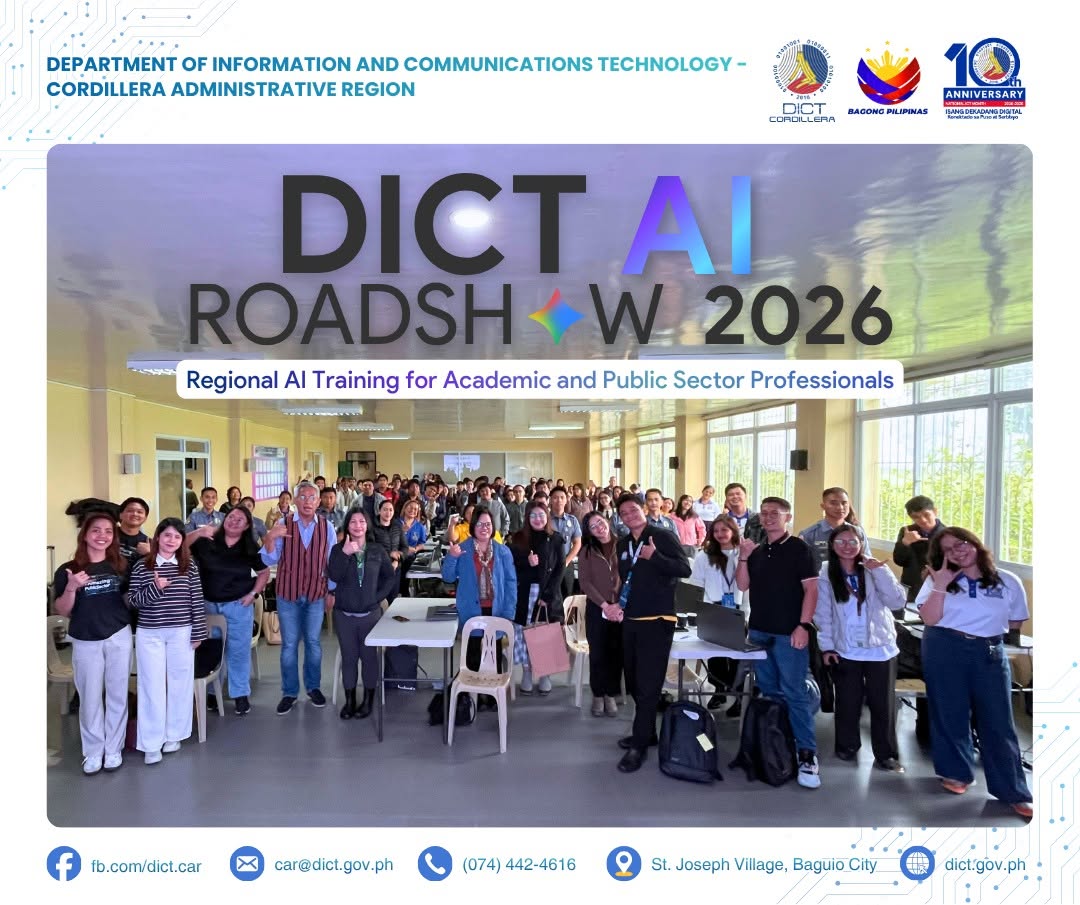
The DICT AI Roadshow 2026: AI-Enabled Productivity and Collaboration with Gemini for Google Workspace brought together nearly 600 online participants and onsite representatives from government, local governments, universities, and educational institutions to explore practical applications of artificial intelligence for workplace productivity, collaboration, and digital transformation.
 Featured Partner
Inv8 Studio
Innovation Partner for Startups & Growing Businesses
AI Skills Are Becoming Part of the Modern Workplace
Artificial intelligence is increasingly becoming a practical tool for how organizations work, communicate, manage information, and deliver services.
Recognizing the need to strengthen AI literacy across the region, the Department of Information and Communications Technology – Cordillera Administrative Region (DICT-CAR), in partnership with Google Workspace Southeast Asia, Maroon Studios, Inc., and Benguet State University (BSU), conducted the DICT AI Roadshow 2026: AI-Enabled Productivity and Collaboration with Gemini for Google Workspace on August 4, 2026.
Conducted through a hybrid learning platform, the event brought together nearly 600 online participants, alongside onsite representatives from regional line agencies, local government units, state universities and colleges, educational institutions, and DICT personnel across the Cordillera.
The roadshow focused on practical applications of AI and how emerging tools can support productivity, collaboration, and digital innovation.
Responsible AI Adoption Starts With Practical Skills
In his opening message, DICT-CAR Regional Director Jimmicio S. Daoaten emphasized the importance of innovation and continuous learning while highlighting the Cordilleran values of binnadang and inayan.
He stressed that artificial intelligence should be used responsibly and ethically to improve lives, strengthen communities, and support more responsive, inclusive, and citizen-centered public services.
This framing is important as organizations move from simply experimenting with AI toward integrating it into everyday workflows.
AI adoption is not only about having access to new tools. It also requires people to understand where these technologies can create value, how to use them responsibly, and where human judgment remains essential.

Exploring Gemini for Google Workspace
The learning sessions began with the AI-MAZING Public Sector Gemini Workshop, facilitated by Ms. Christiane Ross Lombos.
Through live demonstrations and hands-on activities, participants were introduced to the capabilities of Gemini for Google Workspace and explored how AI-powered tools can support everyday work.
The workshop demonstrated applications involving:
Workflow streamlining
Content creation
Research assistance
Workplace productivity
Collaboration
For public sector organizations and other institutions managing large volumes of information and administrative tasks, these applications can potentially reduce repetitive work and allow employees to focus more time on higher-value activities.
Enterprise AI and Responsible Adoption
The program continued with the Gemini for Enterprise session led by Engr. Paul Adrian Puzon.
The discussion focused on Google’s enterprise AI solutions, including responsible AI adoption, enterprise-grade security, and data privacy considerations.
As organizations increasingly explore AI for business and institutional use, these considerations become critical. Productivity gains need to be balanced with appropriate safeguards around information, data, and organizational processes.
For businesses and startups, this is particularly relevant as AI becomes embedded into customer service, marketing, operations, product development, and internal workflows.
NotebookLM Demonstrates AI for Knowledge Management
The final learning session featured Ms. Jing Berry Nino of the DICT-ICT Literacy and Competency Development Bureau (ILCDB), who demonstrated practical applications of NotebookLM in supporting ILCDB programs and initiatives.
The demonstration encouraged participants, particularly DICT personnel, to explore AI-enabled tools for productivity, collaboration, and knowledge management.
This highlights another growing application of AI within organizations: helping people work with the information they already have.
Instead of simply generating new content, AI tools can also help users organize, understand, summarize, and interact with existing knowledge and documents.
What This Means for Northern Luzon’s Innovation Ecosystem
AI adoption is becoming an important component of regional competitiveness.
For Northern Luzon, building AI capabilities across government, universities, businesses, and communities can create opportunities to improve not only productivity but also how organizations develop new products, services, and solutions.
For startups and entrepreneurs, widespread AI literacy can lower the barriers to building technology-enabled businesses. Founders can use AI to accelerate research, content development, customer discovery, software development, operations, and other aspects of venture building.
For government and universities, AI can support more efficient services, research, knowledge management, and collaboration.
But the long-term value of AI adoption will depend less on how many organizations use AI and more on how effectively they apply it to meaningful problems.
This makes initiatives focused on practical AI literacy particularly relevant to the region’s innovation ecosystem. They help move AI from a high-level technology conversation into something people can understand, experiment with, and apply to their actual work.
Building an AI-Ready Cordillera
The DICT AI Roadshow demonstrates the importance of collaboration among government, academia, and industry in preparing communities for an increasingly AI-enabled economy.
With nearly 600 online participants and representatives from institutions across the Cordillera, the initiative provides a foundation for broader conversations around responsible AI adoption and digital transformation.
As AI continues to reshape how organizations operate, regions that invest in both technology and human capability will be better positioned to capture its opportunities.
For the Cordillera, the opportunity is not simply to become an adopter of AI technologies. It is to develop people and institutions capable of using AI thoughtfully to solve local problems, improve services, build businesses, and create new forms of innovation.
AI adoption starts with access to technology, but meaningful transformation starts when people know how to use it well.
The challenge for the Cordillera now is to turn AI literacy into practical capability, and practical capability into better services, stronger enterprises, and locally relevant innovation.
Original Source
This article is based on information provided by the Department of Information and Communications Technology – Cordillera Administrative Region (DICT-CAR) regarding the DICT AI Roadshow 2026: AI-Enabled Productivity and Collaboration with Gemini for Google Workspace, conducted on August 4, 2026.
The initiative was conducted in partnership with Google Workspace Southeast Asia, Maroon Studios, Inc., and Benguet State University.
Market Context
Artificial intelligence is increasingly becoming a general-purpose technology that organizations can apply across research, operations, customer service, content creation, software development, and knowledge management. For businesses and startups, AI can reduce the cost and time required to perform many knowledge-intensive tasks, while for government and educational institutions it can support productivity and service delivery. However, effective adoption requires more than access to AI tools. Organizations also need digital skills, responsible-use practices, data governance, and the ability to identify high-value use cases. For Northern Luzon, strengthening AI literacy across government, academia, industry, and communities can help build the human capabilities needed to participate more actively in the emerging AI economy.
Are you a founder, innovator, or community builder in Northern Luzon?
We're always looking for compelling stories from the region's ecosystem. Whether you're launching a startup, running a program, or doing something interesting — we'd love to feature you.