
A Magnitude 7.8 Earthquake Just Hit Sarangani. It Is a Reminder That Coastal Communities in Northern Luzon Need Warning Systems That Work When the Power Goes Out.
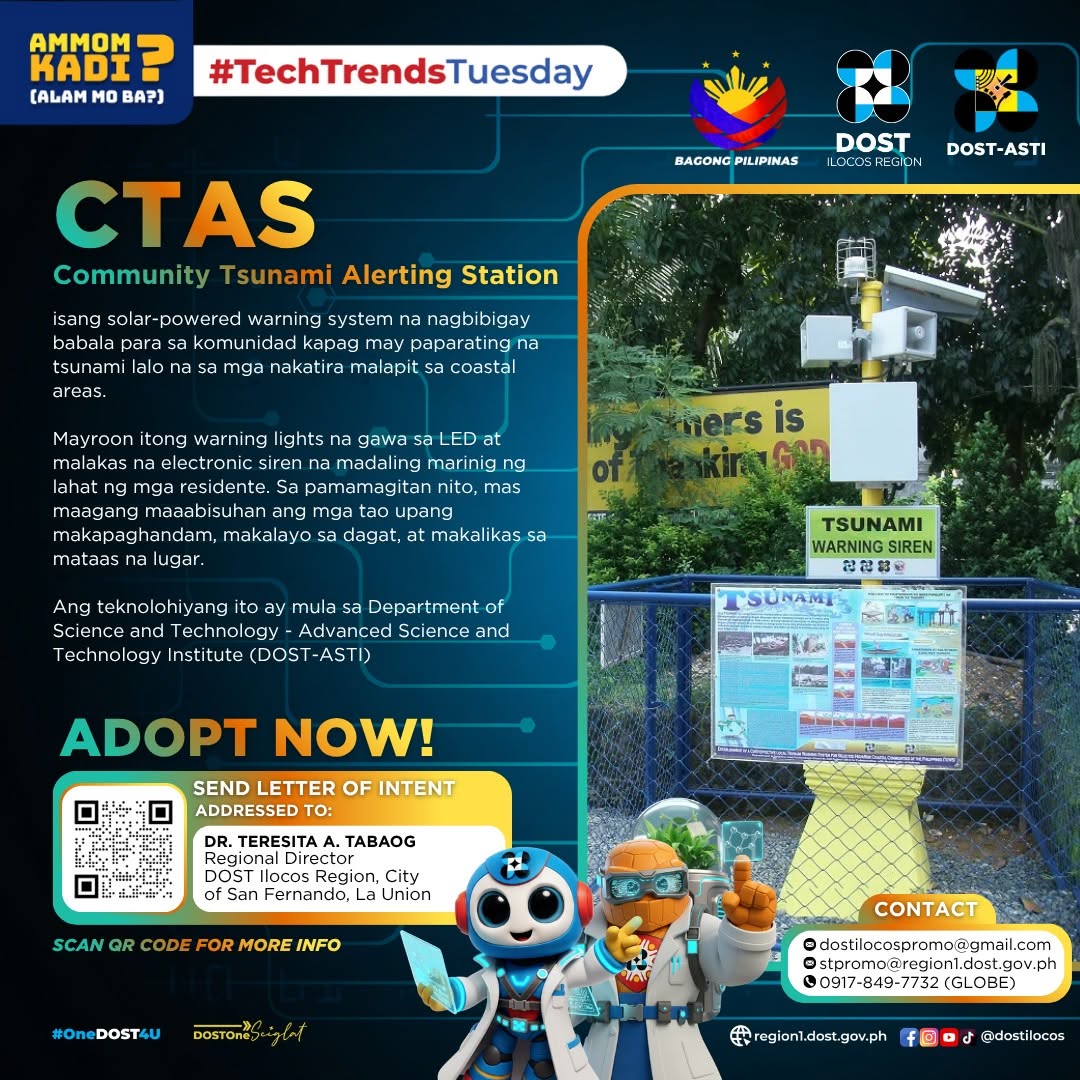
The DOST Advanced Science and Technology Institute developed the Community Tsunami Alerting Station, a solar-powered warning system with LED warning lights and an electronic siren designed to alert coastal communities of incoming tsunamis even during power outages, and it is now available for adoption through DOST Ilocos Region.
 Featured
Amianan Ventures
On June 8, 2026, a magnitude 7.8 earthquake struck off the coast of Maasim, Sarangani, making it the strongest earthquake recorded in the Philippines this year. The tremor was strong enough to generate tsunami waves in several areas following the initial shaking. It was, by any measure, a worst-case scenario for coastal communities in the affected zone: a powerful undersea earthquake followed by waves that arrived with little time for evacuation.
The Philippines sits on the Pacific Ring of Fire and is consistently ranked among the world's most disaster-prone countries. The Ilocos coastline, the shores of La Union and Pangasinan, and the coastal communities of Cagayan and Isabela face the same fundamental vulnerability that Sarangani faced on June 8: proximity to the sea and insufficient time between warning and wave.
There is a technology designed specifically for this problem. It is available for adoption right now. And the window to put it in place before the next event is the time between today and whenever that event arrives.
What the CTAS Is
The Community Tsunami Alerting Station is a solar-powered warning system developed by the Department of Science and Technology through its Advanced Science and Technology Institute. It is designed to provide early warning to residents in coastal communities when a tsunami is incoming, with two alert mechanisms: LED warning lights and a high-powered electronic siren loud enough for all residents in the area to hear.
The solar-powered design solves a problem that most emergency systems fail to address adequately. Earthquakes frequently damage power infrastructure. A warning system that depends on grid electricity may be non-operational at exactly the moment it is most needed. The CTAS runs on solar power, which means it remains fully operational during a power outage, including the power outages most likely to accompany the very earthquakes that could trigger a tsunami.
There is also an often-overlooked dimension to tsunami risk that the CTAS addresses. Not every tsunami is preceded by a locally felt earthquake. Tsunamis can be triggered by distant seismic events and arrive at a coastline where residents felt no shaking whatsoever. In that scenario, the absence of ground movement gives communities no natural warning cue. A dedicated alerting system is the only mechanism that closes that gap.
Why Northern Luzon's Coastal Communities Need This Conversation Now
The Ilocos Region has more than 700 kilometers of Pacific and South China Sea coastline. La Union, Pangasinan, Ilocos Sur, and Ilocos Norte all have municipalities where fishing villages, tourism infrastructure, and residential communities sit within immediate reach of the waterline. The same is true for Cagayan and Isabela along the Pacific coast, which faces open ocean exposure to tsunamis generated anywhere along the Ring of Fire.
The June 8 Sarangani earthquake is a concrete reminder of how quickly these scenarios materialize. The time between an undersea earthquake and tsunami arrival at a nearby coast can be as short as a few minutes. In that window, the difference between an orderly evacuation and a casualty event is almost entirely determined by how fast the warning reaches the people who need to move, and how clearly that warning is communicated.
LED warning lights are visible at night and in conditions where audio signals may not be audible to everyone. An electronic siren at sufficient decibels penetrates buildings, reaches people on the water, and alerts residents who may not be monitoring phones or radios. The combination of both in a single, solar-independent unit is a practical emergency communication solution that can be deployed at the community level, at the barangay level, in ports and fishing communities, and at coastal resort and tourism zones.
How to Adopt the CTAS
The Community Tsunami Alerting Station is available for adoption by LGUs, barangays, cooperatives, and organizations in the Ilocos Region. The adoption process begins with a Letter of Intent addressed to Dr. Teresita A. Tabaog, Regional Director of DOST Ilocos Region, at the DOST Ilocos Region office in the City of San Fernando, La Union.
For questions about the technology, the adoption process, and the support DOST Ilocos Region provides to adopters:
Email: stpromo@region1.dost.gov.ph
Email: dostilocospromo@gmail.com
Phone: 0917-849-7732 (Globe)
Website: techub.dost.gov.ph
The DOST TecHub platform at techub.dost.gov.ph lists the full range of DOST-ASTI and other agency technologies available for adoption across sectors.
The Larger Point
Disaster preparedness infrastructure in Philippine coastal communities has historically been uneven. National agencies and large urban centers tend to have systems. Smaller municipalities, fishing barangays, and rural coastal communities frequently do not. The CTAS is designed specifically for community-level deployment, which means it addresses the gap at exactly the right scale.
The Sarangani earthquake is not unique. It is one in a series of high-magnitude seismic events that the Philippine fault system produces regularly, and it will not be the last. For LGUs in the Ilocos Region and across Northern Luzon's coastlines, the question is not whether a major seismic event will affect the region. The question is whether the warning systems will be in place when it does.
The technology exists. The adoption pathway is open. The Letter of Intent takes an afternoon to write. The window to act is now.
Original Source
This article is based on the technology announcement published by DOST Ilocos Region and DOST-ASTI regarding the Community Tsunami Alerting Station, and on reports of the June 8, 2026 magnitude 7.8 earthquake off Maasim, Sarangani. We are grateful for the original information that brought this technology and this event to public attention.
Market Context
The Philippines experiences an average of five magnitude 6.0 or higher earthquakes per year, and its Pacific coastline faces exposure to tsunamis generated by seismic activity anywhere along the western Pacific Ring of Fire. The DOST-ASTI Community Tsunami Alerting Station is part of a broader portfolio of disaster risk reduction technologies developed by DOST agencies specifically for Philippine community-level deployment, recognizing that national-level warning systems alone are insufficient to reach every coastal resident with enough lead time for effective evacuation. For Northern Luzon, which includes over 700 kilometers of combined coastline across the Ilocos Region and the Pacific-facing provinces of Cagayan and Isabela, community-level alerting infrastructure represents one of the most direct investments an LGU can make in the safety of its coastal residents. Solar-powered independence from grid electricity is a critical design requirement in a country where earthquakes frequently damage power infrastructure in the same moment they generate tsunami risk.
Are you a founder, innovator, or community builder in Northern Luzon?
We're always looking for compelling stories from the region's ecosystem. Whether you're launching a startup, running a program, or doing something interesting — we'd love to feature you.