
Before You Look for Investors, Look for Customers
Before founders raise capital, they need evidence that they are solving a real problem. This article explores the case for customer validation before fundraising, the strengths and limitations of bootstrapping, and how founders can choose the right type of capital at the right stage of their journey.


Leandro Gepila
Founder / Co-founderInv8 Studio · cordillera
Product & Innovation Operator based in Baguio. I work with founders, institutions, and teams to turn ideas into validated products and build structured innovation programs that drive real outcomes.
 Featured
Amianan Ventures
Most first-time founders think the journey goes like this: have an idea, find an investor, build the startup.
That sequence is not wrong in every case. But for most founders, especially those building from outside a major financial hub, it is the wrong starting point.
The founders who build lasting companies almost always do one thing before they raise money: they reduce uncertainty. They find out whether the problem is real, whether people want the solution, and whether the business model holds together. Only then do they ask someone else to fund it.
This article is about that process. It is sometimes called bootstrapping. But the more important word is validation. And understanding the difference between the two might change how you think about the entire early stage of building a company.
What Bootstrapping Actually Means
Bootstrapping means building a company using your own resources (revenue from customers, personal savings, or both) without relying on outside investment to survive.
It does not mean being broke. It does not mean doing everything yourself forever. It means your first source of capital is the market, not a venture capitalist.
The term comes from the old phrase "pulling yourself up by your bootstraps." The startup world uses it to describe founders who fund their own growth rather than depending on external money to stay alive.
This is how most successful businesses in the world are built. But bootstrapping is not the point. The point is what bootstrapping forces you to do: figure out what your business actually is before asking other people to bet on it.
The Problem with "Find an Investor First"
This is not an argument that investors are bad. Some of the best outcomes in startup history happened because a great investor wrote a check at exactly the right moment. Sequoia's early investment in Apple. Benchmark's bet on Uber. Andreessen Horowitz backing GitHub. Capital, deployed at the right time by the right partner, genuinely accelerates things.
But "the right time" is doing a lot of work in that sentence.
When a founder's first move is to pitch investors before validating the idea, several predictable problems emerge.
You optimize for the wrong feedback. Investors evaluate potential. Customers evaluate whether something actually solves their problem. These are not the same thing. A founder can spend months refining their pitch, collecting promising signals from investors, and building a deck that generates meetings, while learning almost nothing about whether the product will work in the real world. Investor feedback feels like progress. It often is not.
You build before you know what to build. The pressure to show investors a product leads founders to build too early, before they understand what problem they are actually solving. Steve Blank, one of the foundational thinkers behind the Lean Startup movement, calls this "premature scaling" and identifies it as the primary cause of early startup failure. Building a product is not progress if you are building the wrong thing.
You give up leverage before you have earned it. Investors fund companies that have proven something. A founder who arrives with nothing but an idea either gets rejected or accepts unfavorable terms. A founder who arrives with paying customers, signed pilots, or measurable traction negotiates from a fundamentally different position. The product you are selling in that meeting changes completely.
You inherit someone else's timeline before you understand your own. When you take investment, you are now accountable to your investors' goals, not just your own. For many founders, that accountability is healthy and useful. But it only works when both sides want the same thing. And you cannot know what you want until you know what your business actually is. Taking money before you know that locks you into a path before you have chosen it.
The Reality of Having an Investor
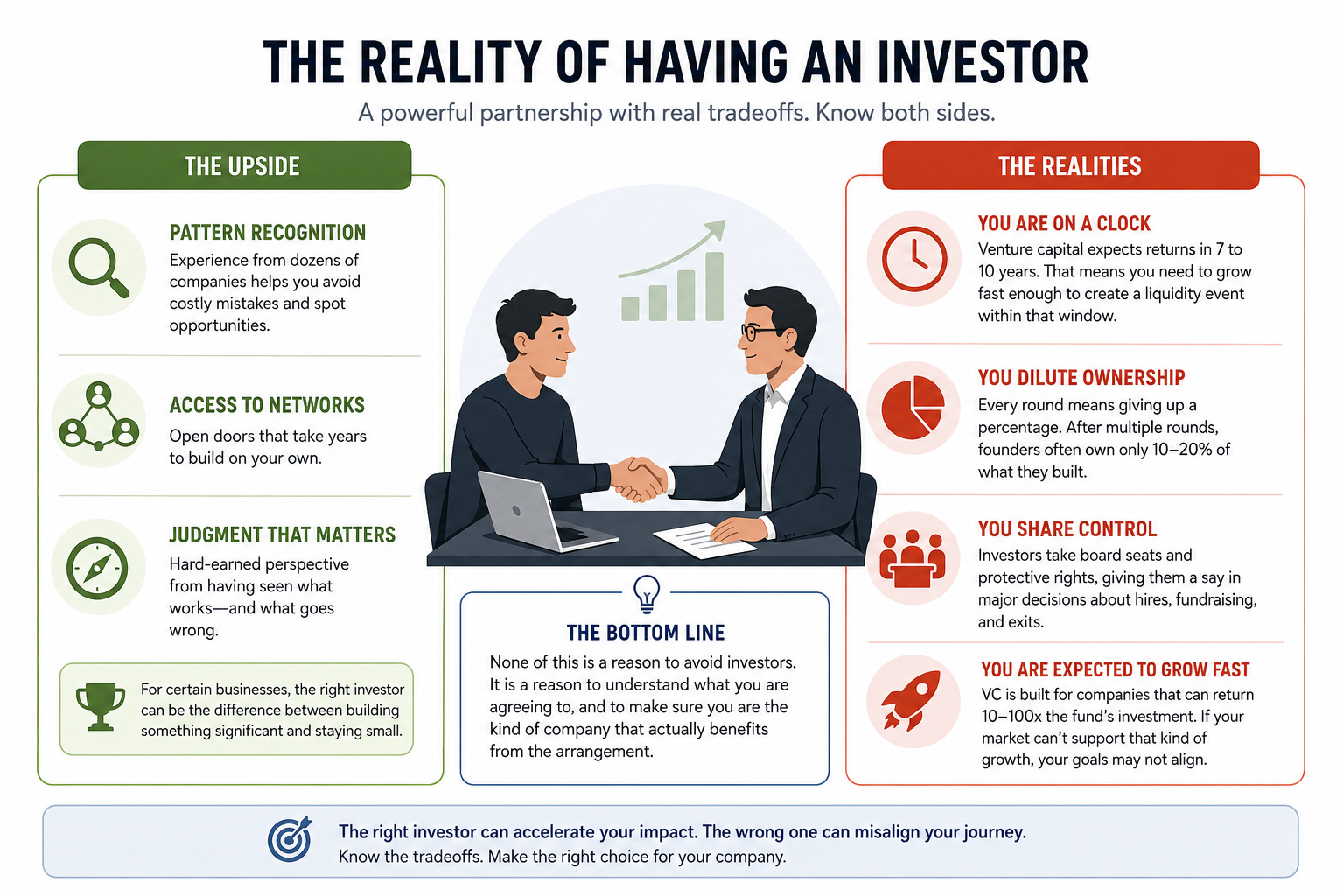
A good investor is one of the most valuable partners a founder can have. The best ones bring pattern recognition from dozens of companies, access to networks that take years to build independently, and the kind of judgment that only comes from having seen things go wrong before. This is not a small thing. For certain businesses, it is the difference between building something significant and building something that stays small.
It is worth being honest about the full picture, though.
You are on a clock. Venture capital is structured to produce returns within a specific window, typically 7 to 10 years. That means your investor needs you to grow fast enough to create a liquidity event (a sale, a merger, or an IPO) within that timeframe. If your business is healthy and profitable but growing slowly, that is a problem for your investor even when it is not a problem for you.
You dilute your ownership. Every round of funding means giving up a percentage of the company. Founders who raise multiple rounds can end up owning 10 to 20 percent of what they built. That is not inherently bad (15 percent of something large is still meaningful) but it is a real tradeoff that compounds with every subsequent round.
You share control over major decisions. Investors often take board seats and protective provisions that give them a say in significant decisions: who you hire into leadership, when you raise again, whether and when you sell. For some founders, this structure adds useful discipline. For others, it creates genuine conflict about direction. Either way, the company is no longer entirely yours to steer.
You are expected to grow fast. Venture capital is not designed for lifestyle businesses, for regional companies growing at a measured pace, or for founders who want to build something sustainable over a long time horizon. It is designed for companies that can return 10 to 100 times the fund's investment. If your market does not support that kind of growth, you and your investor will eventually want different things from the same company.
None of this is a reason to avoid investors. It is a reason to understand what you are agreeing to, and to make sure you are the kind of company that actually benefits from the arrangement.
Validation Is the Real Goal
Steve Blank's core teaching is this: a startup is not a small version of a big company. It is a temporary organization searching for a repeatable, scalable business model.
The word "searching" is the important one.
In the early days, you do not know your business model. You have a hypothesis. Your job is to test it against the real world as cheaply and quickly as possible before committing major resources to it.
This is what validation means. And it is broader than most founders assume.
Validation is not just revenue. Revenue is one form of validation, usually the clearest one. But a business can also reduce uncertainty through:
Customer interviews that reveal a pattern: many different people describing the exact same problem in the same words
Pilot projects where a real organization tests your solution and measures results
Letters of intent from buyers who are ready to pay once the product is ready
A waiting list that converts at a meaningful rate when you actually launch
A partnership with an institution that signals market credibility
Research outcomes that establish technical feasibility for a hard problem
Signed agreements that de-risk a critical assumption before you build
The question is not "do I have paying customers yet?" The question is: what do I still not know about this business, and what is the cheapest way to find out?
Y Combinator partner Michael Seibel describes this as finding the "hair on fire" problem, a problem so urgent that the person experiencing it will try anything to solve it. If your early conversations reveal that kind of urgency, and you can document it consistently across many conversations, that is validation. If people describe the problem as a mild inconvenience, you need to dig deeper.
Eric Ries, author of The Lean Startup, frames the goal as maximizing validated learning per dollar spent. Not building as much as possible. Not growing as fast as possible. Learning what is true about the market before betting everything on an assumption.
That is the mindset shift. Fundraising feels like progress. Validation actually is progress.
"But I Actually Need Money to Build the Thing"
This is the most common pushback, and it deserves a direct answer.
Some ideas feel like they require capital before anything can be tested. A hardware device. A platform that only works at scale. A product that requires specialized equipment, regulatory approval, or a laboratory. The objection is: "I cannot validate without a prototype, and I cannot build a prototype without money."
That is sometimes true. But less often than founders assume.
The first question to ask is: what is the minimum amount of product that lets me test the most critical assumption? Not the full product. Just the piece that answers the question whose answer would change everything.
Eric Ries calls this the Minimum Viable Product, but the word "product" is misleading. An MVP is not a cheap version of what you want to build. It is a question disguised as a product. Before writing a single line of code or assembling a single component, ask: what is the one assumption that, if wrong, makes this entire idea worthless? Then find the cheapest possible way to test that assumption.
In practice, that looks like this:
Use a signal instead of a product. Dropbox validated their cloud storage idea with a three-minute explainer video before a single feature was built. Thousands of people signed up. That was enough to justify building the actual product. You do not need the product to test demand for the product.
Do it manually before automating it. Before building a marketplace, connect buyers and sellers yourself. Before building a logistics app, use a spreadsheet and a phone call. Y Combinator calls this "doing things that don't scale," and it works because it teaches you how the process actually works before you automate it. The goal is not efficiency first. It is proof that the process works at all.
Sell it before it exists. Show a potential customer a mockup, a diagram, a demo video, then ask if they will sign a letter of intent or pay a deposit. A customer who commits resources before the product exists is one of the strongest validation signals available.
Build only the critical core. If you genuinely need to build something to test the idea, build only the part that tests your most dangerous assumption. A taped-together 3D-printed prototype can reveal whether a physical product concept resonates. A no-code tool can test whether a software workflow solves the problem, before you hire engineers to build the real version.
If you have done all of this and still need capital to build the next version, your options extend well beyond venture capital. Government grants through DOST, DTI, and CHED programs are non-dilutive: you do not give up equity. For founders in Northern Luzon, programs like DOST-CAR's i.Hub, SILBI, and the ConRes TBI exist specifically for this stage. Friends and family rounds, crowdfunding, and revenue-based financing are other paths that do not require giving away control.
The principle is this: separate the question of what you need to build from the question of what you need to learn. Learn as cheaply as possible. Then fund only the building that your learning justifies.
When Investors Should Come First
There are legitimate exceptions to the validate-before-you-raise approach. It is worth naming them clearly rather than pretending they do not exist.
Some categories of business genuinely require significant capital before meaningful validation is possible.
Deep tech and research commercialization. If your startup is built on a scientific breakthrough (a novel material, a new class of drug, a fundamental advance in computation) the validation timeline is measured in years and the cost is measured in millions. You cannot test a cancer immunotherapy in a weekend. You cannot validate a new semiconductor process with a landing page. In these cases, early investment is not a shortcut around validation. It is the only path to it.
Biotech and medical devices. Regulatory requirements mean that a biotech or medical device company must invest in clinical trials, safety studies, and compliance infrastructure long before a single paying customer exists. The "customer" in these industries is often a hospital, a payer, or a regulator, and their validation process is structured and slow by design. Investment is often the only mechanism to fund the journey from research to approval.
Hardware at scale. Building a physical product for volume manufacturing requires tooling, supply chain relationships, certifications, and inventory, all of which require capital before meaningful revenue is possible. An early prototype can validate the concept, but scaling hardware is capital-intensive in ways that software simply is not.
Capital-intensive infrastructure. Energy, logistics, agriculture tech, and telecommunications infrastructure often require significant upfront investment just to begin operations. The unit economics only work at scale, which means you need capital to reach scale before the economics prove themselves.
AI foundation models. Training large-scale AI models requires compute resources that cost tens of millions of dollars. The validation (whether the model is capable enough to be useful) can only happen after that investment is made.
What unites all of these exceptions is not that validation does not matter. It is that the form of validation is different.
A deep tech company validates through scientific breakthroughs, peer-reviewed results, and technical milestones. A biotech validates through preclinical data and early trial results. A hardware company validates through industrial design, manufacturing partnerships, and pilot deployments. These are not easier forms of validation. They are often harder and more rigorous. But they require capital to pursue.
If you are building in one of these categories, you may need to raise early. The right investor for this stage is not a generalist VC looking for fast growth. It is a deep tech fund, a corporate venture arm, a government-backed research grant, or an angel investor with domain expertise in your field. These investors understand that the path from research to market is long and that technical milestones matter as much as revenue metrics.
Even here, the principle holds: reduce uncertainty before you deploy capital. Know what the critical technical questions are. Know which experiments would answer them. Know what "good" looks like at each stage. That discipline, the habit of asking "what do I still not know, and what would it take to find out?", is what separates founders who raise intelligently from those who burn through capital without learning.
Traction Changes Everything
"Traction" is the word investors use for evidence that a business is working.
It is not about having a polished pitch deck. It is not about having a finished product. It is about proof that real people want what you are building, and that you have found a way to reach them.
Traction looks different depending on the type of business:
Paying customers (usually the clearest signal)
Month-over-month revenue growth
User retention (people who keep coming back)
Signed letters of intent from buyers ready to commit
A pilot deployment with a real organization measuring results
A waiting list that converts meaningfully at launch
When founders work through the validation process before raising, something important happens beyond the obvious. They learn the business. They develop an intuition for what customers actually value, what they will pay for, and what they do not care about. They understand their own unit economics. They know which channels work and which do not.
That knowledge is durable. No pitch deck shortcut produces it.
And when they decide to raise money, they walk into the conversation with something most first-time founders do not have: certainty about what they are building and why. They are not selling potential. They are selling a machine that already works and just needs more fuel.
The investor relationship is better for it. A founder who knows their business can evaluate whether a specific investor's network, expertise, and expectations are actually the right fit. They can negotiate with confidence. They can set appropriate expectations from the beginning. The partnership that results is more honest on both sides, because both sides understand what they are agreeing to.
The Mindset Shift
Bootstrapping is not just a financial strategy. It is a way of thinking about uncertainty.
It forces resourcefulness. When you cannot afford to waste money, you get creative about testing assumptions. You talk to customers instead of building features. You use free tools before buying expensive ones. You validate before you build.
It builds resilience. Silicon Valley has a long history of founders who built lasting companies without early external funding, or who raised money only after the business was already working. GitHub bootstrapped for three years before raising $100 million. Mailchimp bootstrapped for its entire existence and sold for $12 billion. Basecamp has been independently profitable since its founding, by deliberate choice. These are not stories about avoiding investors. They are stories about founders who understood their business before scaling it.
It clarifies your purpose. When your survival depends on customers paying you rather than investors believing in you, your incentive structure is completely different. You cannot survive on hype. You have to build something that actually works, for people who actually need it.
That is not just good startup advice. It is good thinking discipline for any kind of building.
When to Raise (And When Not To)
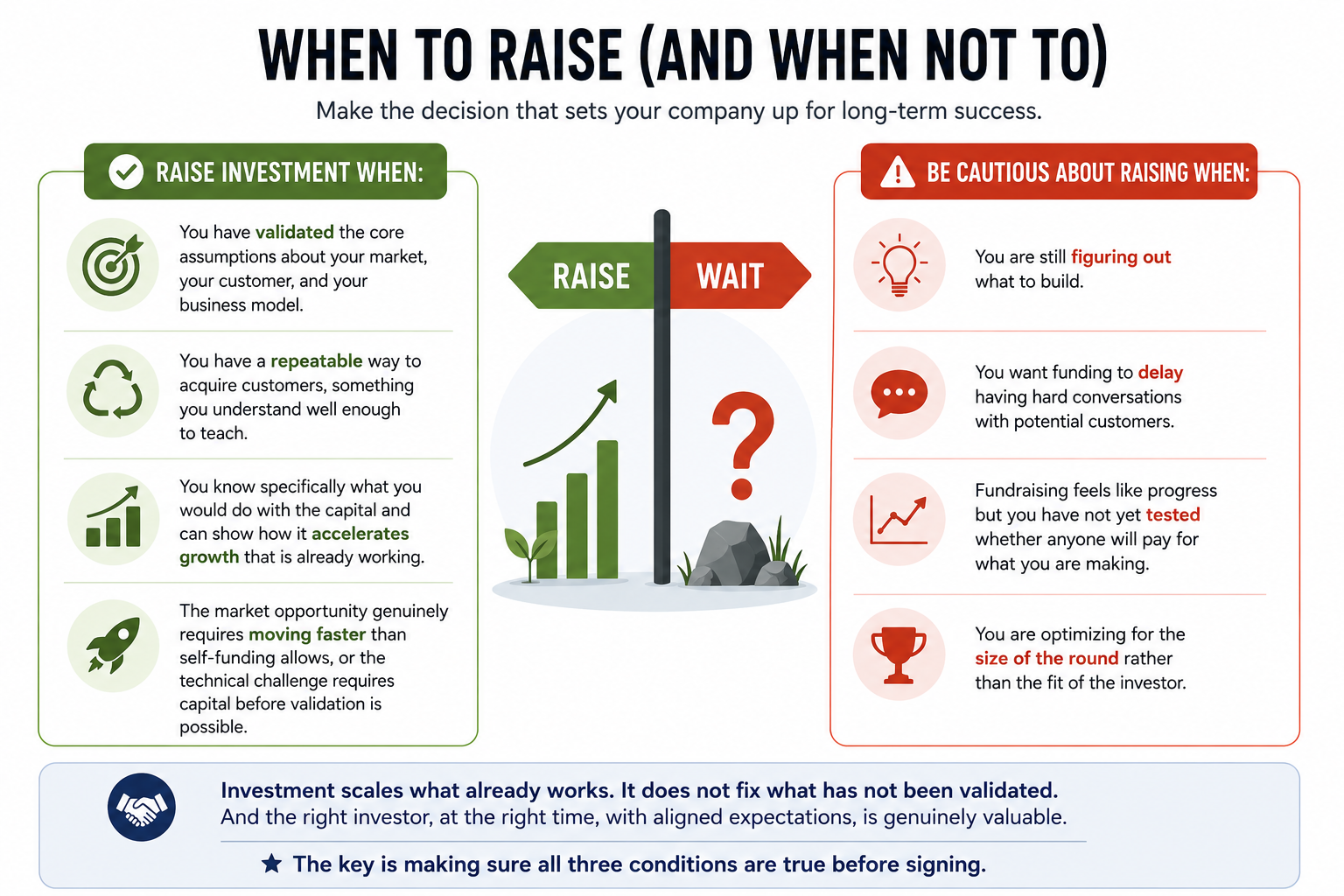
Raise investment when:
You have validated the core assumptions about your market, your customer, and your business model
You have a repeatable way to acquire customers, something you understand well enough to teach
You know specifically what you would do with the capital and can show how it accelerates growth that is already working
The market opportunity genuinely requires moving faster than self-funding allows, or the technical challenge requires capital before validation is possible
Be cautious about raising when:
You are still figuring out what to build
You want funding to delay having hard conversations with potential customers
Fundraising feels like progress but you have not yet tested whether anyone will pay for what you are making
You are optimizing for the size of the round rather than the fit of the investor
Investment scales what already works. It does not fix what has not been validated. And the right investor, at the right time, with aligned expectations, is genuinely valuable. The key is making sure all three conditions are true before signing.
A Word for Northern Luzon Founders
If you are building from Baguio, from the Cordillera, from Ilocos, from the Cagayan Valley, the validation-first mindset is not just practical. It is a competitive advantage.
You are not competing in Metro Manila's hype cycle. You are building in communities where trust is earned through consistent, practical value. Where the customers you serve will tell you the truth faster than a focus group would. Where the problems are more immediate and less abstract. Where your proximity to the people you are building for is a genuine asset.
The distance from major capital markets that feels like a disadvantage early in the process becomes an advantage when you understand your market better than any outsider could. Founders who validate thoroughly from the regions of Northern Luzon walk into investor conversations, local or national, with something rare: real knowledge of an underserved market with specific, documented, unmet needs.
That is a compelling story. It is also, more importantly, a true one.
Validate until you understand your business. Then use the right type of capital to accelerate what is already working.
Start with the customer. The rest follows.
Comments
Leave a Comment
Community Contributions
Have a story to share?
Founders, researchers, and builders — submit your perspective.