
What Is Innovation? (It Is Not Just Technology)
Most people think innovation means building an app. It does not. This piece redefines innovation using real examples from Northern Luzon, covers four types of innovation, and explains why the biggest opportunities in this region are coordination and distribution problems, not technology problems.

Leandro Gepila
Founder / Co-founderInv8 Studio · cordillera
Product & Innovation Operator based in Baguio. I work with founders, institutions, and teams to turn ideas into validated products and build structured innovation programs that drive real outcomes.
 Featured
Amianan Ventures
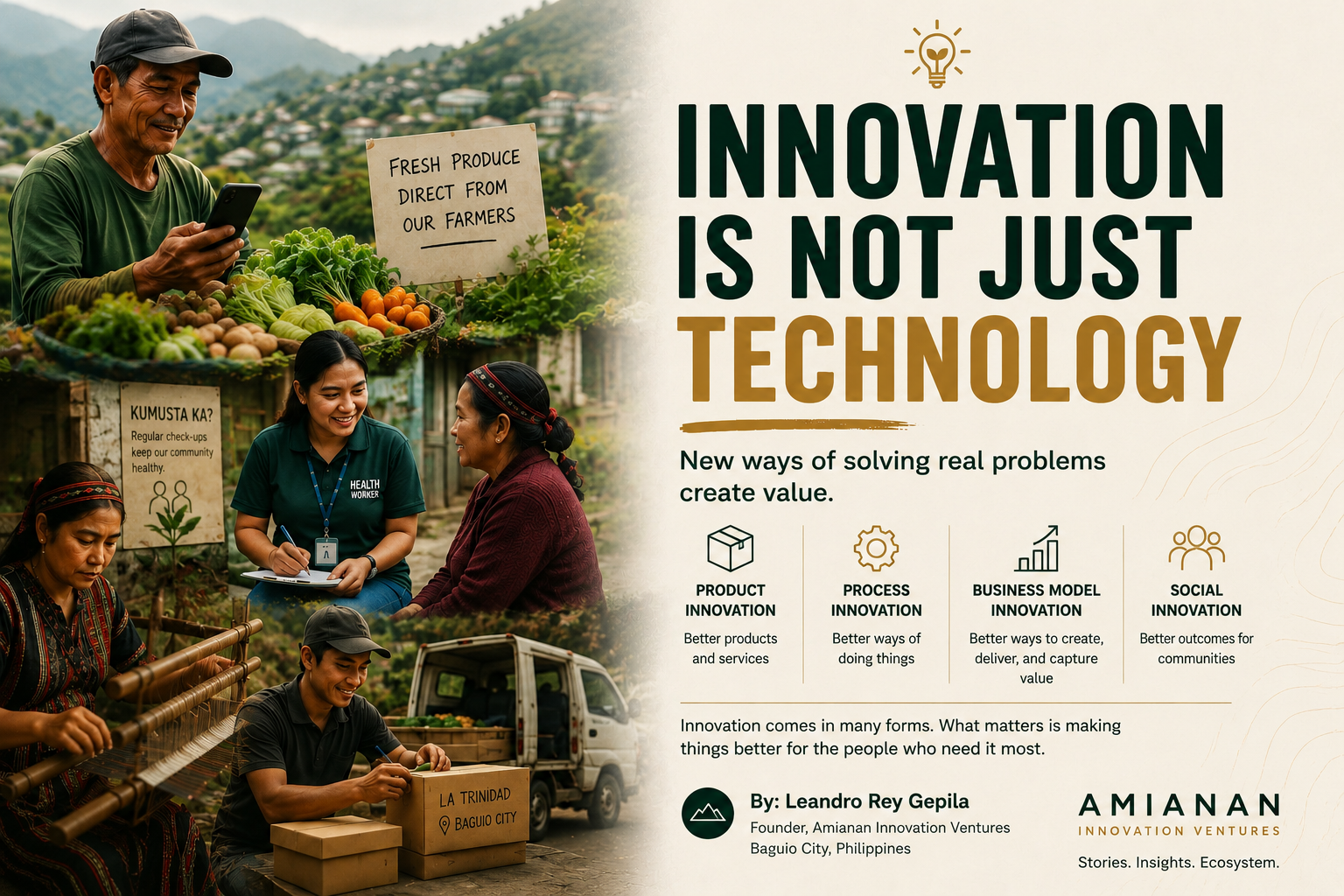
A vegetable farmer in La Trinidad started selling directly to Baguio restaurants through a group chat. No app. No platform. No investor pitch deck. Just a phone, a contact list, and a decision to remove the middleman who was taking a third of his margin. His income went up. The restaurants got fresher produce. The supply chain got shorter.
That is innovation.
Not because it involved technology in any dramatic sense, but because it was a new approach to a real problem that created measurable value for everyone in the chain. If your definition of innovation requires a software product or a laboratory, you are leaving out most of the interesting work happening in this region and most of the opportunities available to founders who live here.
Where the Misconception Comes From
The popular image of innovation in the Philippines is shaped almost entirely by what gets covered in national tech media: apps, fintech platforms, e-commerce startups, and AI tools. These are real innovations. But they represent a narrow slice of what innovation actually is.
The word innovation comes from the Latin innovare, which means to renew or to change. It does not specify a medium. It does not require a screen. It requires a problem, a new way of addressing it, and evidence that the new way works better than what came before.
When a community health worker in Kalinga develops a new protocol for following up with patients after barangay health consultations, that is a process innovation. When a weaving cooperative in Benguet restructures how it takes orders so that weavers can fulfill international requests without going through a consolidator, that is a business model innovation. When a school in Baguio redesigns how it runs parent-teacher communication to reduce no-shows and improve follow-through on student support plans, that is a service innovation. None of these required a developer. All of them created real value.
What Innovation Actually Is
A useful working definition: innovation is the successful introduction of something new that creates value for a specific group of people.
Three parts of that definition matter.
The first is "successful introduction." An idea that stays in a notebook is not an innovation. A prototype that never reaches users is not an innovation. Innovation requires that the new thing actually reaches the people it is meant for and that they experience its value. Execution is part of the definition.
The second is "something new." This does not mean invented from scratch. It means new to the context you are applying it in. A logistics approach already common in Cebu but never applied in Apayao is innovative in Apayao. A teaching method developed in Finland but adapted for IP communities in Mountain Province is innovative in that context. Novelty is relative to the problem and the place.
The third is "creates value." Innovation is not neutral experimentation. It has a purpose: making something meaningfully better for someone. If the new approach does not actually improve outcomes for the people it is meant to serve, it is change, not innovation.
The Innovator's Dilemma: Why Incumbents Almost Always Miss It
Clayton Christensen introduced a concept in his 1997 book that remains one of the most important frameworks for understanding how innovation actually spreads through industries. He called it the Innovator's Dilemma.
The dilemma works like this. Established organizations, whether corporations, government agencies, or institutions, are very good at sustaining innovation: improving their existing products and services for their existing customers. They listen to their best customers, invest in what those customers ask for, and get better at what they already do. This is rational behavior. It produces results in the short term.
But this same rationality blinds them to disruptive innovation: new approaches that start by serving overlooked customers, often in a simpler or cheaper way, and then gradually improve until they displace the incumbent entirely.
Disruptive innovations almost always look inferior at first. They serve a smaller market, at lower margins, with a product that the incumbent's best customers would reject. The incumbent has every rational reason to ignore them. And that is exactly why they lose.
The classic examples are well-documented. Digital photography disrupted film. Online streaming disrupted cable. Mobile banking disrupted traditional branch-based banking in the Philippines faster than any of the major banks anticipated, precisely because they were focused on serving their existing account holders rather than the millions of unbanked Filipinos who needed something simpler and cheaper.
The Innovator's Dilemma (Clayton Christensen): Successful companies fail not because they make bad decisions, but because they make good ones. They listen to their best customers, invest in sustaining innovations, and rationally ignore disruptive threats until those threats have already reshaped the market around them. The most dangerous competitor is not the one trying to beat you on your own terms. It is the one serving a customer you decided was not worth your attention.
For founders in Northern Luzon, this principle points directly at opportunity. The customers that established players in agriculture, logistics, healthcare, tourism, and education are not serving well are right here. They are the smallholder farmers, the informal traders, the rural health workers, and the students in municipalities without strong institutional infrastructure. Building something that starts by serving them well is not a consolation prize. It is a strategic position.
Four Types of Innovation Worth Knowing
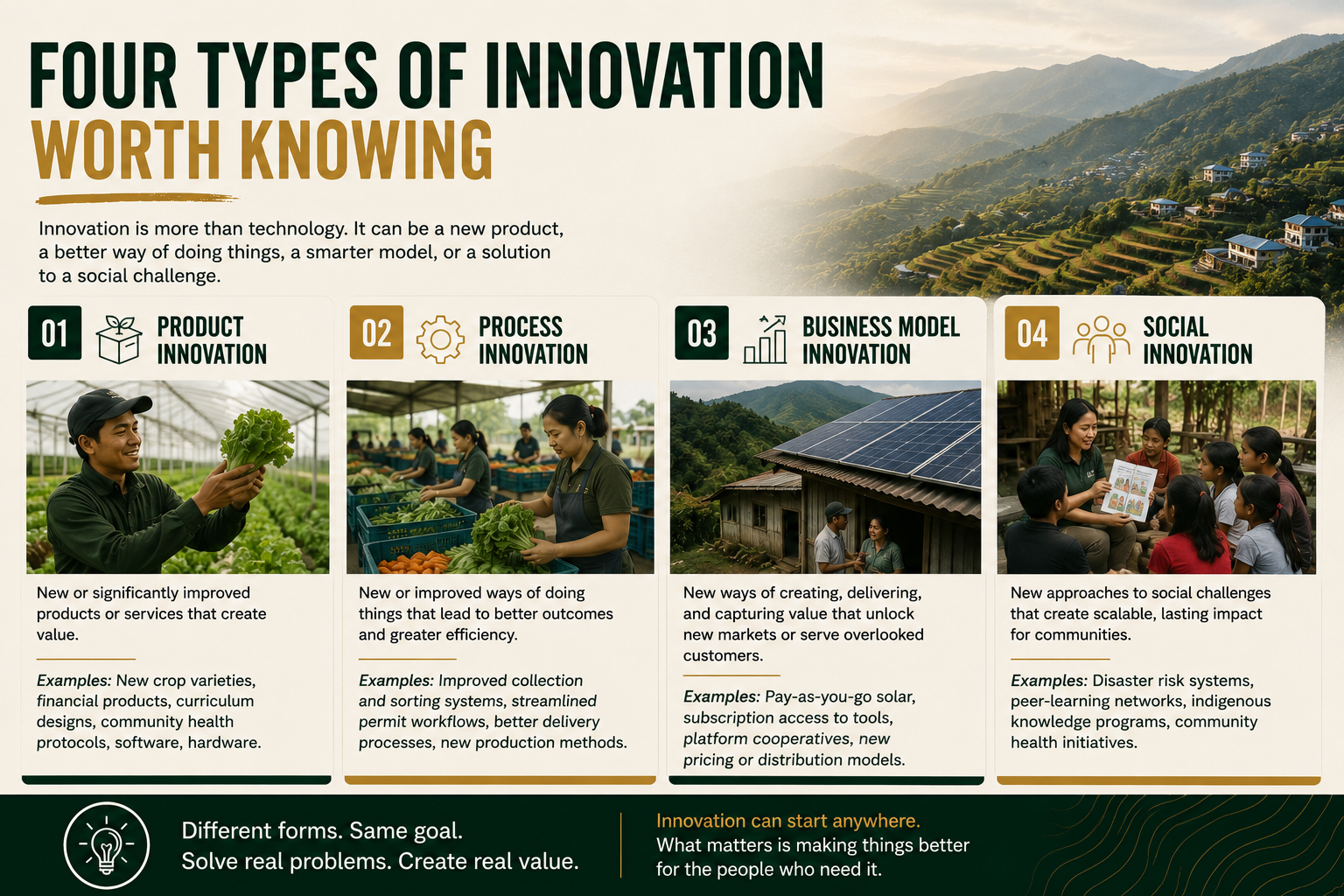
Understanding that innovation is not just technology is more useful if you also understand the different forms it takes. Here are four categories that apply directly to what founders and organizations in this region can pursue.
Product innovation is what most people think of first: a new or significantly improved product or service. This does include software and hardware, but it also includes a new crop variety, a new financial product, a new curriculum design, or a new community health protocol.
Process innovation is a change in how something is done that produces better outcomes. A vegetable aggregator who redesigns the collection and sorting process to reduce spoilage is innovating. A government office that restructures its permit application workflow to cut processing time from 30 days to 5 is innovating. The output looks the same. The process that produces it is fundamentally different.
Business model innovation is a change in how value is created, delivered, and captured. The same product or service, structured differently, can unlock markets that were previously inaccessible. Pay-as-you-go solar power brought electricity to households that could never afford the upfront cost of installation. Subscription-based access to tools and equipment is making it possible for small farmers to use machinery they could never buy outright. The product is not new. The model is.
Social innovation addresses social challenges in ways that create more durable, scalable impact than existing approaches. Community-based disaster risk management systems. Peer-learning networks for out-of-school youth. Indigenous knowledge documentation programs that preserve and commercialize traditional practices. These are innovations even if no one involved thinks of themselves as a startup founder.
Why This Matters for Founders Here
If you are waiting until you can build an app before you call yourself an innovator, you are waiting for the wrong thing.
The most significant innovations available to builders in Northern Luzon right now are not primarily technology problems. They are distribution problems, trust problems, coordination problems, and access problems. They require a new way of organizing relationships, not necessarily a new piece of software.
The Cordillera has agricultural output, natural assets, indigenous craft traditions, and cultural distinctiveness that the rest of the country wants access to. The bottleneck is not that the products do not exist. It is that the systems connecting producers to markets, and connecting communities to institutional resources, are weak, fragmented, or entirely absent.
Building better systems, even manual ones, even imperfect ones, is innovation. Getting 10 vegetable farmers into a group buying arrangement that improves their negotiating position with buyers is innovation. Designing a better intake process for a community program so that more eligible families actually enroll is innovation. Creating a shared inventory and pricing reference for street vendors in a public market so that they can coordinate without undercutting each other is innovation.
None of these require you to raise capital, write code, or move to Manila.
Market Context
The Philippine Innovation Act, signed into law in 2019 as Republic Act 11293, defines innovation broadly: "the creation, development, and implementation of a new or significantly improved product, process, or service." The law explicitly includes non-technological innovation and directs government agencies to support innovation across sectors including agriculture, health, education, and local governance.
The National Innovation Agenda and Strategy Document 2030 identifies inclusive and grassroots innovation as a priority, specifically naming rural and regional communities as underserved by current innovation support programs. DOST-CAR and DTI-CAR both have mandates to translate national innovation policy into regional programs, though implementation at the community level remains uneven.
The opportunity is documented. The mandate is in place. What is still missing in most of Northern Luzon is a critical mass of people who see themselves as capable of innovation and who have the tools to act on that belief.
How to Spot an Innovation Opportunity
You do not need a framework to find innovation opportunities. You need the habit of asking one question: why does this still work the way it does?
Why do farmers still sell through three layers of middlemen when group messaging exists? Why do patients still travel to Baguio for consultations that could be handled remotely? Why do local government units still use manual ledgers for processes that a shared spreadsheet could transform? Why do students in Tabuk have no access to the entrepreneurship programs that students in Baguio take for granted?
Each of those questions is an innovation brief. The answer is usually a combination of habit, trust gaps, coordination failures, and the absence of someone willing to try something different. That someone can be you.
The Honest Takeaway
Innovation is not a sector. It is not a department. It is not something that happens only in cities with venture capital and co-working spaces. It is the practice of finding a better way to solve a real problem and having the discipline to actually implement it.
The region has no shortage of real problems. It has no shortage of people with the local knowledge to understand them in depth. What it has needed, and what it is beginning to develop, is a culture that names what these people are doing as innovation, connects them to the tools and networks that can help them go further, and tells the story of what is being built here clearly enough that the rest of the country and the world can see it.
That is what this platform exists to do. And it starts with getting the definition right.
Comments
Leave a Comment
Community Contributions
Have a story to share?
Founders, researchers, and builders — submit your perspective.