
She Went Looking for Cacao and Found Farmers Who Had Already Given Up. Eva Padua Decided That Was Not the End of the Story.
Eva Ritchelle D. Padua started Dulche Chocolates in Baguio City as a chocolate lover who wanted to make healthier bars. She ended up becoming the Cordillera's first bean-to-bar chocolate producer, a DOST grant recipient, a BPI Sinag national winner, and the founder of an enterprise that now exports to five countries — built on a promise she made to farmers she had never planned to meet.
 Featured
Amianan Ventures
Eva Ritchelle D. Padua bought a cacao pod one day because she was curious. She was a chocolate lover who wanted to make her own, and the pod seemed like the right place to start. The first batch was bitter and wrong and not particularly promising. She did not stop.
She kept researching — YouTube, Google, whatever she could find — until she understood the process well enough to make something worth selling. She learned cacao sourcing, flavor development, and the bean-to-bar method that was almost unknown in the Cordillera at the time. By 2014, she was selling chocolates in simple packaging around Baguio. By 2019, she had launched her signature 70% dark chocolate line under the Dulche brand. By then, restaurants were ordering. Hotels were interested. The business was growing.
And then she went to visit the cacao farmers.
The Moment Everything Changed
The visit was supposed to be practical. Dulche was generating sales and needed more raw materials. Eva asked DTI to help connect her with cacao farmers in the region. The agency did. She drove out to meet them.
What she found broke her heart.
Some of the farmers had already cut their cacao trees. Not because the trees were unhealthy. Because there was no market for what they were growing, and they had stopped waiting for one. They could not afford to keep farming a crop that nobody was buying.
"I have to help these farmers," she said. That sentence, said quietly to herself somewhere between a cacao farm and the drive back to Baguio, changed the shape of everything she was building.
From that moment, Dulche Chocolates stopped being just a business about making good chocolate. It became a business about making sure the people who grow the cacao have a reason to keep growing it.
Learning the Whole Chain
Eva is a chocolatier by training and by instinct. Cacao farming is a different discipline entirely — soil management, seedling production, crop care, harvesting, post-harvest processing, fermentation, drying. She did not know most of it when she made that decision on the road.
So she learned it. She accessed the Women-Helping-Women Innovative Social Enterprise program of DOST-PCIEERD, which awarded Dulche a ₱4.75 million grant for a one-year project called SWEET PH. The project ran from 2023 to 2024, focused on standardizing the full process from farm to finished chocolate. The SWEET PH project was implemented in collaboration with DTI, the Department of Agriculture, DOST, and provincial and municipal local government units across the Cordillera — a coalition that gave the initiative both the technical backbone and the community reach to move beyond a single enterprise and into the broader farming landscape.
The original target for SWEET PH was to train 200 cacao farmers. She trained 520.
"Cacao processors lang natin sa cordillera, we only have forty," she said when the project began. By the time it ended, the number of cacao processors in the region had grown to 59 — and those were processors making more than just tablea.
Today, 2,512 cacao farmers have been assisted through the program across the Cordillera, with more than 400,000 cacao trees planted.. The supply chain Eva went looking for now exists — because she helped build it, farm by farm, training by training.
What Dulche Has Built
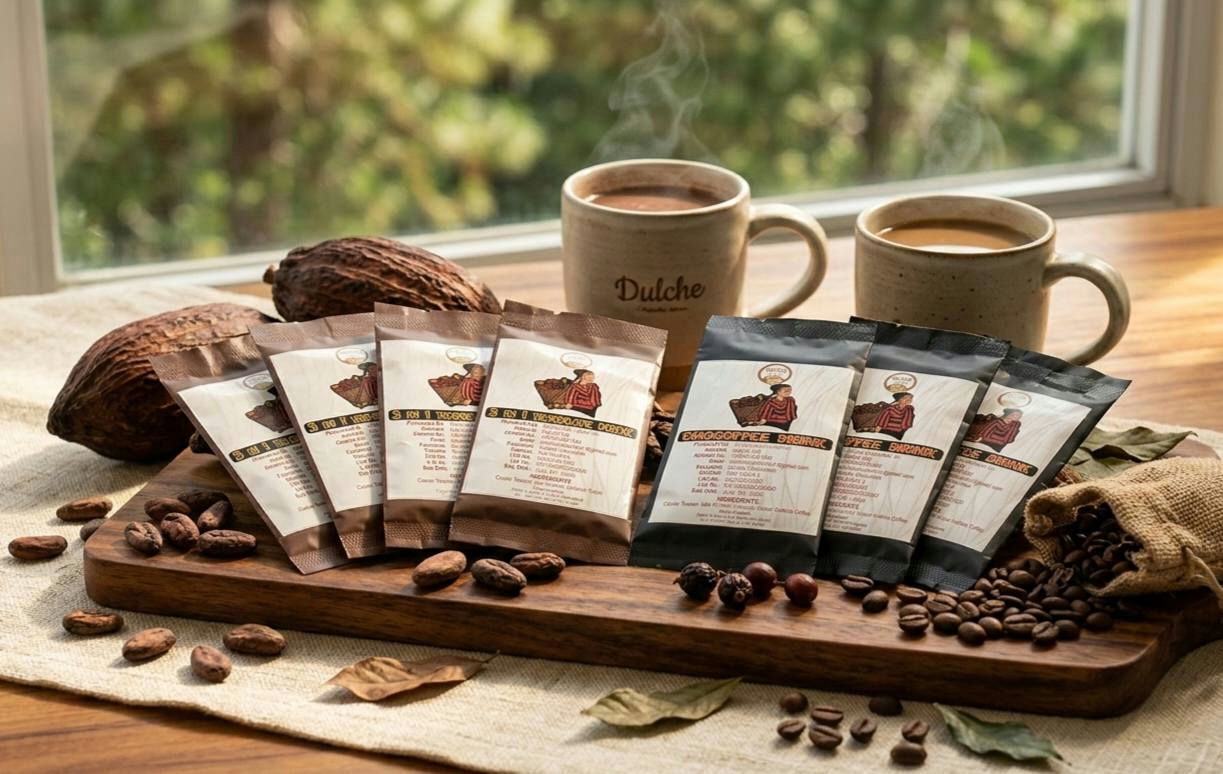
Dulche Chocolates is the Cordillera's first bean-to-bar chocolate producer and one of the most recognized artisanal chocolate brands in Northern Luzon. The product line now runs to 12 flavors — among them a coffee-arabica blend using beans from Atok, a strawberry variant using fruit from La Trinidad, chili, matcha, keto, and the flagship 70% and 80% dark bars. Eva sources cacao from Tuba, Atok, Sablan, and Apayao.
Local clients include Picca Deli, Via Von Joy, Le Monet, Kay-ang Hill, and Uyami's Greenview Lodge and Resto. High-end Baguio hotels are ordering chocobites as buffet offerings. Government agency partnerships span DOST, DTI, and local government units across the region.
Dulche's reach has grown beyond Baguio, with export volumes now reaching Hong Kong, the United States, South Korea, and Canada. Eva declines to disclose exact revenue figures, but the growth in international orders reflects a product that has found its audience well outside the Cordillera.
The pitch circuit has validated what the sales numbers already show. Dulche has competed and won at WHWISE DOST-PCIEERD, BPI Sinag — where it was named a national winner at the SinagElevate 2024 Social Entrepreneurship Challenge — Bella Awards, KAKAIBAGIW Pitch Fest, and the Developmental Social Enterprise program of the Baguio City Youth and Family Forum. In 2019, she was recognized at the Benguet Adivay Celebration. In 2024, Dulche was named among the top five best dark chocolates in the Philippines at Kakao Konek's Chocolate Expo in Davao City — the first time Benguet had ever entered that competition.
Eva now chairs the Cordillera Cacao Industry Development Council. In 2024, she helped organize the first Cordillera Chocolate Festival at Benguet State University in La Trinidad — gathering cacao growers, chocolate makers, and enthusiasts to celebrate what the region has built and signal what it is still building.
What She Is Still Solving
The problem she identifies without hesitation is the same one every MSME in the region knows: budget and finance. Capital access remains the primary constraint on how fast Dulche can grow. The second is cacao supply — not because farmers are cutting trees anymore, but because demand for highland cacao is now outpacing what the current grower network can produce consistently.
She is working on a new product: Kaka-revive, a chocolate capsule supplement aimed at wellness-conscious consumers, drawing on cacao's documented benefits as an antioxidant, anti-inflammatory, and cardiovascular support. She is pursuing additional DOST funding for its development and commercialization. She is also expanding her training program — 2,500 cacao farmers in the Cordillera still need support, and she intends to reach them.
What She Wants People to Know
Eva Padua does not guard her secrets. Her competitive advantage is not a formula or a proprietary process she keeps locked away. It is the network of trained farmers, the supply chain she helped build, and the trust she has earned in communities that had every reason to be skeptical of someone who showed up after the trees had already been cut.
"I am training other women using the funds provided by the DOST and I have to give them my secret so that I can proceed with my plan and be able to compete in terms of the required quantity by clients," she said.
That logic runs against every conventional startup instinct about protecting intellectual property and maintaining competitive moats. It is also why Dulche works. The business grows when the farmers it depends on grow. The secret, shared, becomes a supply chain. The supply chain becomes a chocolate legacy built by Igorot hands.
"In everything you plan to do, commit to Lord," she says. "He is faithful and just to answer our prayers."
Dulche Chocolates is located at 001 Skyland Compound Purok 18, Irisan, Baguio City. Products are available at select shops and pasalubong centers across Benguet and Northern Luzon. Follow the brand at facebook.com/the.dulche.chocolates.house or contact Eva directly at dulchechocolates1@gmail.com.
Key Takeaways for Founders
1. The problem worth solving often appears after you start. Eva did not launch Dulche Chocolates to help cacao farmers. She launched it to make better chocolate. The mission found her when she followed the supply chain back to its source and saw what she saw. Sometimes the real problem is not the one you started with.
2. Sharing your process is not weakness — it is the business model. Eva's decision to train other farmers and chocolate makers using her own methods is counterintuitive only if you assume the market is fixed. She understood that more skilled growers and more cacao supply means more capacity for Dulche. Her generosity is also her growth strategy.
3. Government programs exist to be used — actively. Eva accessed DTI's KMME program, OTOP NextGEN, and DOST-PCIEERD's WHWise grant. Each one changed the trajectory of her business at a specific stage. She did not wait to be invited. She sought out the programs, applied, and put the funding to work. The results — 520 farmers trained, international exports, a ₱4.75 million project — came from engagement, not passivity.
4. Local ingredients are a product differentiator, not a supply constraint. Arabica coffee from Atok. Strawberries from La Trinidad. Cacao from Apayao. Every sourcing decision Eva made that seemed like a local limitation turned into a product story that international buyers found compelling. What looks like constraint from the inside often looks like authenticity from the outside.
5. Building a community is building a supply chain. Over 1,900 farmers. More than 400,000 trees. A regional cacao council that Eva now chairs. The infrastructure she built to supply her own business is simultaneously the infrastructure that makes the entire Cordillera cacao industry more viable. That compounding effect — where your business development is indistinguishable from your community development — is one of the most durable competitive positions a founder can occupy.
Are you a founder, innovator, or community builder in Northern Luzon?
We're always looking for compelling stories from the region's ecosystem. Whether you're launching a startup, running a program, or doing something interesting — we'd love to feature you.