
CHED Invests ₱120 Million to Help Student Innovators Build Agri-Aqua Startups
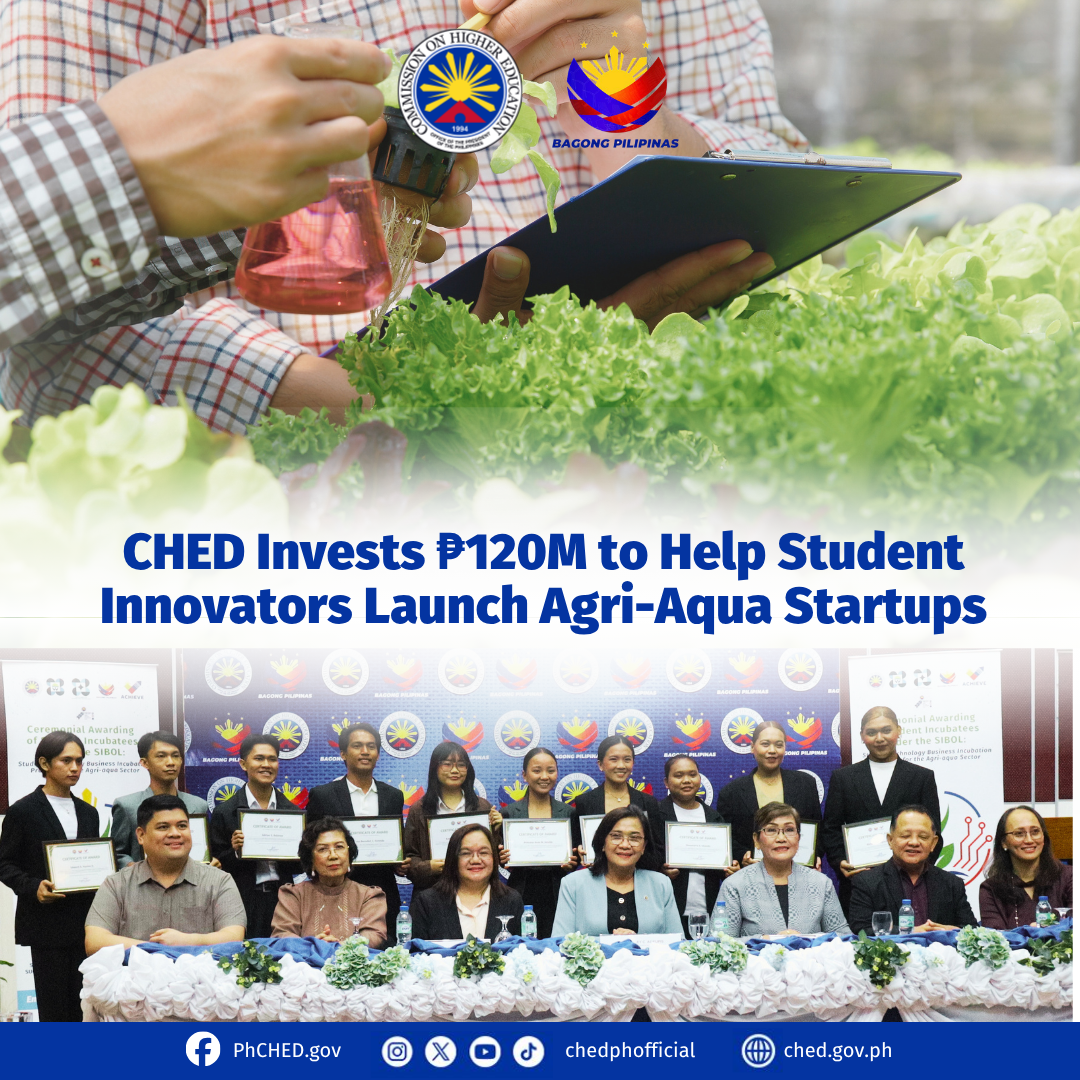
The Commission on Higher Education (CHED) has launched the SIBOL: Student Technology Business Incubation Program for the Agri-Aqua Sector, investing ₱120 million to help student innovators transform research and technologies into startup ventures. The initiative will support 24 State Universities and Colleges (SUCs) nationwide through mentorship, incubation, and commercialization over the next two years.
 Featured
Amianan Ventures
Turning Student Research Into Startup Ventures
Every year, universities produce research with the potential to solve real-world problems. Yet many of these innovations never move beyond the classroom.
To help bridge this gap, the Commission on Higher Education (CHED), through the Higher Education Development Fund (HEDF), has launched the SIBOL: Student Technology Business Incubation Program for the Agri-Aqua Sector, a nationwide initiative that aims to transform student research and innovative ideas into viable startup enterprises.
During the ceremonial awarding held on July 30, CHED announced a ₱120 million investment in the program, reinforcing the role of higher education institutions as drivers of innovation, entrepreneurship, and economic development.
₱120 Million to Strengthen University Startup Incubation
Under the SIBOL Program, 24 State Universities and Colleges (SUCs) were selected from proposals submitted nationwide.
Each participating university will receive ₱5 million over a two-year implementation period, with CHED allocating ₱60 million annually to support the initiative.
The participating universities are members of the National Agri-Aqua Technology Business Incubation Network under the Department of Science and Technology – Philippine Council for Agriculture, Aquatic and Natural Resources Research and Development (DOST-PCAARRD), ensuring that student innovators can access established incubation facilities and technical support.
The investment reflects a growing emphasis on moving university innovations beyond research outputs and into commercially viable businesses.
Supporting the Next Generation of Agri-Aqua Entrepreneurs
Each participating university will incubate 10 student innovators, providing support that extends beyond financial assistance.
Student startups will receive:
Business mentorship
Capacity-building programs
Access to laboratories and incubation facilities
Technical assistance
Financial support
Industry linkages
Opportunities to connect with potential investors and partners
These interventions aim to help students validate their technologies, strengthen their business models, and prepare for commercialization.
By the end of the two-year implementation period, CHED targets the creation of at least 200 new registered enterprises, strengthening both the country’s startup ecosystem and the agriculture and fisheries sectors.
Universities as Centers of Innovation
During the launch, CHED Chairperson Dr. Shirley C. Agrupis highlighted a longstanding challenge in higher education.
Every year, students and faculty develop promising technologies and research outputs, but many remain as theses, capstone projects, or academic requirements because they lack opportunities for further development and commercialization.
The SIBOL Program seeks to change this by creating pathways that allow promising innovations to evolve into products, services, and startup ventures capable of benefiting communities, industries, and the broader economy.
The initiative also supports the national government’s objective of expanding entrepreneurship opportunities for Filipinos, particularly among youth and women, while strengthening universities as innovation hubs.
Commercialization Begins With Incubation
The inaugural launch also featured presentations by Isabela State University (ISU), which introduced the program framework, incubation process, and selection criteria.
ISU student innovators also showcased technologies and prototypes with commercialization potential, demonstrating the types of innovations the program hopes to support nationwide.
Following the initial awarding ceremony, CHED plans to conduct similar recognition activities across participating universities throughout the country.
What This Means for Northern Luzon’s Innovation Ecosystem
The SIBOL Program represents a significant investment in one of Northern Luzon’s greatest strengths: its universities.
Several higher education institutions in the region already host Technology Business Incubators focused on agriculture, fisheries, and natural resources. With additional funding and structured incubation support, more student researchers will have opportunities to transform academic innovations into businesses that address real industry challenges.
For Northern Luzon, where agriculture remains a major economic sector, supporting agri-aqua startups creates opportunities to improve productivity, strengthen food systems, and generate higher-value enterprises built on locally developed technologies.
The initiative also reflects a broader shift in Philippine higher education, where universities are increasingly expected not only to produce graduates and research but also to create startups, commercialize technologies, and contribute directly to regional economic development.
As more student innovators move from laboratories into the marketplace, programs like SIBOL will help strengthen the country’s innovation pipeline while encouraging entrepreneurship among the next generation of Filipino founders.
Research creates knowledge. Entrepreneurship transforms that knowledge into impact. Through the SIBOL Program, CHED is helping ensure that promising student innovations have the opportunity to become businesses that create jobs, strengthen industries, and contribute to the country’s long-term development.
Original Source
Market Context
Universities play an increasingly important role in national innovation systems by serving as sources of research, technology, talent, and startup creation. Around the world, student-focused incubation programs help bridge the gap between academic research and commercialization by providing entrepreneurs with mentorship, funding, facilities, and industry connections. In the Philippines, strengthening university-based Technology Business Incubators has become a key strategy for accelerating innovation in priority sectors such as agriculture and fisheries. For Northern Luzon, where agri-aqua industries remain central to regional development, investments like CHED’s SIBOL Program create opportunities to transform research into scalable enterprises that generate employment, improve productivity, and support food security while strengthening the country’s startup ecosystem.
Are you a founder, innovator, or community builder in Northern Luzon?
We're always looking for compelling stories from the region's ecosystem. Whether you're launching a startup, running a program, or doing something interesting — we'd love to feature you.